
Sovereigns
Sovereign Funds
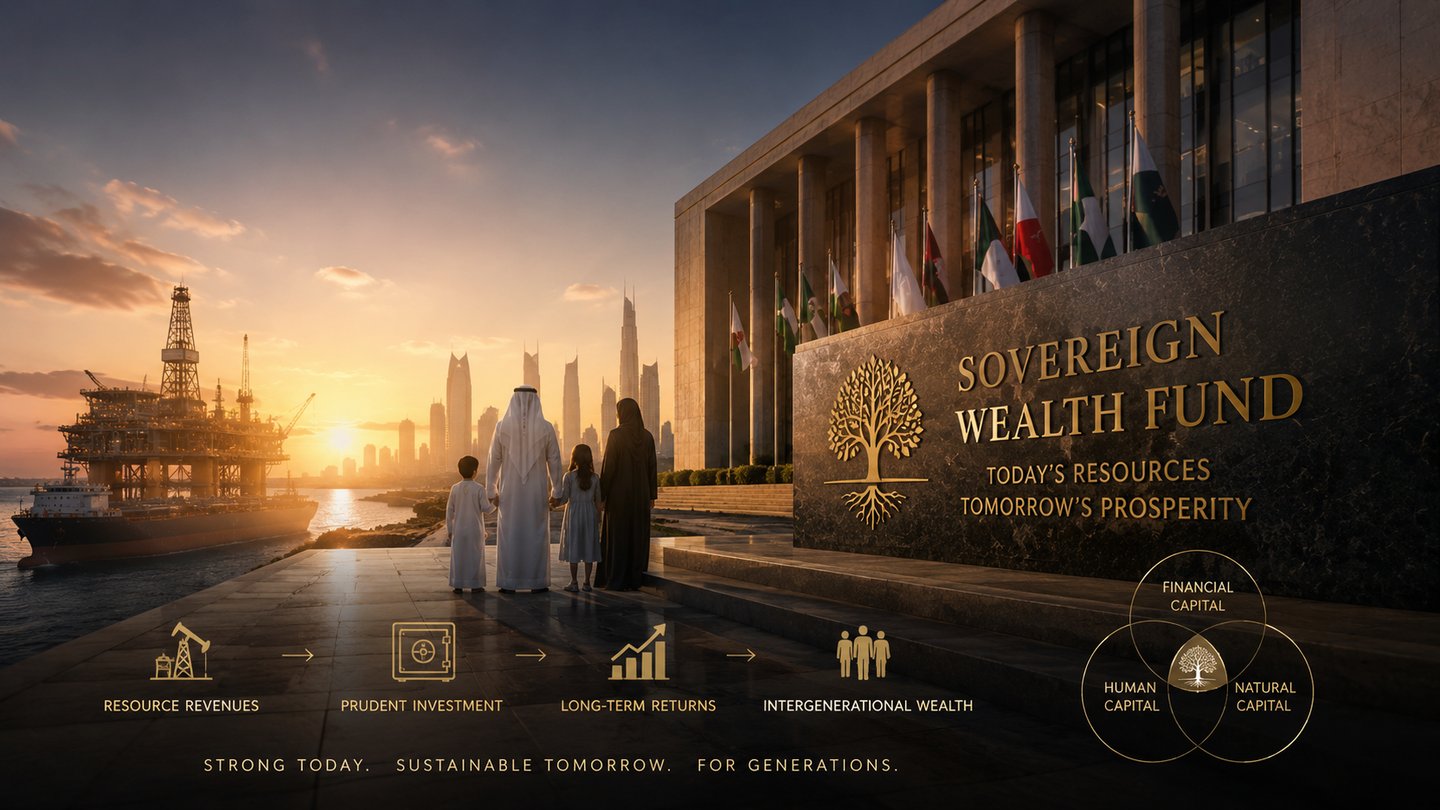

Establishing a Sovereign Wealth Fund
From resource revenues to intergenerational wealth: architecture, governance, and the founding window.
Most of the world’s sovereign wealth funds were designed after the money arrived. The successful ones were designed before. The interval between the discovery of a major revenue stream and its fiscal plateau, often only a few years, is the founding window: the period in which rules can still be written without contesting an existing spending habit. Rules written before abundance protect. Rules written after abundance yield.
International Finance Bank Ltd advises governments, ministries of finance, and public institutions on the establishment of sovereign wealth funds from first principles: legal foundation, institutional architecture, revenue traceability, and investment governance, sequenced so that credibility precedes capital.
The Dilemma
A new resource revenue stream arrives with a paradox attached. The same inflows that can fund generations can also destabilise a budget, appreciate a currency against its own exporters, and convert a ministry of finance into a hostage of a single commodity price. The academic name is the resource curse. The practical name is a sequence of avoidable institutional failures.
Seven decades of experience, since the Kuwait Investment Board was founded in 1953, point in one direction: governance matters more than investment performance. The documented failures of first-generation funds trace mainly to discretionary withdrawals, capture by unbankable political projects, opacity, concentration in the very commodity that feeds the fund, and the loss of institutional memory with each political rotation, rather than to asset allocation.
The founding government therefore faces a governance problem disguised as a finance problem, under time pressure, in front of rating agencies, multilateral partners, and its own citizens.
IFB’s Response
IFB acts as institutional architect for the founding phase: the design work between political decision and first invested dollar. We do not replace the multilaterals that publish the standards. We convert those standards into an operating institution, at the speed a founding window demands.
Our establishment framework covers four layers, in strict sequence:
- Legal foundation. An organic law that fixes deposit and withdrawal rules, protects appointments, and makes deviation costly and visible. The statute is the fund’s true balance sheet.
- Institutional architecture. Separation of the state as owner, a supervisory board with an independent majority, and an executive management recruited internationally. No organ holds two functions.
- Revenue traceability. A single collection account, dual signature, reconciliation within 24 hours, and EITI-grade reporting from extraction point to fund account. Credibility begins at collection, not at investment.
- Investment governance. A published Investment Policy Statement, global custodian with segregated accounts, delegated management with mandatory skills transfer, and a risk framework tested before the first trade.
The Three-Compartment Architecture
Resource-based funds succeed when mandates are separated rather than blended. The reference architecture holds three compartments, each with its own horizon, liquidity rule, and benchmark:
- Stabilisation. Horizon 0-3 years. Fully liquid, typically managed by or alongside the central bank, sized against budget volatility. It absorbs the commodity cycle so the budget does not have to.
- Savings. Horizon 10 years and beyond. Invested entirely outside the home economy, with the fund’s own commodity and correlated assets excluded. This is the intergenerational endowment, modelled on the strictest international practice.
- Development. Horizon 3-10 years. Co-finances bankable domestic infrastructure only, and never alone: a minimum share of third-party private or multilateral capital on every project, at identical economic terms. Co-investment is not a preference. It is the discipline that keeps a development compartment from becoming a second, softer budget.
A single automatic cascade connects them: the budget is served on a smoothed multi-year reference price, stabilisation fills to target, development draws a capped fraction, and savings receives the protected residual. Automation is the point. Virtue that depends on annual discretion is not virtue; it is a queue.
Standards We Build Against
- Compliance with the Santiago Principles (2008) designed in from day one, not retrofitted
- IFSWF membership path prepared alongside the founding statute
- EITI-consistent revenue reporting across the full extraction-to-account chain
- FATF-standard AML/CFT architecture, including PEP protocols without domestic exceptions
- IFRS accounting with external audit rotation and published annual reporting
- Custody under segregated accounts, insolvency-remote, with on-site audit rights
The Engagement
Establishment work follows a phased 30-90-180 day structure. The first 90 days produce the decisions that create institutional irreversibility at negligible financial cost: the founding political act, a single enabled project lead, the international search for the board chair and chief executive, arbitration of the fund’s working hypotheses, and a public commitment to international standards. The following phases deliver the draft organic law, the governance manual, the Investment Policy Statement, and the custodian and delegated-management selection, each through competitive procurement.
We advise; the state decides. Every parameter with fiscal consequence, from cascade percentages to withdrawal triggers, is presented as a working hypothesis for sovereign arbitration, never as a fait accompli. And every engagement embeds skills transfer, because a fund that depends permanently on its advisers has merely outsourced its fragility.
Request a Fund Establishment Blueprint: legal foundation, three-compartment architecture, revenue cascade design, and a sequenced founding roadmap.