
International Bank Drafts (IBD)
Definition, Workflow, Settlement, and Risk Controls
Executive summary
An International Bank Draft (IBD) is a bank-issued, prepaid instrument – functionally akin to a cashier’s cheque – used for high-value cross-border payments where the beneficiary requires a firm undertaking of funds. IFB accepts IBDs “for collection”: we verify the instrument, present it through our correspondent network to the issuing bank, and credit your account after final settlement is received. In limited, clearly defined circumstances and jurisdictions, IFB may offer earlier value “under reserve” (with recourse) pending final clearance.
1. What an IBD is – and is not
- Prepaid, bank-drawn: Funds are taken from the purchaser at issuance, and the draft is drawn on the issuing bank (or its designated paying branch).
- Denominated in foreign currency: Typically the beneficiary’s currency, though multi-currency issuance is common.
- A physical negotiable instrument: Original paper is required for deposit and clearing.
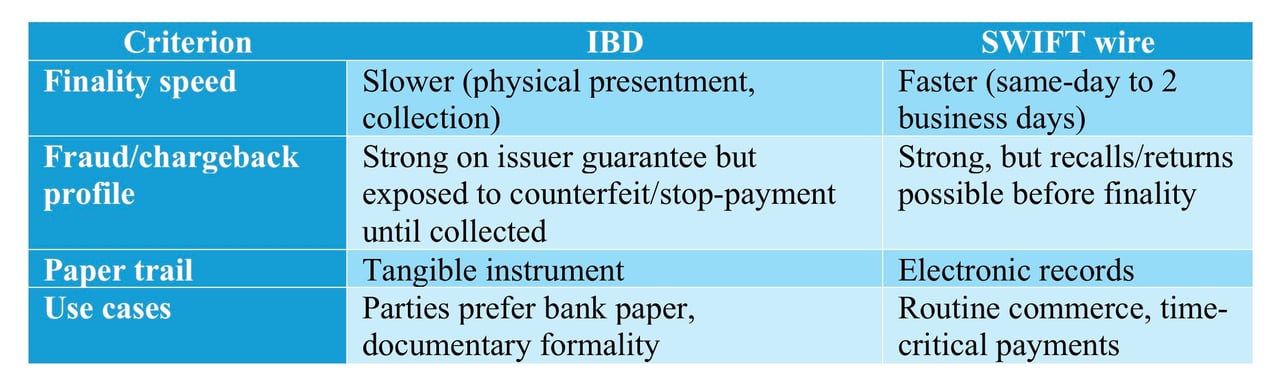
- Not an instant transfer: Unlike SWIFT wires, IBDs require physical presentment and interbank clearing before finality.
2. When an IBD makes sense
- Property acquisitions, tuition, earnest-money deposits, and transactions where a beneficiary mandates a bank-backed instrument.
- Environments where counterparties distrust electronic transfers or require “bank paper”.
- Situations demanding a clear audit trail and issuance on security paper with anti-counterfeit features.
3. How IFB handles an incoming IBD
3.1 Lodgement at IFB
- Send the original draft by approved courier to our Trade & Collections desk; IFB does not operate public branches.
- Provide:
- Your IFB account details for credit.
- Valid identification and, for corporate clients, authority to deposit.
- Any supporting documentation (invoice/contract) if requested for compliance.
3.2 Instrument verification
- Visual and security checks: Watermarks, microprint, holograms, chemical sensitisation, serial integrity.
- Issuing bank validation: SWIFT/secure messaging to confirm issuance details where appropriate.
- Sanctions/AML screening: Parties, purpose, and jurisdictions screened against applicable lists and internal risk rules.
Outcome: IFB either accepts for collection, accepts under reserve (rare and discretionary), or declines (e.g., suspected forgery, sanctions risk, incomplete instrument).
3.3 Presentment and collection
- Route: IFB sends the draft to the issuing bank (or its designated paying branch) directly or via our correspondent bank in the draft currency and country.
- Method: Clean collection subject to ICC URC 522 market practice (industry convention), unless the issuing bank prescribes alternative terms.
3.4 Settlement and crediting
- Final credit: Once the issuing bank honours the draft and we receive cleared funds, IFB credits your account value-dated on receipt less applicable fees.
- Under-reserve credit (if granted): IFB may credit funds before final settlement strictly with recourse. If the issuing bank dishonours or returns the draft, IFB will reverse the credit and recover funds from the depositor.
4. Will the issuing bank transfer the funds – or not?
4.1 Honour (payment)
The issuing bank transfers funds when:
- The draft is genuine, unaltered, and valid (within any stated validity period).
- No stop-payment or loss report exists.
- All regulatory checks pass.
Result at IFB: We receive funds via our correspondent. Your account is credited on final receipt.
4.2 Dishonour (non-payment)
The issuing bank may refuse payment if:
- Forgery/alteration is suspected.
- Stop-payment was lodged (e.g., reported lost/stolen).
- Material discrepancy exists (mismatched payee, expired instrument).
- Regulatory/legal block applies (sanctions, court order).
- Issuance irregularities (e.g., instrument not issued by them or issued in error).
Result at IFB: We notify you of dishonour, return the original or provide a formal advice of refusal, and reverse any provisional credit if given. You may pursue remedy with the purchaser/issuer directly.
5. Timelines and value dating
- Verification at IFB: typically 1–2 business days from receipt of the original instrument.
- International collection: commonly 5–15 business days, varying by currency, country, postal/courier legs, correspondent processing, and any regulatory reviews.
- Final credit: on the day IFB receives good value from the issuing bank/correspondent. Funds are then fully usable and transferable.
Note: Transit, holidays, and time-zone effects often elongate cycles for USD, CAD, GBP, EUR drafts drawn on foreign branches.
6. Fees and charges
- Handling fee: IBD deposit processing.
- Correspondent fees: As passed through by intermediary/paying banks.
- Courier: Where secure shipping is required for presentment.
- FX conversion (if you request conversion at credit): Executed at IFB’s prevailing client rate on the value date.
- Under-reserve fee: Only if early value is granted.
For the current tariff, consult IFB’s Schedule of Charges or your relationship manager.
7. Comparison: IBD vs SWIFT wire
8. Risks, mitigants, and IFB safeguards
- Counterfeit/alteration risk: Mitigated by multi-factor security checks and issuer confirmation.
- Loss/theft in transit: Mitigated by controlled custody, sealed dispatch, and tracked couriers.
- Regulatory risk: Managed through full AML/CFT and sanctions screening.
- Dishonour risk: Eliminated only on final settlement; before that, any early credit is strictly with recourse.
Client obligations: provide accurate beneficiary details, maintain transparency on transaction purpose, and retain purchase/contract evidence.
9. Outbound transfers after credit
Once cleared funds are credited:
- Transfer within IFB or to other banks via SWIFT, SEPA, RTP, or local rails as applicable.
- Optional FX conversion at instruction or automatic conversion rules per your mandate.
- Standard cut-off times apply for same-day value by currency.
10. Handling special scenarios
- Lost or damaged drafts: IFB will not process photocopies or scans. The purchaser must request the issuing bank to place a stop and reissue. We can provide deposit evidence if loss occurred after lodgement with IFB.
- Name discrepancies: Endorsement and documentary proof are required; otherwise, the draft must be reissued.
- Expired drafts: Many drafts reference a validity window; IFB follows the issuer’s rules. Reissuance may be required.
- Multiple endorsements: Accepted subject to issuer rules and IFB risk review.
11. Documentation checklist for depositing an IBD at IFB
- Original draft, unaltered.
- Your IFB account information.
- Valid government ID (individuals) or corporate mandate and signatory IDs (companies).
- Underlying transaction evidence if requested (invoice, contract, purchase agreement).
12. Legal and regulatory framework
- Collections follow prevailing market practice (e.g., ICC URC 522 principles for bank collections) and applicable local law.
- IFB’s acceptance is for collection unless expressly stated otherwise in writing.
- Early credit, where granted, is under reserve/with recourse and may be reversed on dishonour.
13. Key takeaways
- An IBD is secure but not instantaneous.
- IFB credits after receiving good funds from the issuing bank; earlier value, if any, is conditional.
- Dishonour remains possible until final settlement; treat any provisional funds as non-final.
- For time-critical payments, a SWIFT wire is generally superior; for formal, documentary requirements, an IBD remains appropriate.
14. Contact
For lodgements, tariffs, and currency-specific cut-offs, contact your IFB Relationship Manager or the Trade & Collections desk.



Next step
Request an introduction
Tell us in a few lines who you are and what you have in mind. Your enquiry goes directly to the bank and is treated in confidence.
Prefer to talk? Book a 30-minute videoconference.