
Currency Creation
Currency Creation by Banks


Currency creation by banks in a fractional-reserve banking system.
Commercial banks create most of the money in circulation by lending: when a bank makes a loan, it credits the borrower’s account with a new deposit. The textbook “money multiplier”, in which banks lend out a multiple of their reserves, does not describe how modern banking systems work (Bank of England, “Money creation in the modern economy”, 2014). Here’s how it works:
- Deposits and Reserve Requirements: Some central banks require banks to hold a fraction of certain deposits as reserves – the ECB 1%, while the US Federal Reserve has set the requirement at zero since March 2020 and the Bank of England has none. In practice, lending is constrained by capital and liquidity rules, borrower demand and the policy interest rate rather than by reserves.
- Loan Creation: When a bank gives out a loan, it doesn’t physically hand out the cash from its reserves. Instead, it creates a deposit in the borrower’s account, effectively creating new money. This process expands the money supply in the economy.
- Interest and Repayment: The bank earns money through interest on these loans. As borrowers repay their loans, the money supply contracts, and the bank’s liabilities (deposits) decrease.
To manage risks associated with loan defaults and overextending their lending capacity, banks use several strategies:
- Risk Assessment and Credit Scoring: Banks conduct thorough risk assessments and use credit scoring to evaluate the creditworthiness of borrowers. This helps in minimizing the risk of default.
- Diversification of Loan Portfolio: Banks diversify their loan portfolios across different sectors, geographic regions, and customer segments to spread out the risk.
- Capital Adequacy Ratios: Banks are required to maintain certain capital adequacy ratios, ensuring they have enough capital to absorb losses. These requirements are often part of regulatory frameworks like Basel III.
- Provisioning and Write-Offs: Banks set aside a portion of their earnings as provisions for bad debts. If a loan goes bad, it’s written off against these provisions.
- Liquidity Management: Banks manage their liquidity to ensure they have enough liquid assets to meet their short-term obligations. This includes maintaining a healthy balance between short-term liabilities and liquid assets.
- Regulatory Oversight: Banks are subject to regulatory oversight, ensuring they adhere to prudent lending practices and maintain financial stability.
In terms of preventing the creation of too much currency:
- Central banks influence the amount of money banks create mainly through the policy interest rate, together with capital and liquidity regulation and, in some countries, reserve requirements.
- If a bank creates too much currency, leading to risks of inflation or financial instability, the central bank can intervene, either by changing policy rates, modifying reserve requirements, or through open market operations.
- In cases where banks face insolvency risks due to over-lending, central banks can act as lenders of last resort. However, this is typically a measure used in extreme situations to prevent systemic collapse rather than a regular practice.
The central bank’s role in bailing out banks depends on the severity of the situation and the systemic risk posed by the failing bank. Bailouts are usually the last resort and come with stringent conditions aimed at restoring financial stability and preventing moral hazard.
The proportion of currency created by commercial banks through lending and that created by central banks varies significantly across different economies, depending on their banking practices, monetary policies, and economic structures. Here’s a general overview:
- Commercial Banks: In most modern economies, the majority of the money supply is created by commercial banks through lending. When banks provide loans, they create deposits, which are a major component of the broader money supply. This form of money is often referred to as “bank money” or “commercial bank money.”
- Central Banks: Central banks create currency in the form of physical cash (banknotes and coins) and reserves held by commercial banks at the central bank. This represents a smaller portion of the total money supply compared to bank-created money. Central bank money is often referred to as “base money” or “high-powered money.”
The specific percentages can vary:
- In the United Kingdom, according to the Bank of England (2014), banknotes and coins made up only about 3% of the money held by the public; the remaining 97% consisted of bank deposits.
- In the euro area, currency in circulation accounts for roughly a tenth of the broad money aggregate M3; the rest consists of deposits and other instruments issued by banks and money market funds (ECB monetary statistics).
- In emerging or less developed economies, the ratio might be different due to a higher reliance on physical cash, stricter banking regulations, or different monetary policy frameworks.
It’s important to note that these figures can fluctuate based on economic conditions, monetary policy changes, and regulatory shifts. For example, during periods of quantitative easing, the percentage of money created by central banks can increase significantly as they buy financial assets to inject liquidity into the economy.
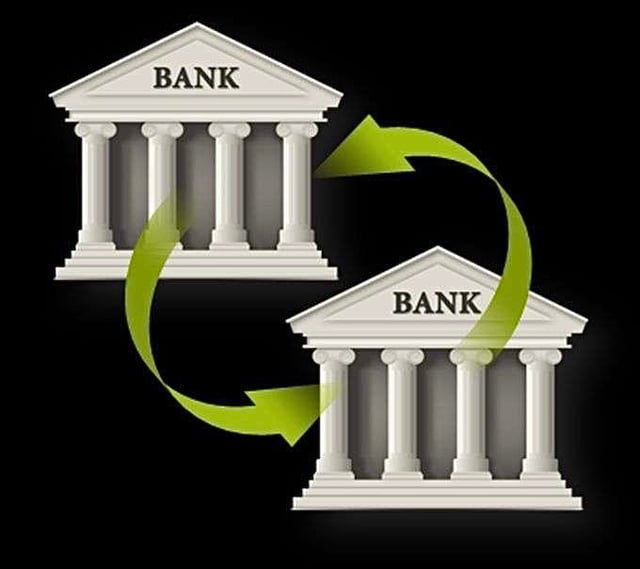
Transfer of newly created bank money between banks.
Here’s an explanation of how banks internal process works:
Loan Creation: When a bank issues a loan, it does indeed create a deposit in the borrower’s account. This is a digital entry rather than physical cash. This deposit represents an obligation or liability for the bank (the bank owes this amount to the depositor) and an asset for the borrower (the borrower can use this amount).
Transfer of Funds: Suppose the borrower decides to transfer some or all of this loan to a different bank. The borrower instructs their bank to make a payment to an account at another bank.
Interbank Settlements: Banks settle transactions between each other through a process called interbank settlements. This is done either in real time or in batches during the day, through:
- Central Bank(s): The central bank plays a crucial role in this process. Banks maintain reserve accounts with the central bank, and these accounts are used to settle interbank transactions. If Bank A needs to transfer funds to Bank B, the central bank will reduce the reserve balance of Bank A and increase the reserve balance of Bank B accordingly in the RTGS System or
- Clearing Houses or Correspondent Banking Networks: Sometimes, transactions are settled via clearing houses or through correspondent banking networks. These systems facilitate the transfer of funds and ensure that each bank maintains the required reserves to honor its obligations.
Maintaining Reserves: Throughout the day, banks monitor their reserve positions. If a bank is short on reserves due to outflows (like in our example), it may borrow from other banks in the interbank lending market or, as a last resort, from the central bank.
- Central Bank as Lender of Last Resort: The central bank acts as a lender of last resort to provide liquidity to banks that are temporarily short of reserves. This ensures that banks can meet their payment obligations and the banking system remains stable.
In summary, when a bank transfers money to another bank upon a client’s instruction, the actual settlement involves adjusting the reserves that banks hold either at the central bank or through interbank transfers. This system ensures that while individual banks create money through lending, the overall integrity and stability of the banking system are maintained through a combination of central bank oversight, interbank lending markets, and reserve requirements.