
The “level 14+ banker”: a rank that does not exist
How authority in banking is actually allocated
There is no such thing as a “level 14+ banker”. No regulator, no industry body and no bank recognises the term as a standard rank. What does exist is a carefully layered system of authorisation, from the limits of a teller to the powers of national supervisors and international standard-setters. It is one of the industry’s principal defences against operational risk, security breaches and financial instability, and it is the subject of this page.
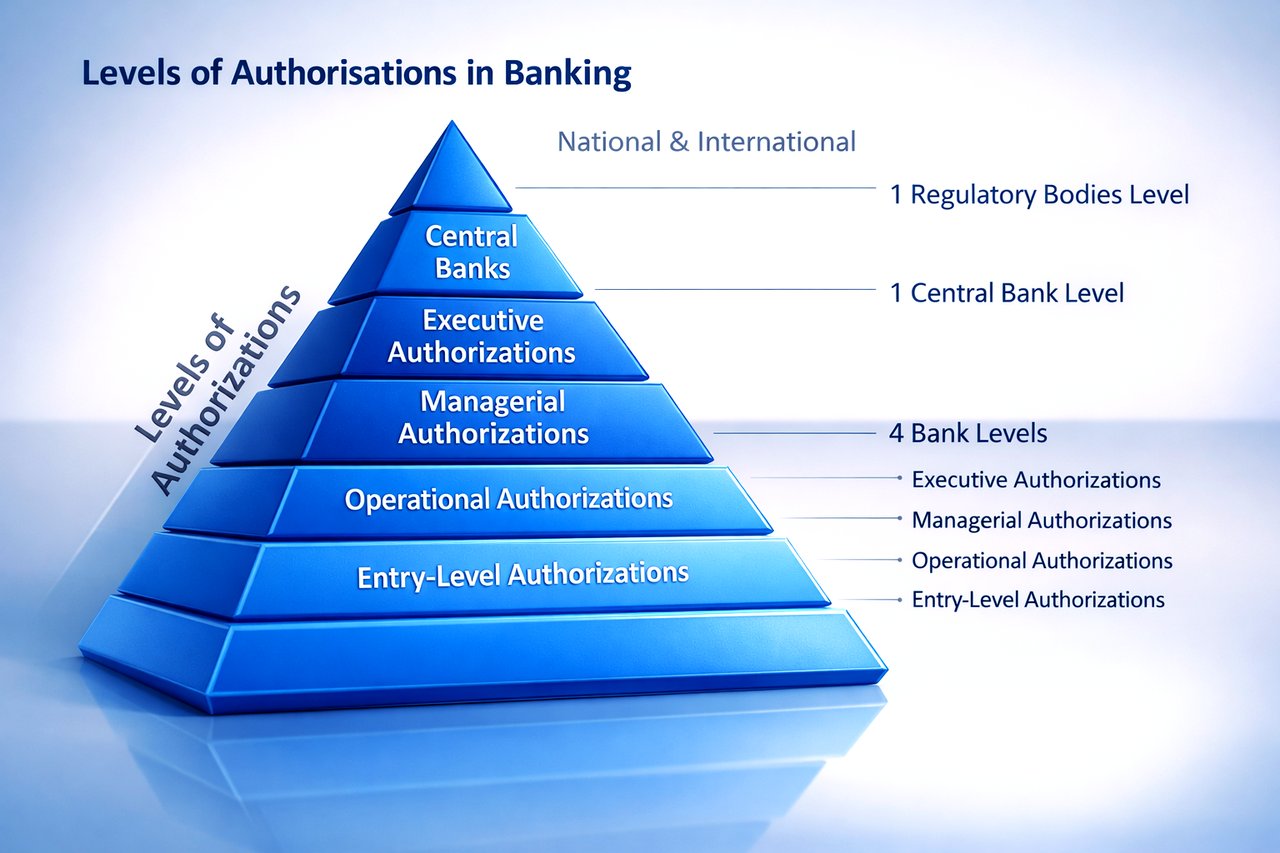
Authority inside a bank
Within each bank, authority is allocated by role, with defined limits at every level. The Federal Financial Institutions Examination Council describes the typical structure (FFIEC, 2016):
- Entry level: tellers and client service staff carry out routine transactions and see client information within strictly defined limits.
- Operational level: loan officers and account managers approve loans and manage client accounts, usually behind additional authentication.
- Managerial level: managers approve large transactions, see detailed reports and conduct audits, which provides the internal checks and balances.
- Executive level: senior executives hold full access, take strategic decisions, approve major commitments and see the reports that set the bank’s direction.

These limits are enforced through access control systems, as required by regulatory frameworks such as the Gramm-Leach-Bliley Act (GLBA) in the United States (Federal Trade Commission, 2002).
Titles, grades and the missing level 14
Banks name roles by function, not by number. Investment banks use titles such as Analyst, Associate, Vice President, Director and Managing Director. Retail and commercial banks speak of tellers, client service representatives and branch managers, with an executive tier headed by the Chief Executive Officer and the Chief Financial Officer. Each title carries defined responsibilities and a defined level of authority.
Some banks do run internal numeric grades for seniority or pay. These scales differ from one institution to the next: a level 4 in one bank may correspond to a level 3 in another. A “level 14” could therefore exist inside a particular bank’s grading system, for internal use, but it means nothing outside that bank without its grading guidelines.
Nor was the expression coined by a novel or any official publication. Tom Wolfe’s The Bonfire of the Vanities and other satires of the financial elite come to mind, but the phrase appears to have emerged in online finance discussion. It borrows the numbered levels of video games, where a higher number signals progress and status, and in non-professional circles it is a deliberate exaggeration.
National oversight
Above the individual bank stand national authorities that supervise banking operations and enforce financial and consumer protection law. The Bank for International Settlements describes their functions (BIS, 2021):
- Bank supervisors inspect, examine and sanction the banks under their jurisdiction, enforcing regulation and protecting consumers. In the United States, the Office of the Comptroller of the Currency (OCC) charters and supervises national banks, the Federal Reserve supervises state banks that are members of the Federal Reserve System, and the Federal Deposit Insurance Corporation (FDIC) supervises state-chartered banks outside it. In the United Kingdom, the Prudential Regulation Authority (PRA), part of the Bank of England, supervises banks for safety and soundness, while the Financial Conduct Authority (FCA) regulates their conduct.
- Central banks such as the Federal Reserve and the European Central Bank (ECB) manage currency, monetary policy and payment systems, and intervene to secure liquidity and solvency when required.
International standards
Because finance crosses borders, international bodies coordinate supervision and set common standards (BIS, 2023):
- The BIS acts as a bank for central banks and a forum for international financial cooperation, and hosts the Basel Committee on Banking Supervision (BCBS).
- The BCBS issues the Basel Accords, which set global standards for bank capital, risk management and supervision (BCBS, 2022).
Authorisation in practice
Meeting these requirements takes both technology and compliance discipline. The FFIEC (2016) identifies three points:
- Technology and compliance: IT systems that enforce role-based access controls and satisfy regulatory requirements such as the General Data Protection Regulation (GDPR) or the Sarbanes-Oxley Act.
- Continuous monitoring: ongoing review of authorisation practice, with anomaly detection to identify unauthorised access attempts and suspicious transaction patterns.
- Adaptation: authorisation systems must keep pace with financial technology, and banks increasingly use artificial intelligence and machine learning to strengthen security against new cyber threats.
Supervisory standards and industry practice
The supervisory standards point the same way. The Basel Committee’s revised Principles for the Sound Management of Operational Risk (BCBS, 2021) hold that a sound internal control programme requires appropriate segregation of duties, and treat the performance and security of information and communication technology as essential to a bank’s business. The Chartered Institute for Securities & Investment (CISI, 2021) stresses continuous staff training, regular audits and recognised standards such as the NIST Cybersecurity Framework.
In short
Authority in banking is real, layered and documented. It runs from internal role limits through national supervisors to international standard-setters, and it is enforced by technology, compliance and audit. A “level 14+ banker” has no place in that structure. The structure will keep adapting as financial technology changes; the need for it will not.



Next step
Request an introduction
Tell us in a few lines who you are and what you have in mind. Your enquiry goes directly to the bank and is treated in confidence.
Prefer to talk? Book a 30-minute videoconference.