
Payments & Transfers
SEPA

STEP2 SEPA Credit Transfer (SCT)
STEP2 SEPA Credit Transfer (SCT) service from EBA Clearing.
SEPA is a European Union (EU) initiative aimed at simplifying and harmonizing electronic payment transactions within Europe. SEPA covers all EU and European Economic Area (EEA) countries as well as further participants such as Switzerland, the United Kingdom, Monaco, San Marino, Andorra and Vatican City. The main objective of SEPA is to create a single, integrated market for euro-denominated payments, making cross-border transactions as easy and efficient as domestic transactions. The SEPA schemes cover credit transfers (SCT), instant credit transfers (SCT Inst) and direct debits (SDD Core and SDD B2B).
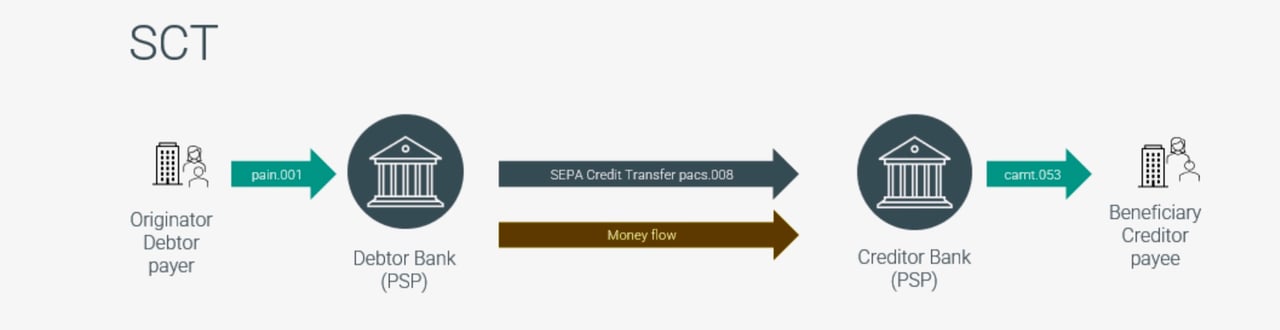
The STEP2 SEPA Credit Transfer (SCT) Service is a Pan-European Automated Clearing House (PE-ACH) operated by EBA Clearing, a pan-European payment infrastructure provider owned by banks. The SCT Service enables banks and financial institutions to send and receive SEPA payments across the entire SEPA region.
Here’s how the STEP2 SCT Service operates:
- Pan-European reach: The SCT Service allows participating banks to send and receive SEPA credit transfers, reaching all other financial institutions within the SEPA region. This ensures that euro-denominated payments can be made smoothly across borders.
- Resilience and disaster recovery: The SCT Service is designed with high resilience and full disaster recovery features, ensuring the continuous, secure, and efficient processing of SEPA payments, even in the event of technical disruptions or failures.
- Settlement in T2: Participants in the SCT Service settle their STEP2 positions through T2, which is the Eurosystem’s real-time gross settlement (RTGS) system for large-value payments in euros. STEP2 first creates bilateral gross positions for each participant and reports them. Then, it calculates the multilateral net positions and settles them in T2 through the ancillary system settlement procedures.
- Reconciliation messages: Participants can receive ISO 20022 notifications and statements (camt.054, camt.053) from T2 for reconciliation purposes. These messages provide transaction confirmations, account statements, and balance reports, which can help participants verify and reconcile their account activity.
In summary, SEPA is an EU initiative aimed at simplifying and harmonizing electronic payment transactions within Europe, making cross-border payments as easy as domestic ones. The STEP2 SCT Service from EBA Clearing is a Pan-European Automated Clearing House that enables banks and financial institutions to send and receive SEPA credit transfers across the SEPA region. The service operates with high resilience and disaster recovery features and settles participant positions through T2, allowing for secure, efficient, and smooth euro-denominated transactions across borders.
Step2-T Processing Modes
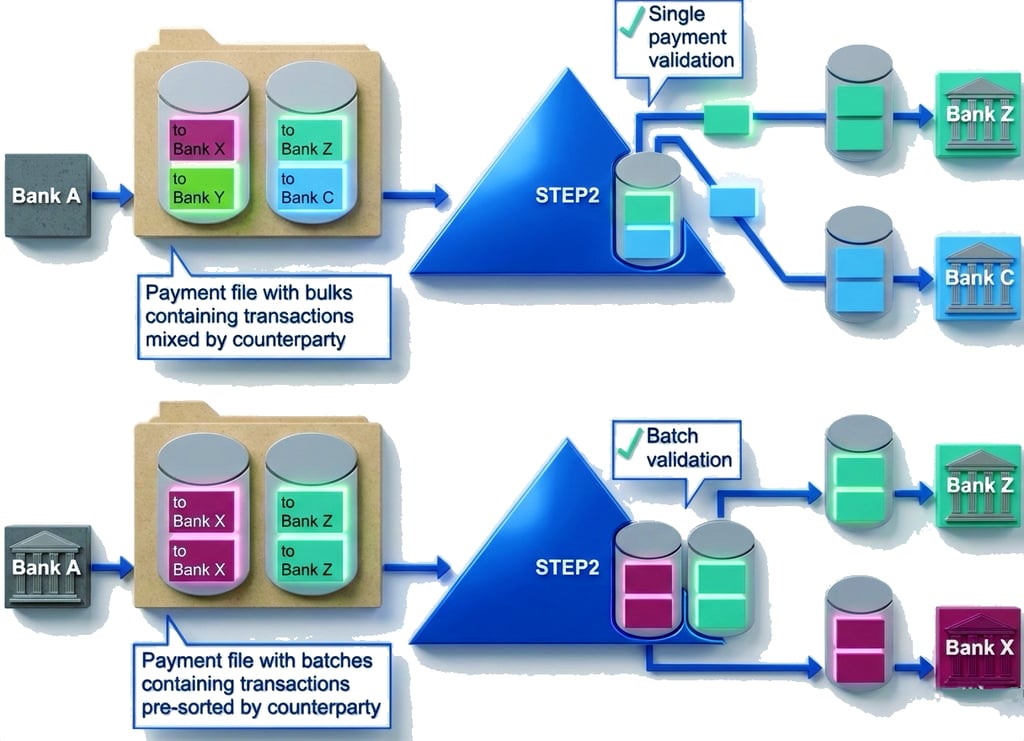
STEP2-T
A Cornerstone of European SEPA Payment Clearing
STEP2-T is a pan-European large-scale retail payment system designed for the processing of euro-denominated mass payments. Operated by EBA CLEARING, it constitutes a critical component of Europe’s payment market infrastructure and plays a central role in enabling harmonised cashless payments across the European Economic Area.
The platform supports SEPA Credit Transfers (SCT) and SEPA Direct Debits (SDD), providing a highly automated, standardised, and resilient clearing environment for cross-border and domestic euro payments.
Key Facts at a Glance
- System operator: EBA CLEARING
- Initial launch: April 2003
- Primary function: Clearing of SEPA credit transfers and direct debits
- Participants: Direct participants plus banks reachable indirectly across SEPA
- Settlement currency: Euro (EUR)
Background and Evolution
STEP2 was introduced in 2003 as Europe’s first pan-European automated clearing house (PE-ACH), with the explicit objective of supporting the emerging Single Euro Payments Area. Its creation addressed the fragmentation of national clearing systems and enabled banks to process cross-border euro payments with the same efficiency as domestic transactions.
The platform has since been extended and re-engineered several times to handle growing volumes and additional clearing cycles.
Functional Design and Operating Model
STEP2-T is engineered for high-volume retail payment processing. It clears SEPA Credit Transfers and SEPA Direct Debits in several settlement cycles per business day.
Key structural characteristics include:
- High automation: Straight-through processing with minimal manual intervention.
- Standardised messaging: Full compliance with ISO 20022 formats, ensuring interoperability and consistency across jurisdictions.
- Operational availability: Clearing cycles on T2 business days, with settlement in central bank money.
STEP2-T is a clearing house, not an RTGS system: it nets positions and settles them in central bank money in T2.
Strategic Importance and Market Integration
STEP2-T materially advances the integration of the European payments market. By providing a single, harmonised clearing platform for SEPA instruments, it removes national barriers, reduces processing costs, and enhances transparency for both banks and corporate users.
The system is interoperable with other SEPA clearing houses and settles in T2.
It processes a large share of SEPA transactions, from payroll and supplier payments to consumer direct debits.
Current Position in the European Payments Environment
STEP2-T is one of the largest SEPA clearing platforms. It is complemented by EBA CLEARING’s instant payment system RT1, launched in November 2017.
RT1 handles instant payments; STEP2-T handles non-instant retail payments.
SEPA Instant Credit Transfer
In the EU, instant credit transfers in euro follow the European Payments Council’s SEPA Instant Credit Transfer scheme (SCT Inst), launched in November 2017. The service is available 24 hours a day, 365 days a year, and the recipient’s payment service provider (PSP) must confirm within ten seconds whether the funds have been made available to the recipient. The scheme no longer sets a maximum amount. Under the Instant Payments Regulation (EU) 2024/886, PSPs in the euro area must be able to receive instant payments since January 2025 and send them since October 2025, at no higher price than standard credit transfers and with Verification of Payee.

SEPA Direct Debit (SDD)
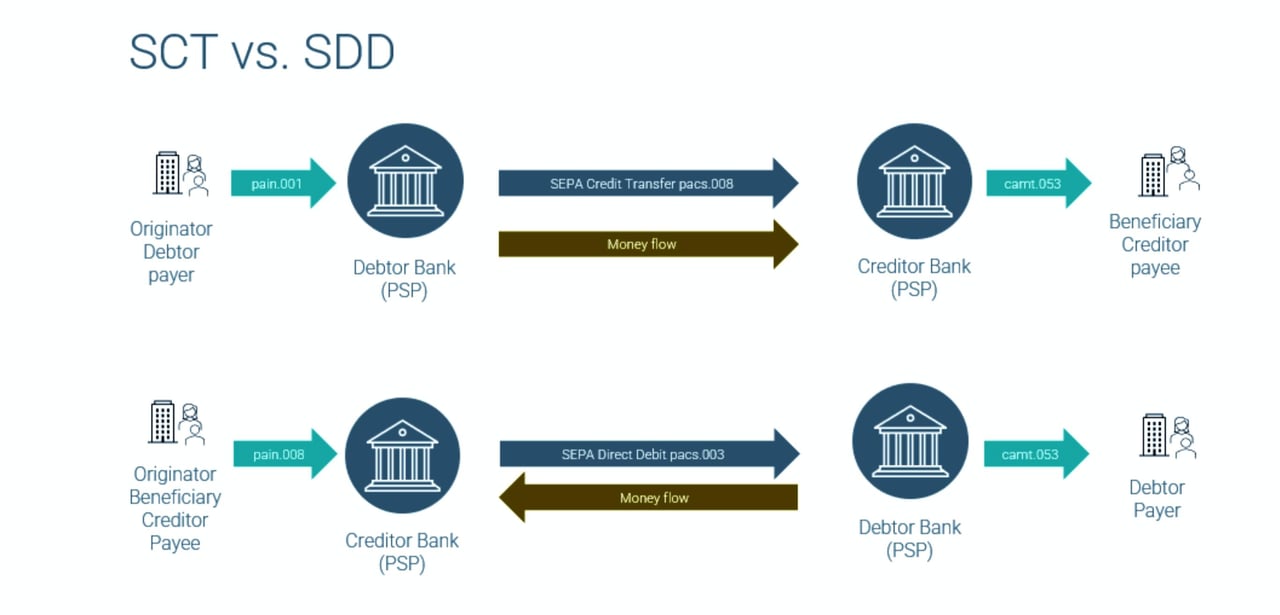
SEPA Direct Debit (SDD)
SEPA Direct Debit is a payment method within the Single Euro Payments Area (SEPA), allowing businesses and individuals to collect euro-denominated payments from debtor bank accounts anywhere in the SEPA zone. It simplifies cross-border direct debit transactions by establishing a standardized framework and simplifying the process for both creditors and debtors.
There are two main types of SEPA Direct Debit schemes:
- SEPA Direct Debit Core (SDD Core): This scheme is designed for both consumer and business-to-business transactions. In this scheme, the debtor can request a refund of an authorised collection within eight weeks without giving a reason, and of an unauthorised collection within 13 months.
- SEPA Direct Debit Business-to-Business (SDD B2B): This scheme is reserved for business debtors. There is no refund right for authorised collections; in return, the debtor’s bank must check each collection against the mandate data the debtor has confirmed.
To initiate a SEPA Direct Debit transaction, the following prerequisites must be met:
- Creditor Identifier (CI): The creditor must obtain a unique Creditor Identifier from the competent national body (in Germany, for example, the Deutsche Bundesbank). The CI is used to identify the creditor in all SEPA Direct Debit transactions and helps maintain a clear audit trail.
- Bank accounts: Both the creditor and debtor must hold bank accounts with financial institutions located within the SEPA zone.
- SEPA-compliant bank: The debtor’s and creditor’s banks must be SEPA-compliant, meaning they can process SEPA transactions according to the established rules and regulations.
- SEPA Direct Debit Mandate: The debtor must sign a mandate authorizing the creditor to collect payments from their bank account. The mandate must include specific details such as the debtor’s bank account information, the CI of the creditor, and the terms and conditions of the agreement.
- Notification: The creditor must notify the debtor of the upcoming direct debit transaction, including the amount and due date, in accordance with the rules of the specific SEPA Direct Debit scheme being used.
- Submission of the transaction: The creditor must submit the direct debit transaction to their bank in the prescribed format (ISO 20022 XML). The creditor’s bank then forwards the transaction to the debtor’s bank for processing.
- Execution of the transaction: The debtor’s bank verifies the validity of the mandate and the availability of funds before executing the transaction. If successful, the funds are transferred from the debtor’s account to the creditor’s account.



Next step
Request an introduction
Tell us in a few lines who you are and what you have in mind. Your enquiry goes directly to the bank and is treated in confidence.
Prefer to talk? Book a 30-minute videoconference.
If you want to know more about how to transfer funds through the corresponding banking system, please get in contact with our Head of Corresponding Banking M. Amri Elarisse