

Monetising SBLCs & BGs?
1. Core Principle (Non-Negotiable)
SBLCs and BGs are not designed to be monetised.
They are contingent credit instruments, not liquidity instruments.
Any claim that they are “cash equivalent”, “fundable”, or “directly monetisable” is structurally false under orthodox banking practice.
2. What “Monetisation” Means in Practice
In legitimate contexts, “monetisation” does not mean:
- Converting the instrument into cash.
- Selling it.
- Drawing funds against it without an underlying obligation.
It can only mean:
- Using the instrument as collateral to support a separate credit facility.
3. Legitimate Contexts Where Limited Monetisation Occurs
3.1 Collateralisation for Credit Facilities (Rare, Controlled)
A top-tier SBLC or BG may be accepted as credit enhancement in the following narrow circumstances:
- Issued by a G-SIB or Tier-1 bank
- Fully MT760 transmitted
- Clean text, unconditional, irrevocable
- Purpose-aligned with the underlying transaction
- Held under bank-to-bank control
Possible outcomes:
- Working capital line
- Project finance tranche
- Trade finance facility
Advance rate: set case by case, well below face value.
3.2 Internal Bank Funding (Closed-System Use)
Banks may internally:
- Recognise an SBLC/BG as risk mitigation
- Reduce capital charges (Basel III treatment)
- Support interbank exposure limits
This is not monetisation for the client.
It is balance-sheet optimisation for the bank.
3.3 Structured Trade Finance Transactions
In tightly structured trade flows:
- SBLC supports payment risk
- Financing is based on goods, contracts, receivables
- Instrument is secondary security only
Cash is generated by:
- Trade flow
- Not the SBLC itself
4. What Is Explicitly Not Legitimate
4.1 “SBLC Monetisation Programmes”
Indicators of fraud:
- Promised funding of 70–90%
- No underlying transaction
- Offshore SPVs
- Upfront “entry”, “blocking”, or “activation” fees
- Claims of “non-recourse cash against instrument”
4.2 Leasing an SBLC/BG to Raise Cash
There is no recognised secondary market for:
- Leasing
- Renting
- Selling
Any such proposal conflicts with:
- The terms on which the instrument was issued
- Issuing bank covenants
- AML and KYC standards
4.3 Drawing Against an Instrument Without Default
An SBLC or BG can only be drawn:
- Upon a defined, documented default
- In strict compliance with the text
Any “pre-default draw” is fraudulent.
5. Strategic Conclusion
- SBLCs and BGs are risk-transfer tools, not funding tools
- Legitimate “monetisation” is exceptional, conservative, and bank-controlled
- Retail, broker-led, or offshore “monetisation” narratives are categorically false
- If cash is the objective, the correct instrument is credit, not a guarantee
6. One-Sentence Truth
If an SBLC or BG could be freely monetised, banks would never issue loans.
That alone settles the matter.
SBLCs or BGs for Monetisation -How the scam works
A purported “Monetization Request” advertises the provision of either a bank guarantee or a standby letter of credit, meticulously customised to the requisite verbiage, for sums reaching several billion, ostensibly secured by tangible cash held in the accounts of Sumitomo Japan or other esteemed institutions. These instruments are proffered as one-year facilities, with an automatic renewal clause extending their validity for up to a decade.
The document alludes to a previous Sumitomo-backed transaction intended to underwrite major projects across Japan and China: from advanced hospitals to a prominent cultural centre. It is emphasised that such guarantees or SBLCs are inherently project-specific, with bespoke wording that precludes arbitrary reissuance. The proposal asserts that, in accordance with internal protocols, the instruments are issued in “hard copy” to obviate the delays intrinsic to SWIFT transfers for foreign transactions.
The prescribed process involves the submission of a proposal, subsequent due diligence, and ultimately the receipt of a hard copy instrument dispatched via “secure email and bank courier”, with a portion of the funds returned to the issuing “institution”. This reliance on antiquated hard copy procedures and ambiguous financial terminology unmistakably raises significant concerns.
In very simple terms, here is how such a scam typically operates:
1. Fake Document Creation:
The scammer produces a fake bank guarantee or SBLC: a type of promise from a bank that looks official and is laden with complex legal wording. They assert that this document is backed by real, hard cash in an actual bank account, even though in reality no such funds exist.
2. Attractive Promises:
The scammer claims that, with the right wording, this document can be “monetized.” In other words, they suggest you can use it to open or secure a huge amount of money for a project. The proposal often includes details like a very large sum (for example, up to several billion), making it sound extremely lucrative.
3. Process and Urgency:
They outline a seemingly efficient process: issuing the document quickly (sometimes within 24 hours) and sending a hard copy by bank courier. This urgency and the mix of digital and physical delivery are intended to give the impression of legitimacy and reliability.
4. The Hook:
Once you are convinced by the impressive language and the reputation of the bank name mentioned (such as Sumitomo), you may be asked to pay fees, provide collateral, or commit funds in some way. The idea is to make you believe that you’re on the verge of receiving a very valuable financial instrument.
5. The Unravelling:
Eventually, when you try to verify the document with the bank or use it as collateral, you discover that it is not genuine. The funds were never there, and the instrument was a fabrication designed solely to trick you into parting with your money.
In summary, the scam exploits the allure of a sophisticated financial instrument and the trust people place in reputable bank names. It uses complicated and impressive language to disguise the fact that the document is fraudulent, leading victims to make payments or decisions based on false promises of easy monetization.
This explanation lays out the scam in straightforward terms, highlighting how the attractive promises and misleading documentation work together to deceive the victim.
In detail
1. Ambiguity in Instrument Classification
Bank Guarantee vs. SBLC:
The proposal asserts that a Bank Guarantee and an SBLC are “basically the same instrument.” In reality, while both serve as credit enhancement tools and are usually independent undertakings, they follow different rule sets – URDG 758 for demand guarantees, ISP98 or UCP 600 for standbys – and different legal traditions. This conflation could lead to misinterpretation of obligations, affecting both legal enforceability and risk assessment.
Verbiage Flexibility:
Allowing the instrument to be tailored to the monetizer’s desired verbiage, albeit within banking protocols, introduces the possibility of non-standard or ambiguous clauses. Deviations from established language could impair the instrument’s clarity, legal validity, and may even contravene regulatory requirements.
2. Financial Underpinnings and Funding Assertions
“Hard Cash Backed” versus Credit Lines:
The proposal emphasises that up to 1.3 billion euros are supported by “actual hard cash backed accounts” as opposed to credit lines. This description is inherently ambiguous. The notion of “hard cash backing” is non-standard in modern banking parlance, which typically relies on electronically maintained reserves and audited liquidity. Such language may raise concerns over the veracity of the backing funds, potentially undermining confidence among regulators and counterparties.
Regulatory and Audit Trail Issues:
The absence of a traditional credit line may imply that funds are segregated in a non-standard or opaque manner. This could complicate both internal and external audits, as well as raise issues with respect to capital adequacy and liquidity regulations imposed by financial authorities.
3. Temporal and Renewal Provisions
Fixed Term with Automatic Renewal:
The instruments are described as one-year facilities that automatically renew for up to 10 years. Such a long duration, coupled with automatic renewal, introduces several risks:
- Regulatory Changes: Banking regulations and international financial standards are subject to evolution; an instrument drafted under current protocols may not remain compliant over an extended period.
- Market Conditions: Fluctuations in market conditions over a decade could render the fixed terms either economically unviable or disproportionately risky.
- Contractual Ambiguity: Automatic renewals necessitate clear-cut conditions for termination or renegotiation. Without stringent safeguards, the parties could find themselves locked into unfavourable terms.
4. Issuing Bank and Geographic Concerns
Use of Sumitomo Japan (Tokyo):
While Sumitomo is a reputable institution, specifying a particular branch raises several issues:
- Jurisdictional Compliance: The instrument must adhere to Japanese banking regulations, which may differ from international or foreign regulatory frameworks. This could present complications for foreign monetizers.
- Due Diligence: The proposal does not clarify whether the branch’s operational capabilities and regulatory standing have been independently verified for such high-stakes transactions.
5. Procedural Vulnerabilities in the Hard Copy Approach
Hybrid Transmission Methodology:
The methodology involves sending a “secure email” confirmation followed by the dispatch of a physical hard copy via bank courier. This hybrid approach exposes the transaction to several risks:
- Physical Security Risks: Hard copies are inherently vulnerable to loss, theft, or damage during transit. Unlike digital instruments transmitted over secure, auditable networks (e.g., SWIFT), physical documents lack an immutable electronic trail.
- Verification Challenges: While the proposal asserts that verification can be accomplished “by phone, email or letter,” these methods do not provide the strong audit trail and instantaneous confirmation that modern electronic systems offer.
- Outdated Practice: The insistence on using hard copies “because no SWIFTs are needed internally” suggests a reliance on antiquated processes. Today, the absence of SWIFT or similar electronic clearing mechanisms could be interpreted as non-compliance with contemporary security and regulatory standards.
- Chain-of-Custody Issues: Without a rigorous and tamper-proof chain of custody, the legitimacy and authenticity of the physical document could be challenged, potentially leading to disputes or even fraudulent alterations.
- Implications for Cross-Border Transactions:
Hard copies sent outside the conventional banking system may encounter difficulties in international legal contexts. The physical nature of the instrument could complicate cross-border recognition and enforcement, especially if discrepancies arise between the digital confirmation and the physical document.
6. Due Diligence and Risk Mitigation
Insufficient Safeguards:
The proposal outlines a due diligence (DD) process for monetizers; however, the procedures appear cursory given the magnitude of the transaction. There is no mention of:
- Independent Verification: Third-party audits or independent confirmations of the funds’ availability are not discussed.
- Anti-Money Laundering (AML) Measures: Strong AML and know-your-customer (KYC) protocols are critical, especially when large sums and international entities are involved.
- Legal Review: The absence of an explicit legal review process could lead to unforeseen contractual liabilities or regulatory breaches.
- Operational Risks:
The reliance on multiple communication channels (secure email, courier, telephone) introduces operational risks. Miscommunications or delays in any of these channels could derail the transaction and expose the parties to reputational and financial harm.
In summary, the proposal exhibits significant vulnerabilities ranging from ambiguous instrument classification and outdated hard copy processes to potential conflicts of interest and regulatory compliance concerns. Adopting modern, electronically verifiable, and standardised procedures, coupled with enhanced due diligence, would mitigate many of these risks and better align the transaction with contemporary best practices in international finance.
SBLCs & BGs for Monetization?
SBLCs and bank guarantees are, by design, instruments of absolute commitment, ensuring that the full nominal amount is available upon demand. Where the applicant’s own credit standing does not suffice, the issuing bank typically requires cash or securities collateral of up to 100% of the face value. However, when one contemplates securing such instruments with 100% securities (plus associated bank fees) only to approach a third-party monetise, who may yield merely 80% of the instrument’s value, the economic rationale unravels.
The Inefficiency of Over-Securing and Discounted Monetisation
Capital Efficiency and Opportunity Costs
When an entity is required to pledge 100% of the instrument’s value as collateral and incur additional bank fees, it is effectively immobilising assets equivalent to the full nominal amount. If a monetiser then only offers a discounted liquidity value of 80%, for instance, the entity is essentially sacrificing 20% of the instrument’s worth: and more, once fees are factored in. This practice is tantamount to an inefficient utilisation of capital, as the locked assets could potentially yield higher returns if deployed elsewhere. The opportunity cost here is substantial: funds tied up as securities are rendered unavailable for alternative investments that might offer a more favourable risk-return profile.
Risk-Return Imbalance
From a risk management perspective, the arrangement introduces an inherent imbalance. The bank, in issuing an SBLC or guarantee, exposes itself to a contingent liability which is entirely mitigated by 100% collateralisation. Yet, if the instrument is later monetised at a discount, the party providing the collateral does not recover the full value of their committed assets. Essentially, they shoulder not only the risk of the underlying transaction but also an implicit loss due to the discrepancy between the collateral provided and the monetised proceeds. This imbalance undermines the economic viability of the entire transaction, as the effective cost of obtaining liquidity through this route far exceeds its benefits.
Redundancy of Financial Engineering
In many respects, the procedure of over-securing an instrument only to monetise it at a discounted rate becomes a redundant exercise in financial engineering. The original purpose of securing the instrument is to provide absolute assurance of payment or performance. However, if a third party is then involved in converting this assurance into cash at an 80% yield, the process introduces an unnecessary intermediary step that erodes value. The inherent full commitment of the instrument is nullified by the fact that only a fraction of that commitment is realised in liquid form. The cost incurred in terms of both collateral and fees effectively negates any potential financial benefit that might have been derived from such an arrangement.
Illustrative Examples
Example 1: International Trade Finance
Consider an exporter who requires an SBLC worth USD 1,000,000 to secure payment from an overseas buyer. The importer’s bank demands a collateral deposit of USD 1,000,000 along with bank fees to issue the SBLC. If the exporter then attempts to monetise this instrument through a specialised financial intermediary that offers a monetisation rate of 80%, the exporter would receive only USD 800,000 in liquid funds. In this scenario, the exporter has committed assets worth USD 1,000,000 (plus fees) yet recoups merely 80% of that value, resulting in a 20% loss of capital efficiency.
Example 2: Construction Contract Performance Guarantee
A construction firm may be required to secure a bank guarantee of £500,000 to assure a developer of its performance. The firm must provide collateral of the full £500,000 and pay the requisite bank fees. Should the firm decide, for any reason, to monetise this guarantee, perhaps to free up working capital, a third-party monetiser might only offer £400,000. Here, the firm suffers an immediate diminution of value, as the full extent of its collateral is not converted into equivalent liquidity, thereby rendering the process economically unsound.
Example 3: Joint Venture Performance Assurance
In a joint venture, one party might be obligated to provide a bank guarantee of EUR 750,000. To secure this instrument, the party pledges EUR 750,000 in securities plus incurs additional fees. If a monetisation attempt through a third-party facility results in an 80% liquidity conversion, only EUR 600,000 is recovered. This discrepancy illustrates the inefficacy of the approach: the entity has effectively sacrificed EUR 150,000 in potential capital value (excluding fees) merely to access funds that could have been more efficiently allocated or utilised elsewhere.
Alternative approaches
Alternative Solutions:
- Direct Credit Facilities: Rather than leveraging SBLCs for liquidity, entities might consider negotiating direct credit lines or overdraft facilities which do not require full collateralisation and thus preserve capital efficiency.
- Securitisation with Better Terms: If monetisation is essential, seeking arrangements where the discount rate is significantly less onerous, through improved credit ratings or more favourable market conditions, could enhance overall returns.
- Structured Collateral Management: Utilising dynamic collateral management techniques to adjust the level of security in real-time might mitigate some inefficiencies, though the fundamental disparity between collateral and monetised value remains.
While SBLCs and bank guarantees are indispensable in securing absolute financial commitment, structuring them with 100% collateral plus fees only to monetise at a discount (for instance, 80%) is economically unsound. Such an approach inefficiently utilises capital, creates a risk-return imbalance, and introduces superfluous financial layering that ultimately erodes net benefit.
Regulatory and Legal Constraints Governing SBLC Issuance, Collateralisation, and Credit Monetisation
1. Governing Legal Framework for SBLCs
Standby Letters of Credit are documentary credit instruments governed primarily by:
- ISP98 (International Standby Practices, ICC Publication No. 590), or alternatively
- UCP 600 (Uniform Customs and Practice for Documentary Credits, ICC Publication No. 600), when expressly stated.
Under both regimes, an SBLC is an irrevocable, independent and documentary undertaking of the issuer (ISP98 rule 1.06). It is not a funding instrument, not a negotiable security, and not a balance-sheet substitute for capital.
The issuing bank pays only against a complying presentation, typically a statement that the applicant has defaulted on an underlying obligation. There is no provision under ISP98 or UCP 600 permitting issuance for the purpose of leverage, monetisation, or capital raising.
2. Capital Adequacy and Prudential Regulation
All internationally active banks issuing SBLCs are subject to:
- Basel III Capital Framework (Basel Committee on Banking Supervision),
- Local implementation via regulators such as the Federal Reserve, ECB, PRA, FINMA, etc.
Under Basel III:
- An SBLC constitutes an off-balance-sheet exposure.
- It attracts a Credit Conversion Factor (CCF) under the standardised approach – 100% for financial standbys (direct credit substitutes), 50% for performance-related standbys and guarantees – converting it into a risk-weighted exposure.
- The issuing bank must hold capital against this exposure.
Consequently, a bank cannot issue SBLCs without either:
- Cash collateral, or
- Fully secured, risk-mitigated exposure supported by eligible collateral or balance-sheet strength.
Issuing unsecured SBLCs of USD 500 million to multiple billions would immediately violate capital adequacy ratios and supervisory limits.
3. Collateral and Credit Risk Rules
Under standard credit policy and regulatory audit requirements:
- SBLC applicants must provide primary collateral acceptable under the bank’s internal credit risk model.
- Collateral eligibility is narrowly defined and excludes speculative assets, future receivables, or third-party promises.
- Collateral must be enforceable, perfected, and jurisdictionally strong.
Sound credit practice excludes issuing SBLCs on the strength of expected downstream financing, investor participation, or post-issuance monetisation.
4. Anti-Money Laundering and KYC Obligations
SBLC issuance and related financing fall under:
- FATF Recommendations,
- EU AML Directives / US Bank Secrecy Act, and equivalent regimes.
Requests involving:
- Circular funding logic,
- Instruments issued without underlying trade or obligation,
- Attempts to transform guarantees into cash equivalents,
are red flags under AML typology guidance.
A functioning compliance department will not approve such structures.
5. Loan-to-Value Constraints on SBLC-Backed Financing
Where a lender accepts an SBLC as credit enhancement, the SBLC is treated as risk mitigation, not principal collateral.
Under internal credit risk policies and regulatory scrutiny:
- Loan-to-value ratios are conservative and set case by case.
- Blocking, margining, and issuer rating constraints further reduce effective liquidity.
- Fees, discounting, and capital charges materially erode net proceeds.
There is no regulatory pathway for a 100% loan against an SBLC, nor for a 100% line of credit derived from it.
6. Prohibition of “100% Funding” Structures
The concepts of:
- “100% loan providers”,
- “fully cash-backed SBLC issued to obtain 100% financing”,
- or “investors funding against guarantees without collateral”,
do not exist within regulated finance.
Such constructs would breach:
- Basel III,
- Banking supervision statutes,
- Internal credit governance,
- Auditor and regulator oversight.
Institutions engaging in such behaviour risk supervisory sanctions up to the loss of their banking licence.
7. Economic Non-Viability
Even if one ignores regulatory impossibility, the economics are fundamentally flawed:
- Cash-backed SBLCs immobilise capital.
- Financing against them is fractional.
- Net liquidity after fees, margins, and capital costs is inferior to direct asset-backed borrowing.
For this reason, legitimate corporates do not pursue such structures.
In summary:
- SBLCs are contingent guarantees governed by ICC rules.
- Their issuance is tightly constrained by Basel III and national regulators.
- They must be secured upfront by the applicant.
- Financing against them is partial, conservative, and secondary.
- Such structures are neither lawful nor executable within the international banking system.
Any serious financing discussion must begin with demonstrable assets, audited financials, and a legitimate underlying transaction requiring credit enhancement.
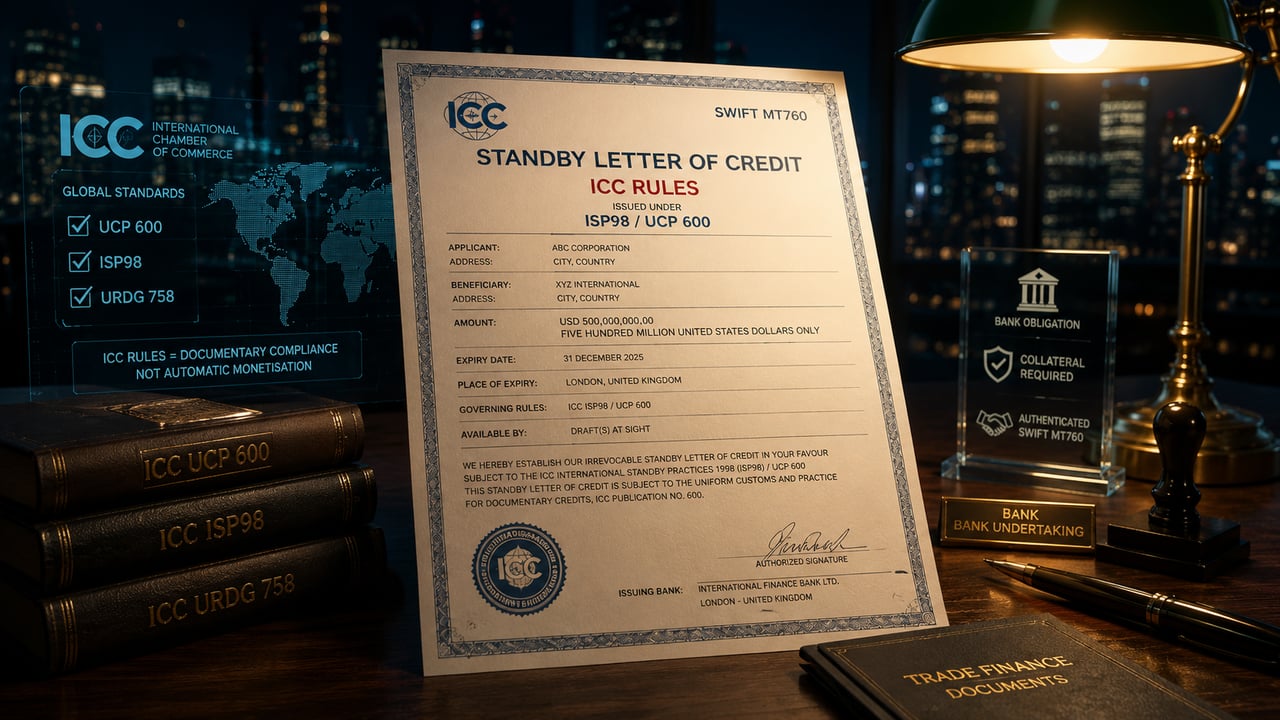
Can Banks Issue ICC-Governed SBLCs or Bank Guarantees Without a Commercial Transaction?
The dangerous half-truth behind “financial SBLCs”
One of the most persistent misconceptions in the standby letter of credit and bank guarantee market is the claim that banks can issue SBLCs or guarantees “under ICC rules” without any real commercial transaction behind them, merely to create liquidity, raise funds, or enable third-party monetisation.
The statement is superficially plausible, but materially dangerous.
It is true that not every SBLC or demand guarantee must support a shipment of goods, a commodity contract, or a conventional import-export transaction. Financial standby letters of credit, performance guarantees, bid bonds, advance payment guarantees, payment guarantees, and guarantees securing loans or contractual obligations are all recognised instruments in international banking practice.
It is false, however, that ICC rules transform an economically empty instrument into bankable collateral, transferable liquidity, or monetisable capital.
ICC rules regulate the documentary undertaking. They do not validate the commercial substance of the transaction, the creditworthiness of the applicant, the collateral behind the instrument, or the legality of the proposed use.
ICC rules govern form, not economic substance
Standby letters of credit and demand guarantees may be issued subject to internationally recognised rule sets, including ISP98, UCP 600, and URDG 758.
These rules are important. They determine how demands are made, how documents are examined, how discrepancies are handled, and how the independent payment undertaking operates.
But ICC rules do not answer the more fundamental banking questions:
- Who is the applicant?
- Who is the beneficiary?
- What obligation is being secured?
- What is the lawful purpose of the instrument?
- What collateral or reimbursement arrangement supports the issuing bank?
- Does the applicant have verified source of funds?
- Does the transaction comply with AML, sanctions, banking, capital, and prudential rules?
- Would a regulated receiving bank accept the instrument as collateral?
A document may be drafted under ICC rules and still be commercially useless, legally defective, or fraudulent in substance.
Independence does not mean purposelessness
A core feature of SBLCs and demand guarantees is their independence from the underlying contract. The issuing bank does not adjudicate the commercial dispute between applicant and beneficiary. It examines the demand and required documents according to the terms of the instrument.
This independence principle is frequently abused.
Fraud promoters often argue that because the SBLC is independent from the underlying contract, no real transaction is required. That is wrong.
Independence means that the bank’s payment obligation is documentary. It does not mean the instrument may be issued without a real applicant, a real beneficiary, a real reimbursement obligation, a lawful purpose, and acceptable credit risk.
The correct distinction is simple:
- The bank does not need to inspect the goods or perform the contract.
- The bank must still understand the banking exposure, applicant risk, beneficiary purpose, source of funds, collateral, and regulatory consequences.
An independent undertaking is not an economically orphaned instrument.
Financial standby letters of credit are legitimate
There is nothing inherently improper about a financial SBLC.
A financial standby may support:
- repayment of a loan;
- payment under a securities transaction;
- lease obligations;
- project finance obligations;
- margin or collateral obligations;
- performance under a major contract;
- advance payment exposure;
- a parent-company or group obligation;
- a regulated credit enhancement structure.
In such cases, the SBLC may have no connection to the movement of goods. That does not make it fraudulent.
The decisive issue is whether the SBLC supports a real, lawful, documented, credit-assessed obligation.
A financial standby is legitimate when it is issued within a proper banking framework. It becomes suspect when it is marketed as a free-standing funding instrument, detached from credit analysis, collateral control, and regulatory substance.
Demand guarantees also do not require a goods trade
Demand guarantees under URDG 758 may secure many types of obligations. They are not restricted to commodity transactions or documentary trade.
A demand guarantee may secure performance, payment, tender obligations, advance payments, warranty obligations, or other contractual exposures.
Again, the absence of a goods shipment is not the problem.
The problem arises when a so-called bank guarantee is presented as a transferable asset that can be purchased, leased, pledged, discounted, or monetised without the receiving bank conducting its own credit and compliance analysis.
No ICC rule compels a bank to lend against a guarantee merely because it is described as ICC-governed.
“Issued by a bank to finance itself” – the real issue
The claim that banks issue SBLCs or bank guarantees “to finance themselves” must be treated with particular caution.
If a bank issues an instrument for its own funding purposes, the transaction is no longer ordinary client trade finance. It may amount economically to bank borrowing, deposit-taking, securities issuance, structured funding, or the creation of a contingent liability.
That has regulatory consequences.
A bank cannot simply create an SBLC or guarantee, call it ICC-governed, and treat it as cost-free funding paper. A bank undertaking is a balance-sheet or off-balance-sheet exposure. It affects capital, liquidity, large exposure limits, accounting treatment, risk concentration, and regulatory reporting.
In plain terms: ICC language does not exempt a bank from banking law.
Cash-backed does not mean automatically bankable
The phrase “full cash-backed SBLC” is often used to create an impression of safety. In legitimate banking, the concept is straightforward: the issuing bank has cash collateral or equivalent eligible assets securing its exposure.
But the phrase is often used deceptively.
A genuine cash-backed structure requires proof of all of the following:
- the cash exists;
- the cash is legally owned or controlled by the applicant;
- the cash is free from encumbrances;
- the cash has lawful origin;
- the cash is acceptable to the issuing bank;
- the cash is blocked, pledged, or otherwise controlled under enforceable documentation;
- the issuing bank has a valid reimbursement right;
- the beneficiary and purpose are legitimate;
- the transaction passes AML, sanctions, and regulatory review.
Without these elements, “cash-backed” is merely a marketing expression.
Why “leased SBLC monetisation” is usually a fraud indicator
The highest-risk formulation is the offer to “lease” an SBLC or bank guarantee and then “monetise” it.
The fraud logic usually runs as follows:
- A third party claims access to a bank instrument.
- The instrument is said to be ICC-governed.
- The client is told it can be leased for a fee.
- The client is told the leased instrument can be monetised by a bank.
- A supposed lender is said to provide 60 per cent, 70 per cent, 80 per cent, or even 90 per cent loan-to-value.
- The client is asked to pay advance fees for issuance, blocking, transmission, compliance, authentication, legalisation, or platform access.
- No real monetisation occurs.
The defect is fundamental: leasing does not normally transfer ownership or unrestricted pledge rights. A beneficiary under an SBLC is not automatically the economic owner of the issuing bank’s undertaking. A receiving bank will not lend merely because an instrument exists. It will analyse enforceability, issuer quality, applicant obligation, collateral, claim mechanics, fraud risk, sanctions exposure, transferability, assignment, and its own credit policy.
- A leased SBLC is not cash.
- A SWIFT message is not money.
- An ICC rule is not collateral.
Red flags in alleged ICC SBLC/BG funding transactions
Particular caution is warranted where any of the following expressions appear:
- “leased SBLC”;
- “fresh cut instrument”;
- “monetisation guaranteed”;
- “non-recourse monetisation”;
- “90 per cent LTV”;
- “no credit line required”;
- “ICC 600 certified”;
- “ICC 758 bank guarantee for trading”;
- “private placement programme”;
- “platform intake”;
- “tranche schedule”;
- “bank-to-bank only after fee”;
- “blocked funds download”;
- “screen only”;
- “no commercial transaction required”;
- “bank uses SBLCs to finance itself”;
- “instrument issued for investment purposes only”;
- “no collateral required because it is full cash-backed”.
None of these phrases proves fraud by itself. But their combination is strongly associated with non-bankable transactions and advance-fee schemes.
The correct banking test
A serious institution will not ask whether an instrument is merely “ICC-governed”. That is only one formal element.
The proper banking test is broader:
- Is there a real applicant?
- Is there a real beneficiary?
- Is the instrument issued by an acceptable bank?
- Is the instrument transmitted through authenticated banking channels?
- Is the applicant’s reimbursement obligation legally enforceable?
- Is the collateral real, verified, controlled, and lawful?
- Is there a legitimate underlying obligation?
- Is the instrument assignable, transferable, or payable only to the named beneficiary?
- Is the governing law acceptable?
- Is the proposed use compatible with the instrument wording?
- Would a regulated bank accept the exposure under its own credit policy?
- Does the transaction satisfy AML, sanctions, tax, accounting, and prudential requirements?
If the answer to these questions is not clear, the transaction is not bankable.
IFB’s position
International Finance Bank Ltd may review standby letters of credit, bank guarantees, demand guarantees, and related documentary undertakings governed by recognised international rules, including ISP98, UCP 600, and URDG 758.
Such instruments do not always require a traditional goods-trade transaction. They may legitimately secure financial obligations, contractual obligations, performance obligations, investment-related obligations, or other lawful exposures.
However, IFB does not accept the proposition that ICC rules alone create collateral value, liquidity, or monetisation capacity.
IFB does not participate in speculative leased-instrument monetisation schemes, broker chains, platform-style funding structures, or transactions where an SBLC or bank guarantee is represented as a freely tradeable funding instrument without verified collateral, lawful purpose, issuer authority, and full compliance review.
Any proposed SBLC or guarantee transaction must be submitted through formal onboarding and compliance review. IFB will require full KYC, AML documentation, source-of-funds evidence, corporate documentation, transaction rationale, instrument wording, issuer details, beneficiary details, and proof of collateral or reimbursement capacity.
No pricing, issuance, acceptance, confirmation, discounting, or monetisation discussion can proceed until the instrument and parties have been verified.
Summary
The absence of a traditional commercial goods transaction does not automatically invalidate an SBLC or bank guarantee. Financial standby letters of credit and demand guarantees are legitimate instruments when they support real, lawful, documented obligations.
But the claim that banks can issue ICC-governed SBLCs or guarantees without economic substance, merely to finance themselves or enable third-party monetisation, is a dangerous distortion.
ICC rules provide documentary discipline. They do not create money. They do not replace collateral. They do not cure a sham transaction. They do not oblige any bank to lend.
A genuine SBLC or guarantee is a serious banking instrument. A purported “leased” or “monetisable” instrument without verified collateral and lawful purpose is usually not finance. It is a warning sign.

Precise trade-finance reality regarding Documentary Letters of Credit (DLCs).
I. Core Structural Reason: Why DLCs cannot be Monetised
Fundamental classification:
A Documentary Letter of Credit (DLC) is a payment commitment – a contingent bank promise tied directly to the performance of a specified underlying trade contract between buyer and seller. It is not a financial asset, economic ownership, or cash claim that can be freely sold, pledged, or funded.
Compare this with monetisable instruments in finance:
| Instrument | Nature | Monetisable? |
|---|---|---|
| Documentary credit (MT 700) | Bank undertaking conditional on complying trade documents | No – but trade finance against it is possible |
| SBLC / demand guarantee | Independent, contingent undertaking to pay against a complying demand | Generally no |
| Financial asset (e.g. bonds) | Transferable, cash-yielding security | Yes |
| Invoice receivable | Legally enforceable cash claim | Yes (factoring, discounting) |
Technical explanation:
A DLC only creates a promise to pay upon documentary compliance. There is no present enforceable cash claim until that compliance event occurs. Because of this:
- It lacks fungibility and transferability as a financial asset.
- There is no inherent right to immediate cash upon issuance.
- There is no tradable market for DLC claims.
- It cannot be pledged independently of the underlying commercial contract.
II. The Monetisation Principles Applied to DLCs
Analogy formulated as rules:
- DLC = Trade Payment Mechanism, not a financial asset.
• It only gives a conditional obligation to pay if documents match terms.
• As long as it is tied to performance conditions, it is not monetisable.
• Monetisation requires a legally enforceable cash claim – not present here. - DLCs are not transferable like tradable securities.
• A DLC can be transferred only if expressly designated as transferable (UCP 600, article 38); most are not. • The beneficiary may, however, assign the proceeds (article 39). - Banks will not treat a DLC as collateral for direct liquidity.
• Because the payment obligation depends on documentary compliance, banks do not lend against a DLC as a free-standing asset; financing is extended only within trade-finance structures (see III).
• Attempting to monetise exposes legal, regulatory, and credit risks.
• Third-party “monetisers” offering “discount for cash now” before any documents are presented are a common fraud pattern. - Intent and contract define usability, not value fungibility.
• DLC text is precise: it specifies documents / terms. Payment flows only on compliance.
• There is no mechanism in UCP 600 or in standard contract law that converts a DLC into a cashable asset.
Thus, the core truth is: no clean, unconditional, immediate cash claim exists in a DLC; therefore, it cannot be monetised.
III. What a Bank can allow when a client receives a DLC
If a client receives a DLC from another reputable bank (i.e., the client is the beneficiary of an LC), its bank can provide trade finance facilities or services that leverage the existence of that DLC. But this is not monetisation: it is trade financing. Typical possibilities include:
1) Deferred Payment usance DLC only
- If the DLC is a deferred payment (usance) LC – where payment is due at a future date – a nominated or confirming bank may discount or prepay the deferred payment obligation after complying documents have been presented and accepted.
- This is trade finance, not monetisation of the instrument itself.
- The discount is based on risk, history of the client, tenor, and credit quality of the issuing bank.
2) Negotiation / Acceptance Facility
- A negotiating bank can pay the beneficiary (or part of it) upon presentation of compliant documents and then recover from the issuing bank.
- The bank extends financing against the obligation to be paid by the issuing bank.
3) Assignment of Proceeds / Transferable LC Provision
- The beneficiary may assign the proceeds of any LC to a supplier or financier (UCP 600, article 39); if the LC is expressly transferable, it may also be transferred in whole or in part to a second beneficiary (article 38).
- This is a contractual transfer of payment rights under the LC text, not monetisation as a tradable asset.
4) Back-to-Back and Structured Trade Finance
- Banks may structure a back-to-back LC or a documentary chain financing, where the primary LC enables financing for sub-transactions.
- These structures still depend on the trade flows, not an independent cash claim.
5) Risk Mitigation Treatment Internally
- The bank may recognise the credit support in risk management (reduced capital cost, internal funding benefit).
- This is bank internal balance-sheet optimisation only.
Rule: DLCs cannot be monetised because they are conditional payment obligations contingent on documentary compliance, not independent cash claims.
Banks can provide trade finance against DLCs (loans, negotiation, assignment, structured financing), but never treat them as monetisable financial assets.

The Monetisation of Bank Drafts: A Misconception with Risky Consequences
In recent years, amid a growing interest in alternative financing and private placement programmes, a persistent and misguided belief continues to circulate: that bank drafts, particularly those issued by reputable global banks, can be monetised in a fashion similar to credit instruments such as Standby Letters of Credit (SBLCs) or Medium-Term Notes (MTNs). This notion is not merely inaccurate; it is financially hazardous and often tied to fraudulent schemes. At IFB International Finance Bank, we categorically reject this practice and wish to articulate, in precise and professional terms, why such transactions are structurally and legally untenable.
I. What Is a Bank Draft?
A bank draft, also referred to as a banker’s draft or cashier’s cheque, is a payment instrument issued by a bank on behalf of a customer. The bank debits the client’s account (or receives cash), assumes the obligation, and issues a draft payable to a third-party beneficiary. Critically:
- It is a payment instrument, not a credit instrument.
- It reflects cleared, settled funds at the time of issuance.
- It functions similarly to a cheque but carries the direct obligation of the issuing bank.
The fundamental purpose of a bank draft is finality of settlement, not the creation of future liquidity. Its legal and financial structure places it squarely in the domain of payment systems, not of capital markets.
II. The False Promise of Monetisation
In financial parlance, monetisation refers to the act of converting a non-cash financial instrument, typically one that implies future payment or credit risk, into immediate liquidity, generally via a loan facility, discounting structure, or repurchase agreement.
To be eligible for monetisation, an instrument must possess the following properties:
- Transferable legal title: ❌ Limited – a draft is payable to the named payee and is often crossed or marked non-transferable
- Veritable credit backing: ❌ No – drafts are pre-funded; not credit-based
- Secondary market value: ❌ None – not listed or tradeable
- Encumbrance capability: ❌ Not recognised as collateral in any standard facility
In short, a bank draft lacks all structural features necessary for legitimate monetisation. It cannot be pledged, discounted, assigned, or fractionalised in a compliant financial transaction. Any party purporting to monetise such an instrument either misunderstands the instrument: or is misrepresenting their capacity with fraudulent intent.
III. Legal Impediments to Monetisation
A bank draft is governed by payment law, not securities or capital markets law. Its legal nature varies by jurisdiction, but key principles include:
- Although a bank draft is legally a cheque-type instrument (for example a cashier’s cheque under UCC § 3-104), it is a payment order for an amount already funded, not an investment or credit asset.
- It cannot be securitised or pooled for syndication.
- It is not an asset class recognised under Basel III risk-weighting or central bank reporting frameworks.
- Attempting to assign, resell, or encumber it outside of its original settlement context breaches the issuing bank’s terms and may trigger compliance flags.
In cross-border contexts, attempts to move or “monetise” a bank draft, especially of high nominal value, may attract suspicion under anti-money laundering (AML), know-your-customer (KYC), and anti-terrorist financing (CFT) regulations.
IV. Economic and Operational Realities
Even if one were to ignore the legal and regulatory red flags, the economic logic behind bank draft monetisation fails under scrutiny.
- No bank will accept a draft as collateral for a loan, because the draft is, in essence, a pre-paid payment. It does not represent a future receivable or cash flow that can be discounted.
- No institutional buyer or private placement platform will recognise a bank draft as having tradeable value, since it is non-fungible and non-marketable.
- Unlike SBLCs or MTNs, a bank draft has no ISIN, no CUSIP, no settlement chain, and no documentation to anchor it in the capital markets infrastructure.
It is, quite simply, an isolated payment promise, a finality instrument, not an asset.
V. Compliance and Fraud Risk
The reality is that many “bank draft monetisation” schemes are:
- Thinly disguised advance fee frauds, in which victims are asked to pay for “attorney fees,” “compliance clearance,” or “monetisation setup costs,” only to be left with nothing.
- Designed to exploit naïve or desperate clients, often in emerging markets, by offering illusory liquidity solutions.
- Structured in a way that makes legal recourse impossible, as the fraudsters are often offshore and unregulated.
At IFB, we are routinely approached to “verify,” “authenticate,” or “monetise” such drafts. In every legitimate case, we follow the same protocol:
- Full KYC on the requesting party
- Document review via legal and compliance
- Rejection based on instrument class and regulatory policy
Any counterpart who claims to be able to monetise a bank draft should be treated with extreme caution.
VI. What IFB Accepts
We do not accept or monetise bank drafts under any structure or denomination.
If you are seeking liquidity or structured finance, we will only consider:
- Cash-backed SBLCs or BGs, issued via authenticated SWIFT MT760
- Rated sovereign bonds or MTNs with clear custodial documentation
- Verified proof of funds (POF) lodged in a compliant escrow
- Project finance structures backed by recognised sovereign, municipal, or institutional guarantees
Every facility is subject to FATF-based AML/KYC standards and Basel-oriented risk management. We will not deviate from these standards.
Bank drafts, despite their apparent security and the prestige of certain issuers, are fundamentally unsuitable for monetisation. They are not credit instruments. They are not investment-grade assets. And they are not recognised as collateral by any Tier-1 institution.
At IFB International Finance Bank, we stand for transparent, structured, and compliant financial services. We urge all clients, partners, and intermediaries to educate themselves and avoid transactions rooted in misunderstanding or misinformation.
Should you require assistance evaluating the legitimacy of a proposed transaction, or if you wish to explore compliant financing alternatives, our legal and financial structuring teams remain at your full disposal.



Next step
Request an introduction
Tell us in a few lines who you are and what you have in mind. Your enquiry goes directly to the bank and is treated in confidence.
Prefer to talk? Book a 30-minute videoconference.