How Cash and Securities Are Held at Banks and Brokers 

A Comprehensive Legal and Operational Guide for Investors, Treasurers, and Sophisticated Private Clients 


1. Why This Matters: The Architecture of Asset Holding in Modern Finance 

Most investors operate under a fundamental misconception. When they see a balance displayed in their brokerage account or banking portal showing securities positions and cash balances, they assume these assets exist in a clearly delineated account that belongs exclusively to them—a digital safety deposit box of sorts. The reality is far more nuanced, and the legal architecture underlying asset holding in modern financial markets creates material distinctions that directly determine what happens to client assets when financial intermediaries encounter distress or insolvency. 

The way an asset is held—the precise legal characterization of the relationship between the investor, the intermediary, and the asset itself—determines five critical dimensions of investor protection and risk exposure. First, it establishes who has legal ownership and what type of claim exists, distinguishing between a property right in a specific asset versus a contractual claim against an intermediary for a fungible obligation. Second, it dictates the insolvency treatment, determining whether assets are returned directly to investors or whether investors must file claims in insolvency proceedings and compete with other creditors. Third, it defines which protective regimes apply, such as investor compensation schemes, deposit guarantee schemes, or client asset safeguarding rules. Fourth, it exposes concentration risks that may be hidden from view, such as reliance on a single custodian, a single central securities depository, or a single deposit-taking bank. Fifth, it creates operational dependencies and counterparty exposures that may span multiple jurisdictions and multiple tiers of intermediation. 

The critical distinction that underpins all subsequent analysis is straightforward: securities are typically held within a custody framework designed to preserve client asset protection and facilitate return of assets in kind upon intermediary insolvency, while cash is held within a deposit framework where the bank becomes the legal owner of the deposited funds and the depositor holds a contractual claim for repayment. This distinction—between custody/beneficial ownership for securities and debtor/creditor for cash—is the foundation of modern financial market infrastructure, and everything that follows is an elaboration of the consequences that flow from this fundamental difference. 

Understanding this distinction requires examining the detailed mechanics of securities custody chains, the legal nature of cash deposits, the function and limitations of omnibus account structures for both asset classes, the specific regulatory frameworks that govern asset safeguarding across major jurisdictions, and the practical implications for risk management and operational due diligence. The analysis that follows provides this examination in depth. 

2. Securities Custody: Legal Framework and Market Infrastructure 

2.1 Dematerialisation and the Multi-Tier Custody Architecture 

Modern securities markets have largely abandoned the practice of issuing physical certificates representing ownership interests in equity or debt instruments. The dematerialisation of securities—the shift from physical paper certificates to electronic book-entry records—fundamentally transformed the operational mechanics and legal architecture of securities ownership and transfer. This transformation was driven by practical necessity: the exponential growth in trading volumes during the latter half of the twentieth century created a paperwork crisis that threatened to overwhelm the physical infrastructure of certificate transfer and registration. The solution was to create electronic book-entry systems where ownership is recorded in computer registers rather than evidenced by possession of physical documents. 

The dematerialisation process created a multi-tier custody chain that intermediates between the issuing corporation and the ultimate beneficial owner. At the apex of this chain sits the issuer itself, which maintains the authoritative record of total issued share capital and the fundamental legal framework governing the securities. The issuer determines the terms of the securities, including voting rights, dividend entitlements, redemption provisions, and corporate actions. However, the issuer no longer maintains direct relationships with the vast majority of its shareholders. 

Immediately below the issuer sits the Central Securities Depository (CSD), which operates the core settlement and safekeeping infrastructure for a securities market. In the United States, the Depository Trust Company (DTC) performs this function for most equity and debt securities. In Europe, the landscape is more fragmented, with Euroclear and Clearstream operating as International CSDs (ICSDs) alongside national CSDs in individual member states. In the United Kingdom, Euroclear UK & International (formerly CREST) serves as the CSD for UK securities. These CSDs maintain the authoritative electronic register of securities positions and operate the settlement systems that facilitate delivery-versus-payment when securities transactions are completed. 

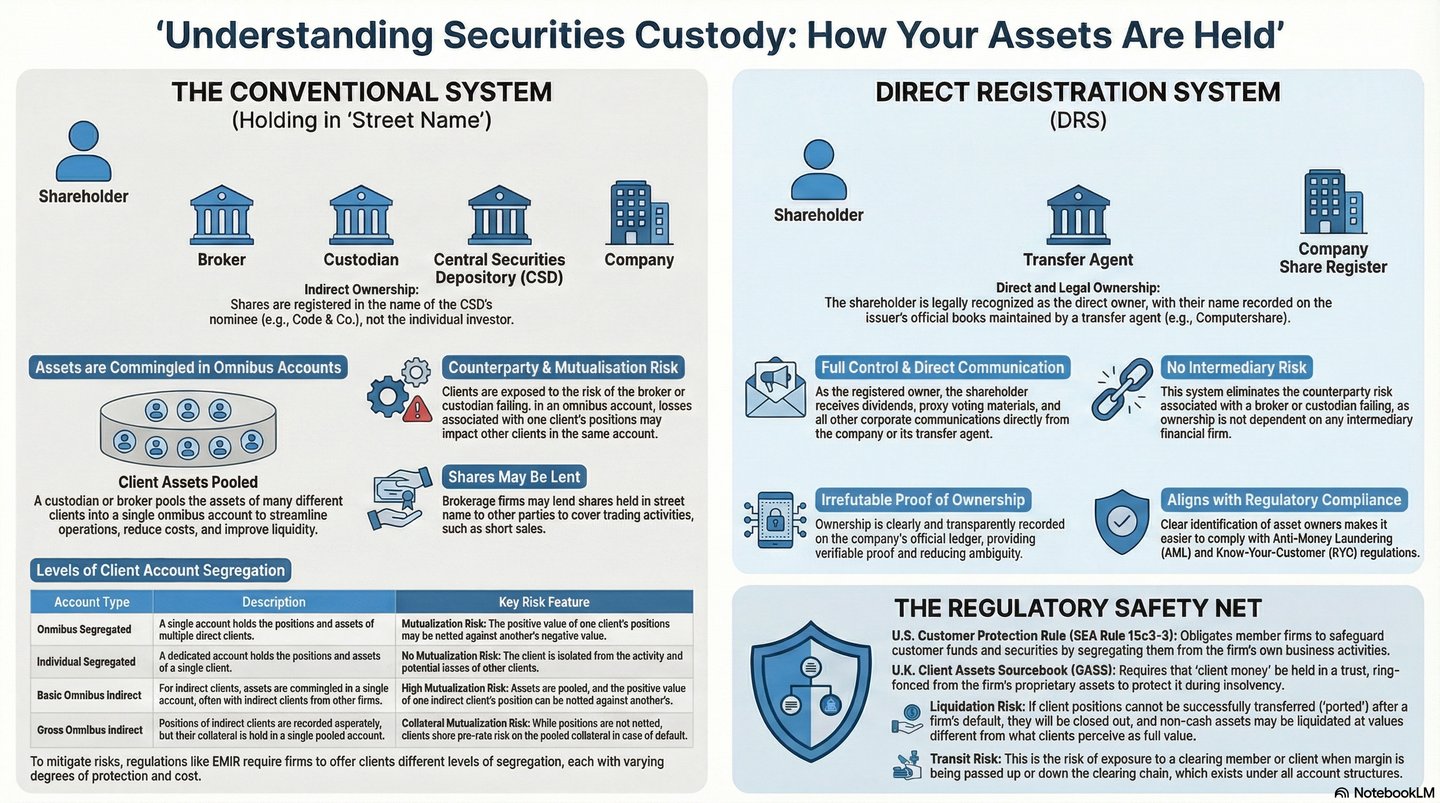
The CSD does not typically maintain accounts for individual investors. Instead, it maintains accounts for major financial institutions—custodian banks, prime brokers, and large broker-dealers—that act as participants in the CSD's settlement system. These participants, in turn, maintain accounts for their clients, who may themselves be intermediaries (such as smaller brokers or investment advisers) or may be end investors. This creates a potentially lengthy custody chain: issuer to CSD to global custodian to sub-custodian to broker to end investor. At each tier, the intermediary maintains internal records allocating securities positions to specific clients, while holding a larger aggregate position at the tier above. 

This multi-tier architecture creates efficiency gains through netting and pooling, but it also creates legal complexity. The end investor typically does not appear on the issuer's register as a registered holder. The registered holder is usually the CSD or a nominee company operated by the CSD. The investor instead holds a beneficial interest in securities that are legally registered in the name of an intermediary or nominee. This beneficial ownership framework is supported by an elaborate legal infrastructure designed to ensure that beneficial owners receive the economic and governance rights associated with the securities (dividends, interest payments, voting rights, participation in corporate actions) even though they are not the registered legal owners. 

2.2 Omnibus Custody Accounts: Function and Legal Character 

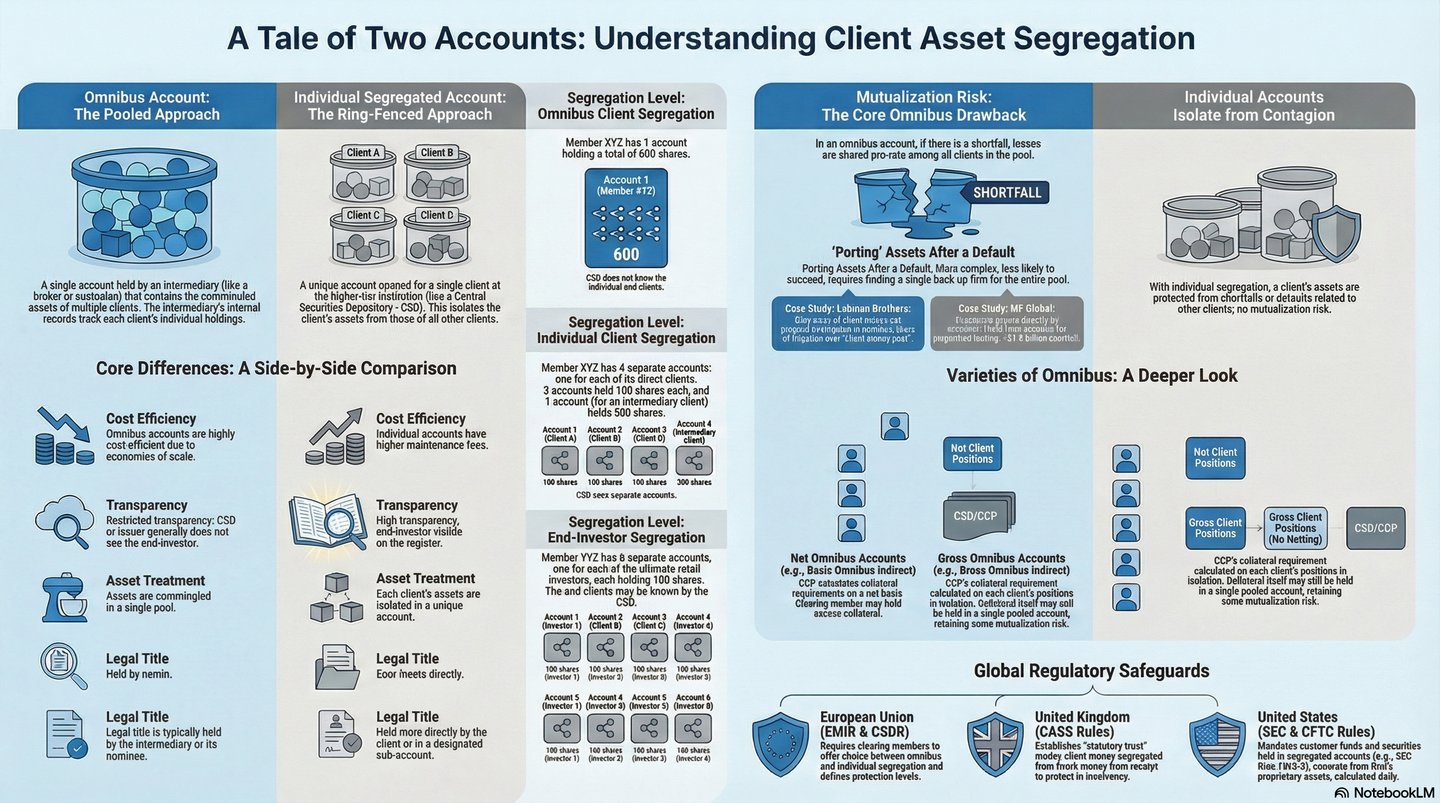
Within this multi-tier custody architecture, omnibus accounts serve as the standard operational mechanism for pooling client securities positions. An omnibus account is a securities account maintained by one intermediary (such as a broker) with another intermediary (such as a custodian bank or CSD) in which the securities of multiple underlying clients are held in a single fungible pool. The intermediary operating the omnibus account maintains internal records—its books and records—that allocate specific securities entitlements to individual clients. From the perspective of the custodian or CSD maintaining the omnibus account, the account appears as a single large position. The custodian or CSD does not necessarily know the identity of the underlying beneficial owners; it knows only that the account contains securities held on behalf of clients of the intermediary. 

The use of omnibus accounts, rather than segregated individual accounts for each beneficial owner, is driven by several pragmatic considerations. Settlement efficiency is substantially enhanced when transactions can be netted across multiple clients. If a broker has ten clients buying and ten clients selling the same security on the same day, an omnibus structure allows the broker to settle the net position with the market rather than processing twenty separate settlements. Operational complexity is reduced because the CSD and custodian maintain relationships with a manageable number of direct participants rather than millions of individual investors. Account proliferation at the CSD level would create scaling problems and increase costs throughout the system. Market standardisation around omnibus structures creates network effects and reduces the need for bespoke arrangements. 

The critical legal question—and the point where omnibus securities accounts differ fundamentally from omnibus cash accounts—is whether the pooling of securities in an omnibus account destroys the property-like character of the investor's interest in the securities. The answer, in well-functioning securities custody regimes, is that omnibus pooling does not destroy property protection, provided that the legal framework appropriately recognises beneficial interests in fungible pools and that the intermediary maintains adequate records and segregation discipline. 

Legal systems have developed sophisticated doctrines to address beneficial ownership of fungible assets held in pools. In common law jurisdictions, trust concepts or similar equitable principles typically govern the relationship. In civil law jurisdictions, various forms of co-ownership, segregation requirements, and statutory protections achieve similar results. The unifying principle is that the intermediary is not the beneficial owner of the securities it holds in omnibus client accounts. The intermediary is a custodian or trustee holding the securities for the benefit of its clients. The clients have beneficial ownership interests—entitlements to specific quantities of fungible securities from the pooled account. 

2.3 Client Asset Segregation: Regulatory Requirements and Operational Implementation 

The protective quality of the custody framework depends on rigorous segregation of client assets from the proprietary assets of intermediaries. This segregation operates at multiple levels: legal segregation (client securities are not owned by the intermediary and are not available to satisfy the intermediary's general creditors), accounting segregation (client securities are recorded off-balance-sheet in fiduciary or custody accounts rather than as assets of the intermediary), and operational segregation (client securities are held in designated client asset accounts at the CSD or custodian level, distinct from proprietary accounts). 

Regulatory frameworks across major jurisdictions impose detailed requirements for client asset segregation. Under the European Union's Markets in Financial Instruments Directive II (MiFID II), specifically Article 16(8) of Directive 2014/65/EU, investment firms are required to make adequate arrangements to safeguard clients' ownership rights, especially in the event of the firm's insolvency, and to prevent the use of client financial instruments on own account except with the client's express consent. The implementing regulation, Commission Delegated Regulation (EU) 2017/565, Article 2, elaborates these requirements by mandating that investment firms distinguish client financial instruments from their own financial instruments and maintain records and accounts that enable them, at any time and without delay, to distinguish assets held for one client from assets held for other clients and from their own assets. 

The Central Securities Depositories Regulation (Regulation (EU) No 909/2014, known as CSDR) imposes parallel obligations on CSDs themselves. Article 38 of CSDR requires CSDs to keep records and accounts that enable them to segregate, in the accounts with the CSD, the securities of each participant and, where relevant, the securities of the participants' clients. CSDs must offer to participants at least the choice between omnibus client segregation (where the securities of all clients of a participant are held in a single account separate from the participant's own securities) and individual client segregation (where the securities of each client of a participant are held in a separate account). This requirement ensures that even within an omnibus framework, client securities are segregated from the proprietary securities of the intermediary. 

In the United Kingdom, the Financial Conduct Authority's Client Assets Sourcebook (CASS) establishes comprehensive custody asset requirements in CASS 6. These rules require firms to register custody assets in the name of the client where possible, or where this is not feasible, to register them in the name of a nominee company with appropriate safeguards. Firms must conduct daily internal reconciliations of their records of custody assets with the records of third parties holding those assets. They must also conduct periodic external reconciliations and maintain organisational arrangements sufficient to minimise the risk of loss or diminution of client assets through fraud, poor administration, inadequate record-keeping, or negligence. The CASS regime operates on the principle that client assets are held on trust for clients and are not available to general creditors in the firm's insolvency. 

The United States approach, embodied in SEC Rule 15c3-3 (the Customer Protection Rule), requires broker-dealers to maintain physical possession or control of all fully paid and excess margin securities carried for customers. Possession or control can be demonstrated through various means: physical possession of certificates, proper registration in the customer's name, control through book-entry at a clearing agency, or control location at a bank under an appropriate control agreement. The rule prohibits broker-dealers from using customer securities to finance their proprietary activities except to the extent of the customer's margin debit. This creates a segregation requirement that protects customer securities from general creditor claims in broker-dealer insolvency. The Securities Investor Protection Act of 1970 provides an additional layer of protection through the Securities Investor Protection Corporation (SIPC), which advances funds to satisfy customer claims for missing securities up to specified limits when a broker-dealer fails. 

2.4 Intermediary Insolvency: Asset Return Mechanisms and Practical Frictions 

When a broker or custodian holding client securities enters insolvency, the legal expectation in jurisdictions with robust client asset protection regimes is that client securities will be returned to clients rather than falling into the general insolvency estate to be distributed among unsecured creditors. The theoretical framework is clear: client securities are not the property of the insolvent intermediary; they are held by the intermediary as custodian, nominee, or trustee for the beneficial owners. Therefore, these assets should be segregated from the insolvency proceedings and returned to their rightful owners. 

The practical implementation of this theoretical framework, however, involves substantial complexity and creates several sources of friction and risk. The first friction arises from reconciliation requirements. When an intermediary fails, the insolvency practitioner or regulatory authority must reconcile the intermediary's internal records (showing what securities positions are attributed to which clients) with the external records (showing what securities are actually held at the custodian, sub-custodian, or CSD level). If the intermediary maintained accurate books and records and conducted regular reconciliations during normal operations, this process proceeds relatively smoothly. If the intermediary's books and records were deficient—a common occurrence in cases of fraud or negligent administration—the reconciliation process can be protracted and contentious. 

The second friction arises from shortfalls. In some insolvency scenarios, the total quantity of securities that should be held for clients according to the intermediary's books and records exceeds the quantity of securities actually held in custody accounts. This shortfall can result from various causes: unauthorised trading or pledging of client securities, failure to settle client purchases while recording them as complete, fraud involving fabricated positions, or operational errors compounding over time. When a shortfall exists, clients typically share the loss pro rata—each client receives a proportionate reduction in their positions—and the clients then hold residual unsecured claims against the insolvent estate for the shortfall amount. The priority and recovery rate for these residual claims depends on the applicable insolvency law and the composition of the insolvent estate's assets and liabilities. 

The third friction involves costs and delays. Insolvency proceedings are expensive. Insolvency practitioners (administrators, liquidators, trustees, or similar officials depending on jurisdiction) charge fees for their services. Legal advisers, accountants, and forensic specialists may be engaged. Resolving disputes about entitlements, tracing commingled funds, and addressing cross-border complications all generate costs. These costs are typically deducted from the assets available for distribution, reducing the recovery for clients. Time delays can also be substantial. Even in straightforward cases, the process of reconciling positions, resolving claims, and effecting transfers of securities to clients or their designated custodians can take months. In complex cross-border failures involving multiple jurisdictions and conflicting legal principles, resolution can extend for years. 

Regulatory authorities and market infrastructure operators have developed various mechanisms to mitigate these frictions. Client asset distribution rules in jurisdictions like the UK establish streamlined processes for returning client assets without the need for full insolvency proceedings when the shortfall is below specified thresholds. Special administration regimes for investment firms, such as the UK's Investment Bank Special Administration Regulations 2011, prioritise the rapid return of client assets over maximising returns to general creditors. Investor compensation schemes, discussed further below, provide backstop protection to compensate clients for losses up to specified limits when assets cannot be returned. 


3. Cash Deposits: The Debtor-Creditor Relationship and Its Implications 

3.1 The Legal Nature of Bank Deposits: Property Rights Versus Contractual Claims 

The legal characterization of cash held in a bank account stands in stark contrast to the custody framework applicable to securities. When an investor deposits cash into a bank account, whether directly with a bank or through a broker that places client cash with a bank, the fundamental legal relationship created is one of debtor and creditor, not custodian and beneficial owner. This distinction has profound implications for the depositor's rights and the treatment of the cash in the event of bank insolvency. 

Under the orthodox legal analysis applied in common law jurisdictions and most civil law systems, a deposit of money with a bank transfers ownership of that money to the bank. The depositor does not retain a property right in specific money or in any identifiable pool of money. Instead, the depositor acquires a contractual right—a chose in action, in common law terminology—to demand repayment of an equivalent sum from the bank. The bank becomes the legal and beneficial owner of the deposited funds and is free to use those funds as it sees fit: to make loans, to purchase securities, to meet regulatory capital requirements, or to fund any other aspect of its business. The bank's obligation to the depositor is to repay the deposit on demand (for demand deposits) or according to agreed terms (for term deposits), typically with interest. 

This legal framework is not an historical accident or a legal technicality that might be reformed to better protect depositors. Rather, it is fundamental to the economic function of banks in fractional reserve banking systems. Banks operate by accepting deposits and using those deposits to fund lending and investment activities that generate returns exceeding the cost of the deposits. This maturity transformation—borrowing short (deposits repayable on demand or at short notice) and lending long (loans repayable over months or years)—creates economic value but depends on the legal principle that deposited funds belong to the bank and can be deployed in the bank's business. If deposits were held in custody and remained the property of depositors, the bank could not use those funds to make loans, and the fundamental mechanism of credit creation in modern economies would be impossible. 

The depositor's position as an unsecured creditor of the bank creates credit risk exposure. If the bank fails and enters insolvency proceedings, the depositor must file a claim in the insolvency for the amount of the deposit. The depositor ranks as an unsecured creditor and must compete with other unsecured creditors for recovery from the bank's assets. The recovery rate depends on the value of the bank's assets, the amount of its liabilities, and the applicable priority scheme in insolvency. In many bank failures, unsecured creditors recover only a fraction of their claims, and in severe failures, they may recover nothing. 

Recognising the systemic importance of protecting depositors and the potential for bank runs if depositors fear losing their funds, most developed jurisdictions have established deposit guarantee schemes that provide statutory protection for depositors up to specified limits. These schemes, discussed in detail below, represent a policy intervention to mitigate the credit risk inherent in the depositor-bank relationship. However, they do not change the fundamental legal characterization: deposits remain contractual claims, not property rights. The guarantee schemes simply ensure that a fund or mechanism exists to compensate depositors when banks fail, up to the coverage limits. 

3.2 Client Money at Brokers: The Two-Layer Architecture 

When investors hold cash with a broker rather than directly with a bank, an additional layer of complexity is introduced. The investor sees a cash balance displayed in the broker's system and may believe this cash is held safely on their behalf. The reality involves two distinct legal relationships and two distinct layers of potential failure. 

At the first layer—the relationship between the investor and the broker—the investor has a contractual claim against the broker for the amount of cash credited to the investor's account. The precise legal character of this claim depends on whether the broker operates under a client money safeguarding regime. In jurisdictions with client money rules (such as the UK's CASS 7 or MiFID II's client money requirements), the broker is required to treat client cash as held on trust or under a similar fiduciary arrangement, segregating it from the broker's own funds. In jurisdictions without comprehensive client money rules, the investor may simply be an unsecured creditor of the broker, and client cash may be commingled with the broker's operational funds. 

At the second layer—the relationship between the broker and the bank or banks where client cash is actually deposited—the broker (or more precisely, the client money trust or client money account if properly structured) is a depositor with contractual claims against the bank. The legal characterization at this layer follows the same debtor-creditor analysis discussed above: the bank owns the deposited funds, and the depositor has a contractual claim for repayment. 

This two-layer structure creates two distinct failure scenarios with different risk profiles. If the broker fails but the banks holding client money remain solvent, client money safeguarding regimes are designed to ensure that client cash is protected from the broker's general creditors and can be returned to clients (or transferred to another broker selected by the clients) relatively quickly. The effectiveness of this protection depends on the broker having properly implemented the safeguarding requirements: maintaining segregated client money accounts, conducting required reconciliations, holding sufficient balances with banks to meet client entitlements, and maintaining adequate records. 

If, conversely, a bank holding client money fails while the broker remains solvent, the analysis shifts to the bank insolvency layer. The broker (or the client money trust) becomes an unsecured creditor of the failed bank, subject to deposit protection limits and the bank insolvency regime. Under most client money safeguarding frameworks, the broker has a duty to pursue claims against the failed bank and to distribute any recovery to clients. However, the recovery may be limited to deposit protection amounts, and clients may face delays in accessing their cash while insolvency proceedings run their course. 

The most catastrophic scenario occurs when both the broker and a bank holding client money fail simultaneously or in close succession, as can happen during systemic financial crises. In such cases, clients face both broker insolvency issues (challenging whether client money was properly segregated and whether any shortfalls exist) and bank insolvency issues (limited recovery beyond deposit protection limits). The complexity of unwinding these dual failures, particularly when they span multiple jurisdictions, can be formidable. 

3.3 Deposit Guarantee Schemes: Statutory Protection and Practical Limitations 

Deposit guarantee schemes represent a fundamental component of the financial safety net in modern economies. These schemes provide statutory guarantees that depositors will be compensated up to specified limits if their bank fails and cannot repay deposits. The schemes serve multiple policy objectives: protecting retail depositors from losses, preventing bank runs driven by depositor panic, maintaining confidence in the banking system, and reducing the systemic risks associated with bank failures. 

The European Union Deposit Guarantee Schemes Directive 

The European Union has harmonised deposit protection across member states through the Deposit Guarantee Schemes Directive (Directive 2014/49/EU, the DGSD). This directive establishes a common framework that all member states must implement, ensuring that depositors benefit from consistent protection regardless of which EU member state's banking system they utilise. Under Article 6 of the DGSD, deposit guarantee schemes must cover deposits up to EUR 100,000 per depositor per credit institution. This coverage level represents a political compromise between competing considerations: providing adequate protection for retail depositors, limiting the fiscal exposure of guarantee schemes, and maintaining incentives for depositors to exercise some discipline over banks by monitoring their financial condition. 

The DGSD distinguishes between eligible deposits (those that benefit from the guarantee) and excluded deposits (those that do not). Article 5 sets out the exclusions, which include deposits made by financial institutions acting in their capacity as financial institutions, deposits arising from transactions in connection with which there has been a criminal conviction for money laundering, deposits by undertakings whose corporate purpose is the conduct of certain financial activities on a professional basis, and certain other categories. The exclusions reflect the policy judgment that the deposit guarantee is primarily intended to protect retail depositors and small businesses, not sophisticated financial institutions or depositors engaged in potentially illicit activities. 

Article 8 of the DGSD establishes strict timelines for repayment. Deposit guarantee schemes must be in a position to make payouts within seven working days from the date on which the competent authority makes a determination that deposits are unavailable or a judicial authority makes a ruling that has the effect of suspending depositors' rights to make claims against a credit institution. This seven-day timeline, reduced from the twenty-day period that existed under the previous directive, reflects lessons learned from the financial crisis about the importance of rapid payout to maintain confidence and prevent economic disruption when banks fail. 

One of the more complex issues addressed in the DGSD is the treatment of omnibus accounts and other accounts where multiple depositors' funds are pooled. Article 7 establishes that where a deposit is made in the name of one or more account holders but the account is designated as being held on behalf of one or more other beneficiaries, the scheme may use look-through provisions to identify and protect the ultimate beneficiaries. For look-through treatment to apply, the beneficiaries must be identified or identifiable before the date on which the competent authority makes a determination or a judicial authority makes a ruling. This look-through mechanism is particularly relevant for client money held by brokers, payment institutions, or other intermediaries in pooled accounts, ensuring that individual clients can benefit from deposit protection for their share of the pooled account rather than the protection being exhausted by treating the pooled account as a single EUR 100,000 deposit. 

The United Kingdom Financial Services Compensation Scheme 

Following the United Kingdom's departure from the European Union, the UK has maintained its own deposit protection regime through the Financial Services Compensation Scheme (FSCS), which continues to provide protection broadly consistent with the EU framework but with some distinctive features. The FSCS protects deposits up to GBP 85,000 per person per authorised deposit-taking institution. This limit is periodically reviewed and adjusted to maintain approximate equivalence with the EUR 100,000 limit established in the EU DGSD when exchange rate movements create significant divergence. 

The FSCS operates under the authority of the Financial Services and Markets Act 2000 and the rules made thereunder, particularly the Compensation Sourcebook in the FCA Handbook. The FSCS covers not only deposits but also various categories of investment business, insurance, and other financial services. For deposit protection specifically, the scheme distinguishes between claims for protected deposits (which benefit from the GBP 85,000 limit) and claims for protected dormant accounts (which benefit from full protection with no upper limit, though dormant accounts are relatively rare in practice). 

One distinctive feature of the UK regime is the temporary high balance provision, which provides enhanced protection up to GBP 1 million for a period of six months for deposits that arise from certain specified life events. These include deposits derived from real estate transactions (such as the proceeds of selling one's home), compensation for personal injury, compensation for wrongful conviction or miscarriage of justice, proceeds from insurance policies, proceeds from inheritances, and proceeds from divorce or dissolution of civil partnership settlements. The policy rationale for this temporary high balance protection recognises that individuals experiencing these life events may need to hold substantial cash balances temporarily while arranging alternative investments or major purchases, and should not be exposed to deposit protection limits during this transitional period. 

The United States Federal Deposit Insurance Corporation 

In the United States, deposit insurance is provided by the Federal Deposit Insurance Corporation (FDIC), established under the Banking Act of 1933 in response to the catastrophic bank failures of the Great Depression. The FDIC insures deposits up to USD 250,000 per depositor, per insured bank, per ownership category. The specification by ownership category is important: a single depositor may have multiple insured deposits at the same bank if those deposits are held in different ownership capacities (for example, individual accounts, joint accounts, certain retirement accounts, revocable trust accounts, and irrevocable trust accounts may each receive separate coverage). 

The FDIC insurance framework, codified in 12 U.S.C. § 1821 and implementing regulations at 12 C.F.R. Part 330, establishes detailed rules for calculating deposit insurance coverage in complex scenarios. For joint accounts, each co-owner's share of the joint account is separately insured up to USD 250,000. For revocable trust accounts, coverage can extend up to USD 250,000 for each unique beneficiary, subject to certain limitations and aggregation rules. For accounts held by corporations, partnerships, and unincorporated associations, coverage applies to the entity itself, not to the individual shareholders, partners, or members. 

A particularly relevant aspect of FDIC coverage for brokerage clients involves brokered deposits and sweep accounts. When a broker sweeps client cash into deposits at one or more FDIC-insured banks, the FDIC's rules require examination of whether the deposits are brokered deposits and how the insurance should be attributed. The FDIC's guidance on pass-through deposit insurance (12 C.F.R. § 330.5) establishes that deposits owned by a principal and deposited by an agent may be insured as the deposits of the principal if certain conditions are met: the deposit account records of the insured bank must disclose the agency relationship, the deposit account records must show the names of the actual owners, and the funds in the account must be owned by the principals. When these conditions are satisfied, each principal can receive up to USD 250,000 of coverage for their share of the deposits held by the agent, rather than coverage being limited to USD 250,000 for the entire pooled account.