
Payments & Transfers
Real-Time Gross Settlement
Similarities and differences between Real-Time Gross Settlement (RTGS) systems and Large Value Payment Systems (LVPS) in terms of transfers and clearing.
Similarities:
- High-value transactions: Both RTGS and LVPS are designed to handle high-value transactions, typically involving large amounts of money exchanged between financial institutions.
- Central bank involvement: Both systems are usually operated or overseen by central banks, ensuring the stability and reliability of the payment infrastructure.
- Systemically important: RTGS and LVPS are considered systemically important payment systems due to their role in the settlement of large-value transactions and their impact on the stability and efficiency of the financial system.
- Settlement risk mitigation: Both RTGS and LVPS aim to reduce settlement risk by providing timely and secure settlement of transactions among participating financial institutions.
Differences:
- Settlement mechanism: RTGS systems settle transactions individually and in real-time, meaning that each transaction is processed immediately and irrevocably. In contrast, LVPS typically use net settlement, where transactions are accumulated over a certain period and then settled in a single, netted amount at specific times during the day.
- Liquidity requirements: RTGS systems often require higher levels of intraday liquidity from participating institutions, as transactions are settled continuously throughout the day. In net settlement systems, like most LVPS, the need for intraday liquidity is generally lower, as transactions are settled in batches.
- Speed: RTGS systems offer immediate settlement, ensuring that funds are transferred in real-time between the accounts of participating institutions. LVPS using net settlement mechanisms may have a slower settlement process, as transactions are only settled at specific times during the day.
- Finality: In RTGS systems, settlement is final and irrevocable as soon as the transaction is processed. In some LVPS, settlement finality may only be achieved at the end of the settlement cycle when the netted amounts are transferred.
RTGS Systems
RTGS
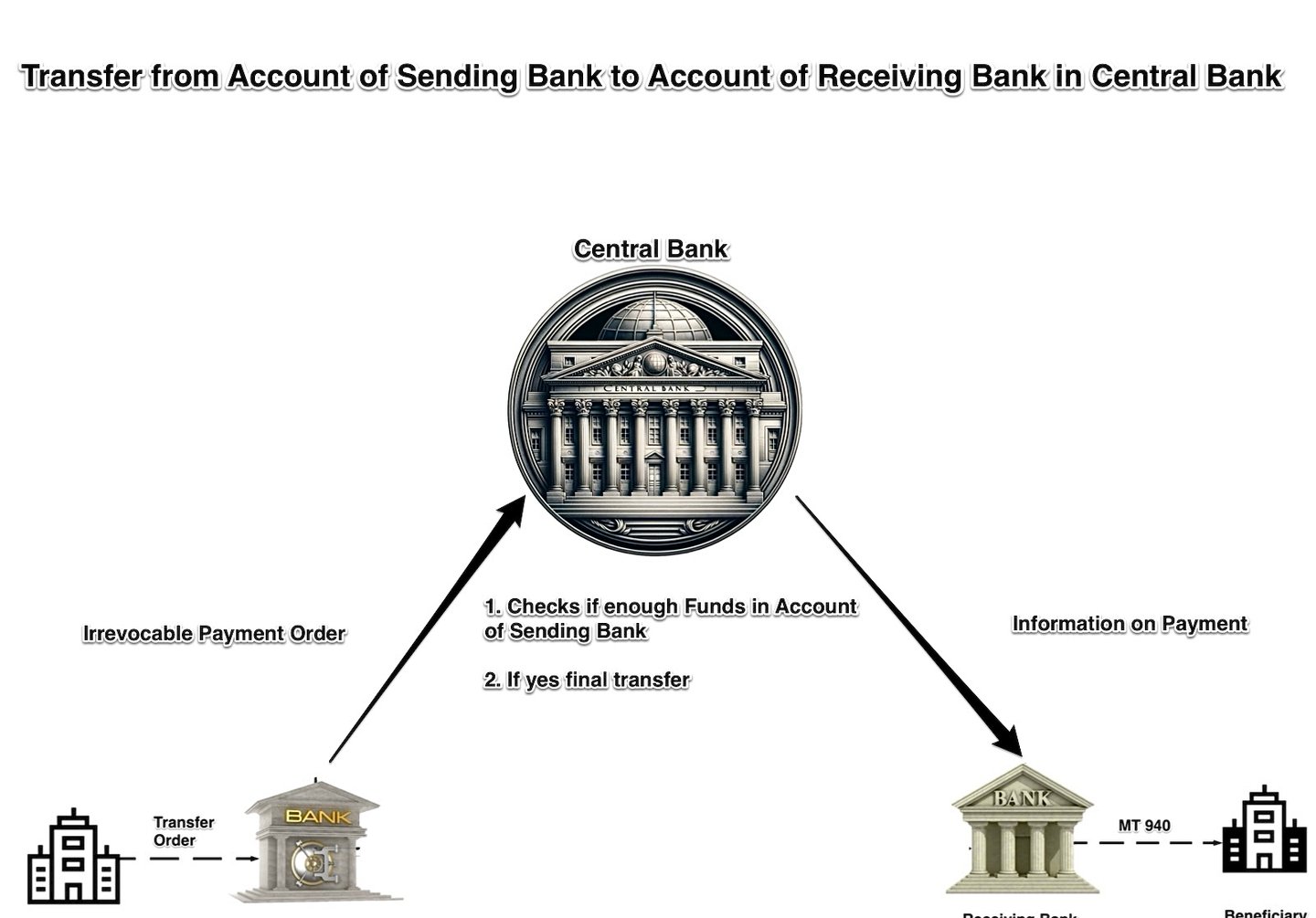
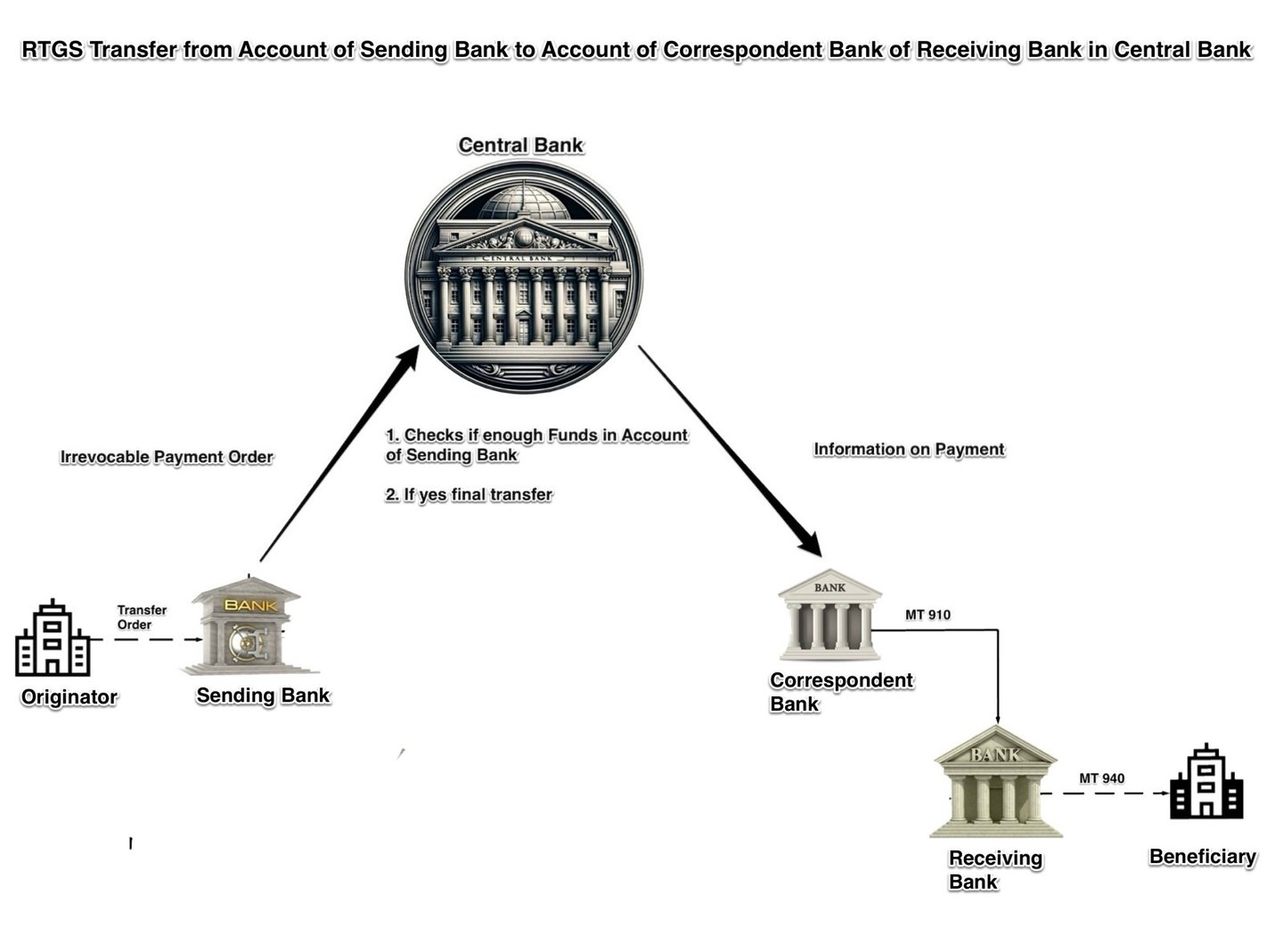
RTGS systems use several message formats for communication between central banks and within their own systems.
Here’s a summary of the key message types used in RTGS-to-RTGS communications:
1. ISO 20022 messages: Most major RTGS systems now use ISO 20022, including T2 (Eurosystem, since March 2023), CHAPS (since June 2023) and Fedwire Funds (since July 2025). Some common ISO 20022 messages used include:
- pacs.008: Customer credit transfer
- pacs.009: Financial institution credit transfer
- pacs.010: Financial institution direct debit
- camt.056: Payment cancellation request
- camt.029: Resolution of investigation
- camt.053: Statement message
- camt.054: Debit/credit notification
2. Proprietary formats: Some RTGS systems still use their own proprietary formats. Fedwire used its proprietary FAIM tag format until it moved to ISO 20022 on 14 July 2025.
3. SWIFT MT messages: Some systems still accept Swift MT messages, but cross-border MT payment messages were retired in November 2025. Their ISO 20022 equivalents are:
- pacs.008 (formerly MT103): Customer credit transfer
- pacs.009 (formerly MT202): Financial institution credit transfer
- camt.054 (formerly MT900/MT910): Debit and credit notification
- camt.053 (formerly MT950): Statement
4. Specialized messages: Some RTGS systems use specialized messages for specific purposes:
- MT096/MT097: Authorization request and response messages used in Y-Copy systems
- xsys.001, xsys.002, xsys.003: Messages used in SWIFTNet Copy for ISO 20022 messages

Real-Time Gross Settlement (RTGS) transfers
RTGS is a specialized funds transfer system used by banks and other financial institutions to process high-value and time-sensitive transactions. The system enables the immediate and continuous settlement of transactions on an individual, transaction-by-transaction basis. The main features of RTGS transfers are as follows:
- Real-time processing: In an RTGS system, transactions are processed and settled immediately as they are submitted, without any delay or waiting period. This real-time aspect ensures that funds are transferred quickly and efficiently between the participating institutions. The operational mechanics of the Real-Time Gross Settlement (RTGS) system commence when a remitting participant initiates a payment transaction by instructing the RTGS system’s managing center, typically situated within a central bank, to proceed with the settlement process. Upon successful execution of this process, the payment details are automatically relayed to the receiving participant. The settlement’s success or failure hinges on the adequacy of the remitting bank’s balance held at the central bank.
- Gross settlement: Unlike net settlement systems, which offset transactions against each other and settle the net amounts at specific intervals, RTGS settles each transaction individually and on a gross basis. This means that each transaction is settled in full, without being netted against other transactions.
- Finality and irrevocability: Once a transaction has been settled in an RTGS system, it is considered final and irrevocable. This means that the receiving bank has an unconditional claim on the funds, and the transaction cannot be reversed or canceled. This feature reduces settlement risk and ensures the stability and reliability of the financial system.
- High-value transactions: RTGS systems are typically designed to handle large-value transactions, often with no upper limit on the transaction amount. This makes RTGS an essential tool for settling transactions related to government securities, foreign exchange, and interbank transfers, among others.
- Continuous operation: Most RTGS systems operate continuously during business hours, allowing banks and financial institutions to process transactions throughout the day. Some systems even provide extended or 24/7 operating hours to accommodate different time zones and facilitate international transactions.
- Central bank involvement: RTGS systems are usually operated by central banks or under their supervision, ensuring the stability, security, and integrity of the system. Central banks also use RTGS systems for monetary policy implementation, such as managing the liquidity of the banking system and controlling short-term interest rates.
- Security and risk management: RTGS systems incorporate advanced security measures and risk management practices to protect against fraud, cyber threats, and operational risks. These measures may include encryption, secure messaging protocols, authentication and authorization controls, and real-time monitoring.
- Liquidity management: Since RTGS systems settle transactions individually and in real-time, they can require a significant amount of liquidity from participating institutions. To address this, central banks often provide intraday credit facilities, allowing banks to borrow funds on a short-term basis to cover their settlement obligations.
In summary, Real-Time Gross Settlement (RTGS) transfers are an essential component of the global financial system, enabling the immediate, continuous, and secure settlement of large-value transactions. RTGS systems provide real-time processing, gross settlement, and finality of transactions, ensuring the efficient movement of funds between financial institutions and reducing systemic risk.

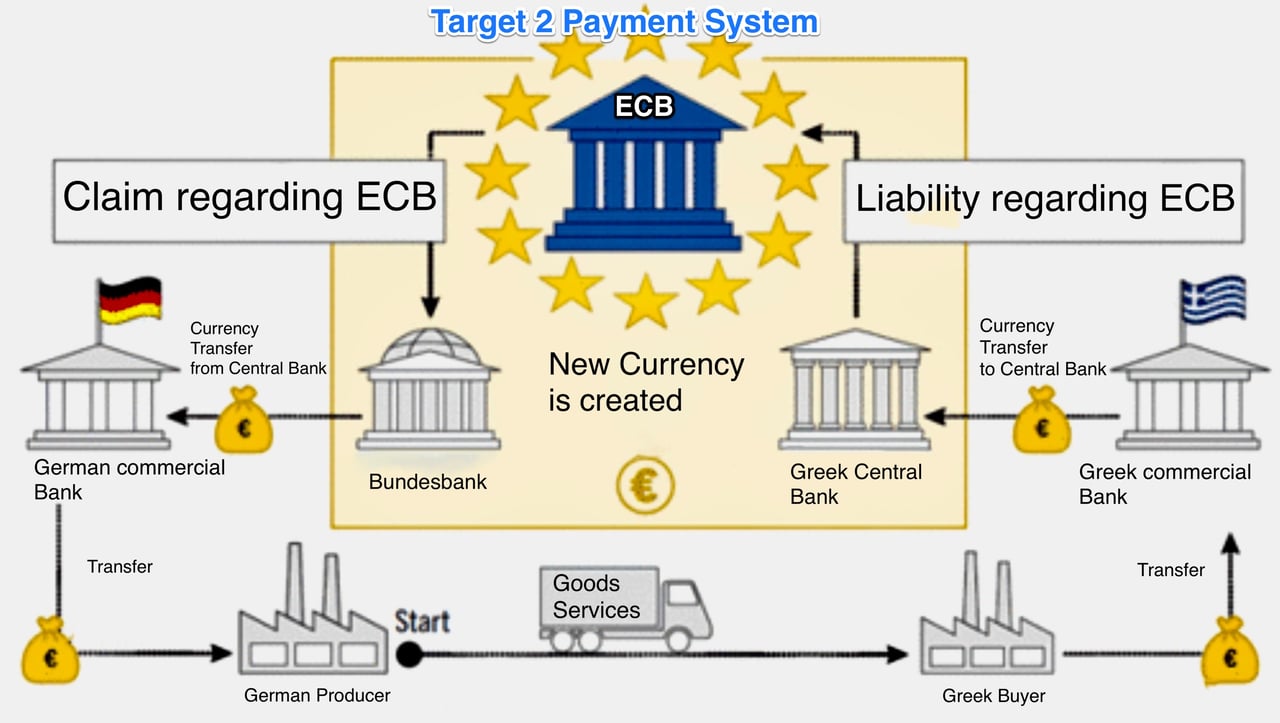

T2, T2S, and TIPS
These are payment and securities settlement systems operated by the Eurosystem, which comprises the European Central Bank (ECB) and the national central banks of the Eurozone countries. Each system has a specific function in the processing and settlement of transactions within the European financial market.
T2 (TARGET2):
T2 replaced TARGET2 (the second-generation Trans-European Automated Real-time Gross Settlement Express Transfer system) in March 2023. It combines a central liquidity management component with an RTGS service for high-value euro transactions between banks and other financial institutions. T2 is operated by the Eurosystem and settles transactions in central bank money, providing immediate finality and reducing settlement risk.
Key features of T2 include:
- Real-time processing and settlement of large-value euro transactions.
- Ensuring the stability, security, and efficiency of the European financial system.
- Facilitating the implementation of the Eurosystem’s monetary policy.
- Offering ancillary services such as liquidity management and collateral pooling.
- Providing a harmonized platform for payment processing across the Eurozone.
T2S (TARGET2-Securities):
TARGET2-Securities is a pan-European securities settlement platform that centralizes the settlement of securities transactions in Europe. It is operated by the Eurosystem and aims to improve efficiency, reduce fragmentation, and lower costs in the European post-trade environment.
Key features of T2S include:
- Centralized settlement of securities transactions in multiple currencies (mainly euro, but also other currencies such as the Danish krone).
- Harmonization of securities settlement practices across participating European countries.
- Facilitating cross-border settlement by connecting Central Securities Depositories (CSDs), which hold and settle securities transactions.
- Reducing the complexity and costs associated with cross-border settlement.
- Operating a delivery-versus-payment (DvP) mechanism, ensuring that securities are delivered only when the corresponding payment is made, which reduces counterparty risk.
TIPS (TARGET Instant Payment Settlement):
TIPS is a pan-European instant payment settlement service provided by the Eurosystem. It enables payment service providers to offer their customers instant euro payments, available 24/7/365, across the Single Euro Payments Area (SEPA).
Key features of TIPS include:
- Instant settlement of euro payments, with transactions usually completed within seconds.
- Availability of the service 24/7/365, facilitating real-time payments across Europe.
- Use of the SEPA Instant Credit Transfer (SCT Inst) scheme, which sets the rules, standards, and processes for instant payments.
- Settlement of transactions in central bank money, ensuring safety and security.
- Low transaction fees (EUR 0.002 per instant payment).
In summary, T2, T2S, and TIPS are essential components of the European financial infrastructure, each serving a specific purpose in the processing and settlement of transactions.
- T2 is a real-time gross settlement system for high-value euro transactions,
- T2S is a centralized securities settlement platform, and
- TIPS is an instant payment settlement service.
Together, they contribute to the stability, efficiency, and integration of the European financial market.
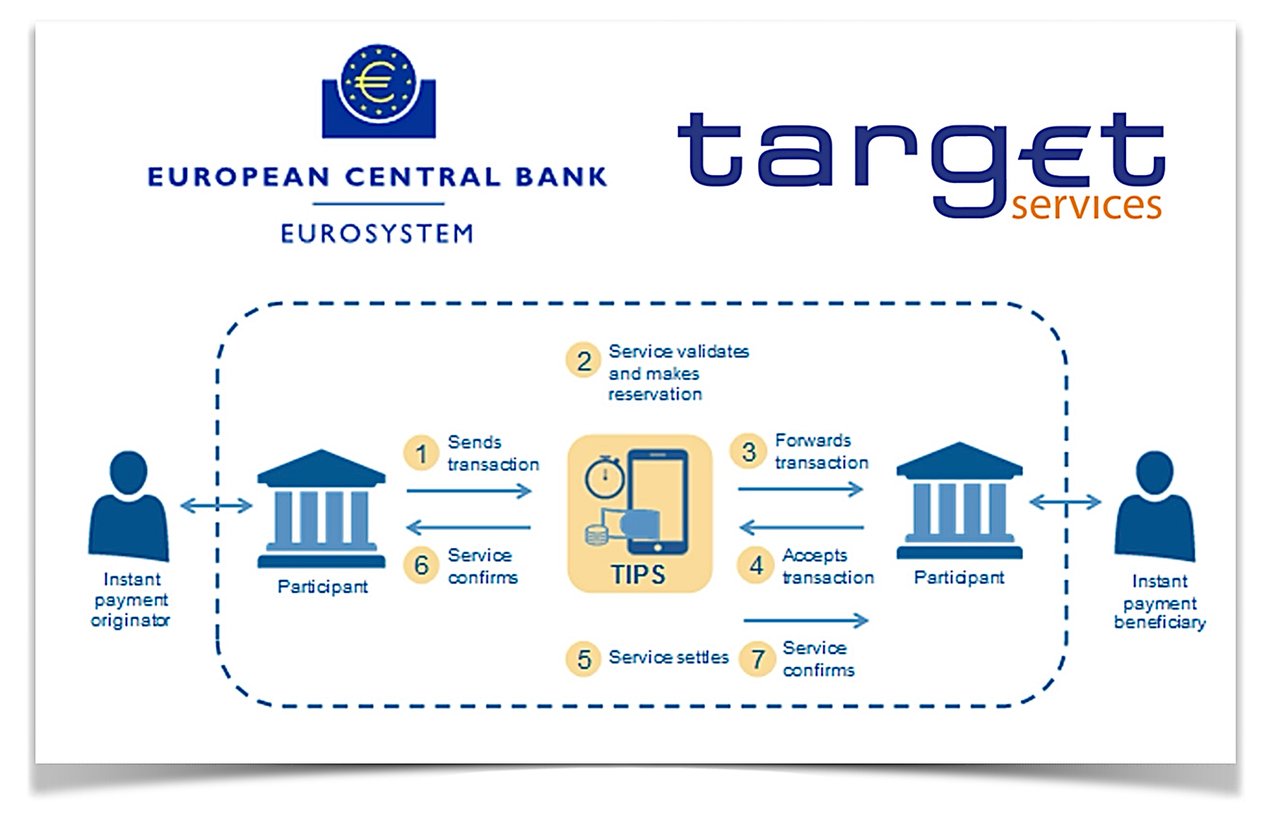
T2 (Target2) Payment System
T2 is a payment system that enables banks to transfer euros between each other in real time. This is known as real-time gross settlement (RTGS).
To understand what T2 is please review the video, for the manual and glossary, click on the link.
For transactions within the RTGS Systems extra fees will apply.
The Payment Identification Number (Payment ID)
in T2 is not a single number assigned by the system. Since the move to ISO 20022 in March 2023, payments are identified by the references the sender puts in the message – the Business Message Identifier, the Message Identification, the End-to-End Identification and, for credit transfers, the UETR. Participants use these references to track payments and to reconcile them against T2 notifications (camt.054) and statements (camt.053).
Legacy TARGET2 documentation (SSP, ICM, ECONS)
TARGET2 and its Single Shared Platform were replaced by T2 in March 2023. The documents below are kept for reference only.
or
- ICM Information and Control Module,
- ECONS Enhanced Contingency Solution
as well as
T2 is the Eurosystem’s real-time gross settlement (RTGS) system for processing large-value payments and time-critical transactions in euros. The Eurosystem comprises the European Central Bank (ECB) and the national central banks (NCBs) of the Eurozone countries. T2 is a crucial component of the European financial infrastructure.
Here’s an overview of how T2 operates:
- Participation: T2 is accessible to banks, central banks, and other eligible financial institutions within the European Union (EU) and the European Economic Area (EEA). Additionally, non-European institutions may access T2 through a European-based bank that acts as their correspondent.
- Real-time gross settlement: Similar to other RTGS systems, T2 processes and settles transactions individually, on a gross basis, and in real-time. This means that funds are transferred and settled immediately between the participating banks without any delay or batching of transactions.
- Central banks’ involvement: Banks participating in T2 hold their accounts with their national central bank (NCB). These central banks play a crucial role in facilitating the settlement of transactions through T2 by acting as the settlement agents.
- Single Shared Platform (SSP): T2 runs on a single technical platform for all participating banks and central banks. It is developed and operated on behalf of the Eurosystem by four central banks (the “4CB”): the Deutsche Bundesbank, the Banque de France, the Banca d’Italia and the Banco de España. Its predecessor, the TARGET2 Single Shared Platform, was run by the first three.
- Operating hours: T2 operates on all TARGET business days. The RTGS day-trade phase runs from 07:00 to 18:00 CET (06:00–17:00 UTC; one hour earlier in summer), with night-time settlement for ancillary systems.
- Messaging and communication: T2 uses ISO 20022 messages, exchanged through the Eurosystem Single Market Infrastructure Gateway (ESMIG) via network service providers such as Swift and Nexi-Colt. This standardized messaging format ensures the secure, efficient, and accurate exchange of payment information within the T2 system.
- Liquidity management: T2 provides tools for banks to manage their liquidity, such as collateralised intraday credit, standing facilities and liquidity transfers between accounts. This ensures the smooth functioning of the payment system and helps maintain financial stability within the Eurozone.
- Relationship with other payment systems: T2 operates alongside other payment systems, such as CHAPS, Fedwire, and CHIPS, which are used for large-value transactions in other currencies (e.g., British pounds, U.S. dollars). T2 also interfaces with TARGET2-Securities (T2S) for the settlement of securities transactions and with TIPS for instant payments.
In summary, T2 is the Eurosystem’s RTGS system for processing large-value payments and time-critical transactions in euros. It provides real-time gross settlement services to banks, central banks, and other financial institutions within the European Union and beyond. T2 plays a vital role in the European financial infrastructure, ensuring the secure, efficient, and rapid transfer of funds across the Eurozone.

How are direct debit operations performed in T2?
In T2, an interbank direct debit is a pull payment: the creditor participant debits the debtor participant’s account, on the basis of an authorisation the debtor has given in advance.
- Pre-authorisation: The debtor participant authorises the creditor (and its central bank) to debit its account, and may set limits per counterparty or overall.
- Instruction: The creditor sends an ISO 20022 financial institution direct debit (pacs.010) to T2. Under TARGET2 this was the Swift MT204.
- Settlement: T2 checks the authorisation, any limits and the available liquidity, then debits the debtor and credits the creditor in central bank money – immediately and with finality.
- Notification: Both participants receive notifications (camt.054) and see the booking in their statements (camt.053).
- Security: Participants must meet the Eurosystem’s endpoint-security requirements, which follow the CPMI strategy for reducing the risk of wholesale payments fraud (2018).
Our Electronic Settlement Accounts for large Volumes
Electronic settlement accounts facilitate the transfer of funds between different banks or financial institutions. The process often involves a central clearinghouse or a central bank that acts as an intermediary. Here’s a simplified explanation of how it technically works:
1. Transaction Initiation: Customer A from Bank X wants to transfer money to Customer B in Bank Y.
2. Message Formation: Bank X formats a secure electronic message (often using standards like ISO 20022 or SWIFT) that includes all the transaction details like amount, destination account, etc.
3. Message Transmission: The message is transmitted to a central clearinghouse or directly to the central bank, depending on the system in place.
4. Verification and Validation: The clearinghouse or central bank validates the message and ensures that Bank X has sufficient funds to complete the transaction.
5. Debit and Credit: Once verified, the clearinghouse debits the settlement account of Bank X and credits the settlement account of Bank Y.
6. Notification: Both banks are notified of the successful settlement, and Bank Y credits the amount to Customer B’s account.
7. Reconciliation: At the end of the day or another agreed period, banks reconcile their books to ensure all transactions are accounted for.
8. Archiving: Transaction records are archived for regulatory and auditing purposes.
9. Settlement Finality: Once the transaction is settled, it is irreversible.
The use of a central entity ensures trust, security, and smooth interoperability between different banking institutions.
RTGS-Systems in the world
Real-Time Gross Settlement (RTGS) systems are the backbone of the financial infrastructure for most countries, providing immediate settlement of high-value interbank transactions. The largest RTGS systems in the world are typically operated by the central banks of major economies. Some of these systems include:
- Fedwire (United States) – Operated by the Federal Reserve System
- T2 – Operated by the Eurosystem for the 21 euro area countries and connected non-euro central banks
- CHAPS (United Kingdom) – Operated by the Bank of England
- Bank of Russia Payment System (Russia) – Operated by the Bank of Russia
- RTGS (India) – Operated by the Reserve Bank of India
- BOJ-NET (Japan) – Operated by the Bank of Japan
- SIC (Switzerland) – Operated by the Swiss National Bank
- RITS (Australia) – Operated by the Reserve Bank of Australia
RTGS systems can be categorized based on different criteria, such as:
- Geographical coverage:
a. Domestic RTGS systems, serving a single country (e.g., Fedwire in the United States, RTGS in India) b. Regional or international RTGS systems, serving multiple countries (e.g., T2 in the Eurozone) - Currency used:
a. Single-currency RTGS systems, settling transactions in a single currency (e.g., Fedwire, which settles transactions in USD) b. Multi-currency settlement systems, such as CLS Bank International, which settles foreign exchange in 18 currencies on a payment-versus-payment basis (strictly speaking not an RTGS) - Type of participants:
a. Central bank-operated RTGS systems, which serve mainly banks and financial institutions (e.g., Fedwire, T2) b. Private-sector-operated large-value systems, usually based on netting (e.g., CHIPS in the U.S., EURO1 in the euro area) - Range of services:
a. RTGS systems focusing primarily on high-value interbank transactions (e.g., Fedwire, T2) b. RTGS systems offering additional services, such as securities settlement or retail payment services (e.g., BOJ-NET in Japan)

Other RTGS Systems
Real-time gross settlement (RTGS) is a type of electronic payment system that allows for the transfer of large sums of money between banks in real-time. RTGS is a high-value system that is typically used for large-value transactions, such as the transfer of funds between banks or the settlement of government securities.
One of the key benefits of RTGS is the speed at which it can process transactions. Because the system operates in real-time, funds are transferred almost immediately, allowing for a rapid settlement of transactions. This is in contrast to other types of payment systems, such as batch processing systems, which can take longer to settle transactions.
Another benefit of RTGS is its ability to handle high-value transactions. Because the system is designed to handle large sums of money, it is often used for the settlement of government securities and other high-value transactions. This makes it an important tool for maintaining the stability and efficiency of financial markets.
RTGS systems are operated by central banks or other financial institutions and are typically only available to financial institutions or other large organizations. In order to use an RTGS system, a financial institution must have an account with the central bank or other operating institution.
RTGS is the continuous process of settling payments on an individual order basis without netting debits with credits across the books of a central bank. Once completed, real-time gross settlement payments are final and irrevocable. In most countries, the systems are managed and run by their central banks.
Overall, RTGS is a fast and efficient way to transfer large sums of money between banks and other financial institutions. Its real-time processing and ability to handle high-value transactions make it an important tool for maintaining the stability and efficiency of financial markets
Other real-time gross settlement (RTGS) Systems like Fedwire, Sorbnet2, etc.:
RTGS systems:
Angola | SPTR (Portuguese: Sistema de pagamentos em tempo real; Real-time Payment System)
Argentina | MEP (Spanish: Medio electrónico de pagos; Electronic Means of Payment)
Azerbaijan | AZIPS (Azerbaijan Interbank Payment System)
Australia | RITS (Reserve Bank Information and Transfer System)
Bahrain | RTGS (Real Time Gross Settlement System)
Bangladesh | RTGS (Bangladesh Bank Payment Service Division)
Barbados | Central Bank Real Time Gross Settlement System (CBRTGS)
Bosnia and Herzegovina | RTGS
Belarus | BISS (Belarus Interbank Settlement System)
Bulgaria | T2 since euro adoption in January 2026 (previously RINGS)
Brazil | STR (Portuguese: Sistema de Transferência de Reservas; Reserves Transfer System)
Canada | Lynx (RTGS since 2021; replaced the net-settlement Large Value Transfer System)
China | China National Advanced Payment System (CNAPS), High Value Payment System (HVPS)
Chile | LBTR/CAS (Spanish: Liquidación Bruta en Tiempo Real; Real-time Gross Settlement)
Croatia | T2 since euro adoption in January 2023 (previously HSVP)
Czech Republic | CERTIS (Czech Express Real Time Interbank Gross Settlement System)
Denmark | T2 for Danish krone since 2025 (previously Kronos2)
Dominican Republic | LBTR (Spanish: Liquidación Bruta en Tiempo Real; Gross Settlement in Real Time)
Egypt | RTGS
Eurozone | T2
Fiji | FIJICLEAR
Hong Kong | Clearing House Automated Transfer System (CHATS)
Hungary | VIBER (Hungarian: Valós Idejű Bruttó Elszámolási Rendszer; Real-time Gross Settlement System)
Georgia | GPSS (Georgian Payment and Securities System)
India | RTGS
Indonesia | Sistem Bank Indonesia Real Time Gross Settlement (BI-RTGS)
Iran | SATNA (سامانه تسویه ناخالص آنی, Real-Time Gross Settlement System)
Iraq | RTGS (Real Time Gross Settlement System)
Israel | Zahav (Hebrew: זה”ב זיכויים והעברות בזמן אמת; Zahav Real-time Credits and Transfers)
Japan | BOJ-NET (Bank of Japan Financial Network System)
Jordan | RTGS-J
Kenya | Kenya Electronic Payment and Settlement System (KEPSS)
Korea | BOK-WIRE+ (The Bank of Korea Financial Wire Network, 한은금융망)
Kuwait | KASSIP (Kuwait’s Automated Settlement System for Inter-Participant Payments)
Lebanon | BDL-RTGS (Banque Du Liban – Real Time Gross Settlement)
Macedonia | MIPS (Macedonian Interbank Payment System) – North Macedonia
Macao | RTGS
Malawi | MITASS (Malawi Interbank Settlement System)
Malaysia | RENTAS (Real Time Electronic Transfer of Funds and Securities)
Mauritius | Mauritius Automated Clearing and Settlement System (MACSS)
Mexico | SPEI (Spanish: Sistema de Pagos Electrónicos Interbancarios; Interbank Electronic Payment System)
Morocco | SRBM (Système de règlement brut du Maroc; Moroccan Gross Settlement System)
Namibia | NISS (Namibia Interbank Settlement System)
New Zealand | ESAS (Exchange Settlement Account System)
Nigeria | CIFTS (CBN Inter-Bank Funds Transfer System)
Pakistan | RTGS (Real Time Gross Settlement System)
Paraguay | LBTR (Spanish: Liquidación Bruta en Tiempo Real; Gross Settlement in Real Time)
Peru | LBTR (Spanish: Liquidación Bruta en Tiempo Real; Gross Settlement in Real Time)
Philippines | PhilPaSS
Poland | SORBNET and SORBNET2
Qatar | Qatar Payment System (QPS)
Russia | Bank of Russia Payment System (replaced BESP)
Romania | ReGIS
Saudi Arabia | Saudi Arabian Riyal Interbank Express (SARIE)
Singapore | MEPS+ (MAS Electronic Payment System Plus)
South Africa | SAMOS (The South African Multiple Option Settlement)
Sri Lanka | LankaSettle (RTGS/SSSS)
Sweden | RIX (Swedish: Riksbankens system för överföring av kontoförda pengar)
Switzerland | SIC (Swiss Interbank Clearing)
Taiwan | CIFS (CBC Interbank Funds Transfer System)
Tanzania | Tanzania Interbank Settlement (TIS)
Thailand | BAHTNET (Bank of Thailand Automated High Value Transfer Network)
Turkey | EFT (Electronic Fund Transfer)
UAE | UAE Funds Transfer System (UAEFTS)
Ukraine | SEP (System of Electronic Payments of the National Bank of Ukraine)
United Kingdom | CHAPS (Clearing House Automated Payment System)
United States | Fedwire
Uganda | Uganda National Interbank Settlement (UNIS)
Zambia | Zambian Interbank Payment and Settlement System (ZIPSS)
Zimbabwe | Zimbabwe Electronic Transfer and Settlement System (ZETSS)
RTGS systems, as their name suggests, facilitate the real-time settlement of large-value and high-priority transactions between participating banks and financial institutions. These systems are typically operated by central banks, which act as the settlement agent to ensure the secure, efficient, and accurate transfer of funds.
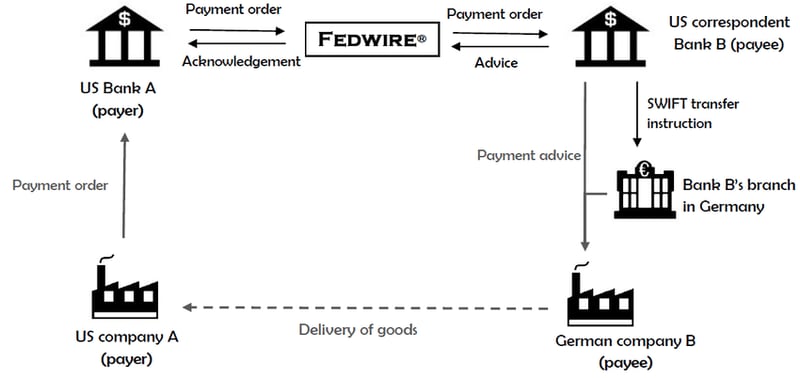
RTGS systems are domestic: each settles only its own currency, among participants holding accounts at its central bank. A cross-border payment therefore does not travel “from one RTGS to another”. It works as follows:
- Correspondent banking: Commercial banks hold accounts with each other (nostro and vostro accounts). A bank without direct access to a foreign RTGS uses a correspondent that has it.
- Messaging: The instructions travel between the banks over Swift, today in ISO 20022 format (pacs.008, pacs.009).
- Domestic legs: Each leg settles in the RTGS of its currency – for example Fedwire for US dollars and T2 for euros.
- FX settlement: Where currencies are exchanged, CLS can settle both legs simultaneously (payment versus payment) to remove settlement risk.
- Central banks: Central banks do not route their banks’ commercial payments. They provide the settlement accounts and, in some cases, swap lines or system links, such as TIPS settling euro, Swedish krona and Danish krone.
For Transactions within the RTGS Systems extra fees will apply.

Fedwire
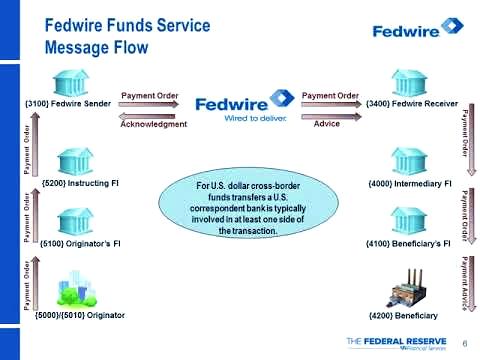
Fedwire, also known as the Fedwire Funds Service, is a real-time gross settlement (RTGS) system for large-value payments in the United States. It is operated by the Federal Reserve System, which is the central banking system of the United States. Fedwire enables participating banks and financial institutions to send and receive electronic funds transfers, typically for large-value transactions and time-critical payments, with immediate finality.
Here is an overview of how Fedwire operates:
- Participation: Fedwire is used by banks, credit unions and other depository institutions that hold an account with a Federal Reserve Bank, as well as the U.S. Treasury and certain government agencies.
- Real-time gross settlement: Unlike some other payment systems that use netting to reduce the number of transactions, Fedwire processes and settles each transaction individually on a gross basis, in real-time. This means that the funds are transferred and settled immediately between the participating banks, without any delay or batching of transactions.
- Immediate finality: Payments made through Fedwire are considered final and irrevocable once processed. This provides a high degree of certainty for participating institutions and helps reduce settlement risk.
- Operating hours: The Fedwire Funds Service operates 22 hours a day on business days, opening at 21:00 ET on the preceding calendar day and closing at 19:00 ET. This allows banks and financial institutions to send and receive payments throughout the business day.
- Security and risk management: Fedwire employs strong security measures and risk management practices to ensure the integrity and stability of the system. This includes net debit caps, fees and collateral for daylight overdrafts, and contingency sites. Fedwire observes the CPMI-IOSCO Principles for Financial Market Infrastructures.
- Relationship with other payment systems: Fedwire operates alongside other payment systems such as CHIPS and SWIFT. While Fedwire is focused on real-time gross settlement of large-value transactions, CHIPS is a private-sector system that employs netting to increase efficiency in clearing large-value payments, and SWIFT is a global messaging network that facilitates cross-border payment communication.
Until July 2025, Fedwire used its proprietary FAIM format, built from numbered “tags”. Since 14 July 2025, Fedwire Funds messages use ISO 20022 (for example pacs.008 for customer transfers and pacs.009 for bank transfers).Key components of a typical Fedwire Funds message include:
- Sender and receiver identification: This includes the American Bankers Association (ABA) routing numbers, also known as Routing Transit Numbers (RTNs), which are unique identifiers for the sending and receiving financial institutions.
- Type code: In the legacy format, a four-digit type/subtype code specified the kind of instruction, such as a basic transfer or a request for reversal; under ISO 20022 the message type itself carries this information.
- Amount: The transaction amount is specified in U.S. dollars, without any commas or other formatting characters.
- Sender’s reference: This is an alphanumeric code, usually up to 16 characters long, provided by the sending institution to identify the transaction uniquely.
- Business Function Code (BFC): This code specifies the purpose or nature of the transaction, such as a settlement payment, a trade payment, or an intra-company transfer.
- Beneficiary details: This includes the name and account number of the beneficiary (the ultimate recipient of the funds), as well as the beneficiary’s financial institution.
- Originator details: This includes the name and account number of the originator (the person or entity initiating the transfer) and their financial institution.
- Other information: Additional transaction-related information, such as remittance information, intermediary bank details, or special instructions, can be included as necessary.
Once a sending institution has prepared a message in the Fedwire Funds Format, it submits the message to the Federal Reserve via the Fedwire Funds Service. The Federal Reserve processes the payment instruction in real-time, and upon successful completion, sends a confirmation message to both the sending and receiving institutions.
In summary, Fedwire is an RTGS system operated by the Federal Reserve System that enables large-value, time-critical payments between participating banks and financial institutions in the United States. It processes and settles transactions individually on a gross basis, in real-time, and with immediate finality. Fedwire plays a crucial role in the U.S. financial system, ensuring the secure, efficient, and rapid transfer of funds between institutions.
Fedwire
Federal Wire Reference Number or Fed Number (IMAD/OMAD)
The Input/Output Message Accountability Data (IMAD/OMAD) system is, similar to the UETR number with SWIFT GPI, a decisive component in the field of electronic funds transfers facilitated by the Federal Reserve Bank Services, specifically through the FedWire Funds Service. This system assigns a distinctive IMAD or OMAD number to every wire transfer transaction. These unique identifiers are instrumental in ensuring the traceability, accountability, and thorough investigation of wire transfers.
An IMAD has 22 characters: the input cycle date (8 digits, YYYYMMDD), the input source (8 characters) and a sequence number (6 digits), for example 20251014ABCD1234000123.
1. Definition and Purpose:
- IMAD/OMAD: These acronyms stand for Input Message Accountability Data and Output Message Accountability Data, respectively.
- Uniqueness: Each IMAD or OMAD number is unique to a specific wire transfer, ensuring that each transaction can be individually identified and tracked.
- Traceability: These numbers facilitate the tracking of wire transfers throughout the payment process, from initiation to completion.
2. Structure:
The IMAD/OMAD number typically consists of three components that provide specific information about the transaction:
- Date (8 digits): The transaction date, which helps to identify the day on which the transaction was processed.
- Input Source (8 characters): A code that identifies the sender’s connection to Fedwire.
- Sequence Number (6 digits): A sequence number that makes the reference unique for that date and source.
3. Functionality:
- Tracking: Banks and financial institutions use IMAD/OMAD numbers to track the status of wire transfers, ensuring they are processed correctly and timely.
- Investigation: The unique nature of IMAD/OMAD numbers allows for efficient investigation of any discrepancies, tracking or issues that arise during the wire transfer process. This can include errors, delays, or suspected fraudulent activities.
- Dispute Resolution: In the event of a dispute, the IMAD/OMAD number can be referenced to provide a clear, indisputable record of the transaction details.
- Compliance: Financial institutions are required to maintain records of IMAD/OMAD numbers as part of their regulatory compliance obligations. This ensures that they can provide detailed reports and respond to inquiries from regulatory bodies or clients
- Auditing: These numbers are crucial during audits, allowing auditors to verify that all transactions have been accurately recorded and processed.

CHAPS
Clearing House Automated Payment System (CHAPS) operates within the Real-time Gross Settlement (RTGS) system of the Bank of England.
CHAPS is a high-value electronic payment system based in the United Kingdom that facilitates the instantaneous transfer of funds between participating financial institutions. It is designed for large-scale transactions, typically between banks, financial institutions, and corporations, and is used for a variety of purposes, such as settling financial market transactions, funding corporate loans, and managing treasury operations.
The CHAPS system operates within the Bank of England’s RTGS infrastructure, which is responsible for settling payments in real-time and on a gross basis, meaning that transactions are settled individually without netting or bundling them with other transactions. This helps to reduce the risks associated with settlement delays and financial gridlocks.
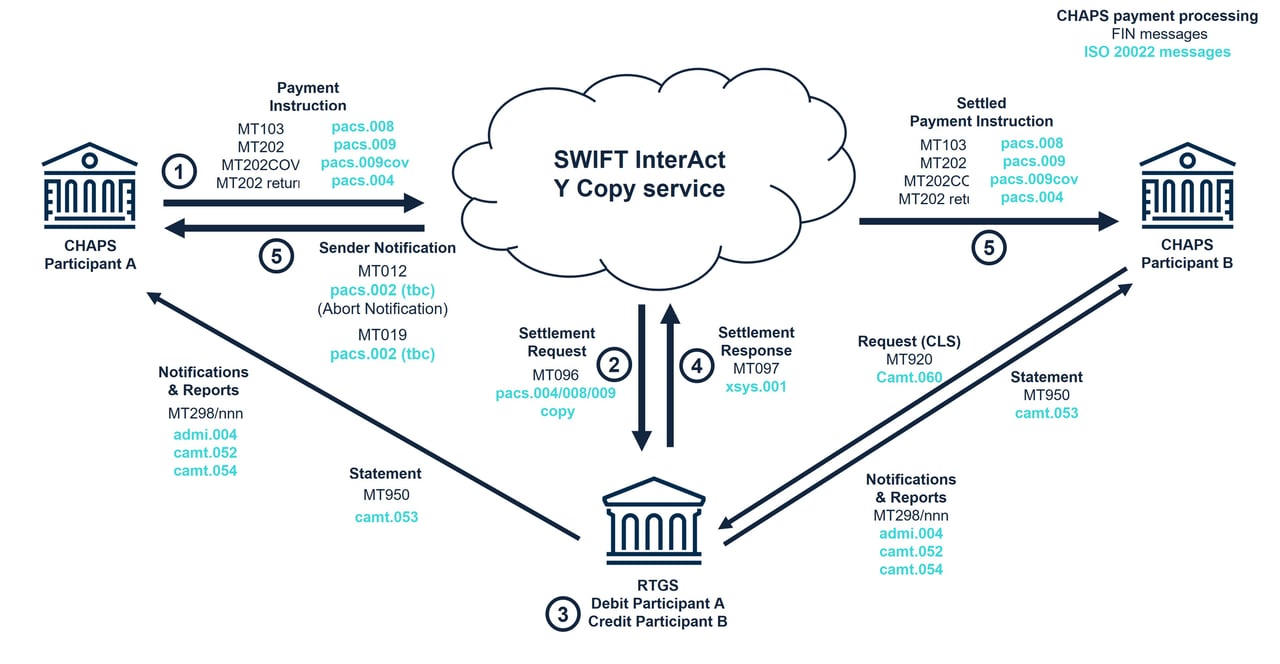
Here is a step-by-step description of how CHAPS operates within the RTGS system:
- Initiation: A CHAPS participant (usually a bank or other financial institution) initiates a payment on behalf of its customer or for its own account. The payment details are entered into the CHAPS system.
- Validation: The CHAPS system validates the payment details, ensuring that the necessary information is provided and accurate, such as the beneficiary account details, payment amount, and other relevant information.
- Transmission: Once validated, the payment message is sent over Swift. Using the Y-copy service, the Bank of England receives a copy and settles the payment before the full message is released to the beneficiary’s bank.
- Receipt: Settlement happens in the Bank of England’s RTGS system (see next step); only then does the beneficiary’s bank receive the payment message.
- Settlement: The Bank of England debits the sending bank’s settlement account and credits the receiving bank’s account in real time.
- Confirmation: After the settlement is completed, both the sending and receiving CHAPS participants receive confirmation messages, indicating that the transaction has been successfully processed.
- Reporting: CHAPS participants are required to maintain records of their transactions, which are subject to periodic auditing and reporting requirements.
The Bank of England has operated CHAPS directly since 2017, and CHAPS has used ISO 20022 since June 2023.

CNAPS II
The CNAPS, which means “China National Advanced Payment System” (中国现代化支付系统), is China’s central bank payment system; its High Value Payment System is the RTGS for renminbi.
CNAPS, whose High Value Payment System was launched by the People’s Bank of China (PBOC) in 2005 and upgraded to the second generation (CNAPS II) from 2013, is a critical payment and settlement infrastructure that enables the instant transfer of large-value funds between participating financial institutions within China.
CNAPS operates on a real-time and gross basis, meaning transactions are settled individually without netting or bundling them with other transactions. This system reduces the risks associated with settlement delays and financial gridlocks, ensuring that funds are transferred promptly and securely.
The China National Advanced Payment System (CNAPS) is primarily designed for domestic transactions within China. However, with the launch of the second-generation system, CNAPS II, cross-border payments and interactions with other RTGS systems around the world have become more efficient.
To facilitate transactions between CNAPS and other RTGS systems, the following processes are typically involved:
- Correspondent banking relationships: Banks in China and banks in other countries establish correspondent banking relationships. This means that a Chinese bank maintains an account with a foreign bank (and vice versa), enabling transactions between customers of both banks in their respective currencies.
- Nostro and Vostro accounts: These correspondent banking relationships involve maintaining Nostro and Vostro accounts. A nostro account (“our account with you”) is an account a bank holds with a foreign bank, usually in that foreign bank’s currency. A vostro account (“your account with us”) is the same account seen from the foreign bank’s side.
- Messaging systems: The Society for Worldwide Interbank Financial Telecommunication (SWIFT) serves as the primary messaging system for secure communication between financial institutions. Payment instructions and transaction details are exchanged between banks using standardized SWIFT messages.
- Settlement: Once the payment instruction is received and verified, the transaction is settled through the respective RTGS systems. The domestic bank will settle the transaction in the domestic currency using the domestic RTGS system (e.g., CNAPS), while the foreign bank will settle the transaction in the foreign currency using the foreign RTGS system.
- Currency conversion: If the transaction involves different currencies, a foreign exchange transaction will take place. The foreign exchange rate will be agreed upon by the involved banks, and the corresponding amount will be converted into the beneficiary’s currency before the final settlement.
- Confirmation and reporting: After the settlement is completed, both the sending and receiving banks receive confirmation messages, indicating that the transaction has been successfully processed. Banks are required to maintain records of their transactions, which are subject to periodic auditing and reporting requirements.
It is important to note that while CNAPS can interact with other RTGS systems through the processes mentioned above, the level of integration and interoperability can vary depending on regulatory frameworks, correspondent banking relationships, and the technological capabilities of the involved parties.
In recent years, there have been initiatives to enhance the integration and cooperation between CNAPS and other RTGS systems. For instance, China launched the Cross-border Interbank Payment System (CIPS) in 2015 for renminbi payments, and the PBOC has signed bilateral currency swap agreements with many central banks.
Overall, the interaction between CNAPS and other RTGS systems relies on correspondent banking relationships, established messaging systems like SWIFT, and foreign exchange transactions to facilitate cross-border payments and settlements. Efforts are ongoing to improve the efficiency, security, and interoperability of these systems in the global financial world.

SIC
The Swiss Interbank Clearing (SIC) payment system serves as the central payment system for Switzerland. Operational since June 10, 1987, it is managed by SIX Interbank Clearing Ltd (SIC Ltd) under the auspices of the Swiss National Bank. The primary participants of the SIC system include Swiss banks and other financial market entities.
In addition to large-value transactions, SIC also processes retail payments associated with services offered by financial market participants, such as bank transfers, card payments, and direct debits. The SIC system has experienced consistent growth since its inception, both in terms of transaction volume and the value of settled transactions.
For more information on the SIC system, refer to ‘The Swiss Interbank Clearing (SIC) payment system – Report on the SIC System and Disclosure Report,’ published jointly by the Swiss National Bank and SIC Ltd. The first section, titled ‘Report on the SIC system,’ provides details on the Swiss Interbank Clearing payment system. As a systemically important financial market infrastructure, the SIC system adheres to the CPMI-IOSCO Principles for financial market infrastructures (PFMI). The second section, ‘Disclosure Report on the SIC system,’ demonstrates the application of the relevant CPMI-IOSCO principles to the SIC system.
BOJ-NET
The Bank of Japan Financial Network System (BOJ-NET) is the Real-Time Gross Settlement (RTGS) system operated by the Bank of Japan. It serves as a critical component of the Japanese financial market infrastructure, enabling the safe and efficient settlement of Japanese Yen transactions among financial institutions in the country.
BOJ-NET facilitates the real-time settlement of large-value payments, such as interbank transfers, securities transactions, and central bank operations. Transactions are settled individually and in real-time, meaning that each payment is processed immediately and irrevocably, eliminating the risk of settlement delays or defaults.
Overview of how BOJ-NET operates:
- Transaction submission: Participant financial institutions submit their payment instructions to BOJ-NET, either directly or through a correspondent bank.
- Real-time processing: BOJ-NET processes payment instructions on a transaction-by-transaction basis. The system verifies the availability of sufficient funds in the sender’s account before approving the transaction. Once approved, the funds are transferred immediately and irrevocably from the sender’s account to the recipient’s account.
- Settlement finality: Settlement in BOJ-NET is final and irrevocable. Once a transaction has been processed, it cannot be reversed or modified. This feature provides a high level of certainty and reduces settlement risk for participating institutions.
- Continuous operation: BOJ-NET operates continuously during business hours, ensuring that payment instructions can be submitted and settled in real-time throughout the day. This allows financial institutions to manage their liquidity more effectively and helps maintain the stability of the Japanese financial system.
- Central bank oversight: The Bank of Japan oversees the operation of BOJ-NET, ensuring the system’s reliability, security, and compliance with regulatory requirements.
RITS
The Reserve Bank Information and Transfer System (RITS) is Australia’s RTGS system, operated by the Reserve Bank of Australia. It facilitates the real-time settlement of high-value Australian Dollar transactions between participating financial institutions. RITS also serves as the settlement system for other Australian payment systems, such as the High-Value Clearing System (HVCS) and the Bulk Electronic Clearing System (BECS).
RITS facilitates the real-time settlement of large-value payments, such as interbank transfers, securities transactions, and central bank operations. Transactions are settled individually and in real-time, meaning that each payment is processed immediately and irrevocably, mitigating the risk of settlement delays or defaults.
Overview of how RITS operates:
- Transaction submission: Participant financial institutions submit their payment instructions to RITS, either directly or through a correspondent bank.
- Real-time processing: RITS processes payment instructions on a transaction-by-transaction basis. The system verifies the availability of sufficient funds in the sender’s account before approving the transaction. Once approved, the funds are transferred immediately and irrevocably from the sender’s account to the recipient’s account.
- Settlement finality: Settlement in RITS is final and irrevocable. Once a transaction has been processed, it cannot be reversed or modified. This feature provides a high level of certainty and reduces settlement risk for participating institutions.
- Continuous operation: RITS operates continuously during business hours, ensuring that payment instructions can be submitted and settled in real-time throughout the day. This allows financial institutions to manage their liquidity more effectively and helps maintain the stability of the Australian financial system.
- Central bank oversight: The Reserve Bank of Australia oversees the operation of RITS, ensuring the system’s reliability, security, and compliance with regulatory requirements.
Large Value Payment Systems (LVPS)

EURO1 is a distinctive private-sector large-value payment system designed for the settlement of high-priority, same-day euro transactions across Europe. The system is primarily geared towards the processing of high-value, time-sensitive transactions, both domestically and cross-border.
Each payment is final when processed, while participants settle only their net balances in T2 at the end of the day.
Operating as a real-time gross settlement (RTGS)-equivalent net settlement system, EURO1 is classified as a systemically important payment system and is overseen by the European Central Bank.
EURO1 started operating with the introduction of the euro in January 1999, succeeding the ECU Clearing System. It is operated by EBA CLEARING; a collateralised liquidity pool held in T2 ensures that settlement completes even if a participant fails.

Continuous Linked Settlement (CLS) is a specialized global financial system designed to eliminate settlement risk in the foreign exchange (FX) market. Settlement risk, also known as Herstatt risk, arises when one party to an FX trade delivers the currency it sold but does not receive the currency it bought, often due to time-zone differences or counterparty default. CLS was established to address this risk and enhance the overall stability and efficiency of the global FX market.
CLS operates by using a payment-versus-payment (PVP) mechanism, which ensures that both sides of an FX transaction are settled simultaneously, eliminating the risk of one party not receiving its payment. Each instruction is settled gross, but members fund only their net position in each currency, which greatly reduces the liquidity required.
Overview of how CLS operates:
- Submission: Member banks submit their FX trades to CLS, which are then matched and confirmed within the system. Each member bank has a designated settlement member, which is responsible for settling the payment obligations arising from the submitted trades.
- Multilateral netting: CLS calculates the net payment obligations for each member bank and currency, taking into account both the purchases and sales of each currency. This process significantly reduces the overall volume and value of transactions that need to be settled.
- Settlement: Settlement members pay their net amounts into CLS Bank’s accounts at the participating central banks. CLS Bank then settles each trade by debiting and crediting both currency legs simultaneously on its own books, and pays out the resulting balances.
- Reporting: CLS provides member banks with real-time updates on the status of their submitted trades, as well as end-of-day reports detailing their settlement activity.
CLS is owned by its member banks. CLS Bank is regulated by the Federal Reserve and overseen by a committee of the central banks whose currencies it settles. It currently settles 18 currencies.

CHIPS
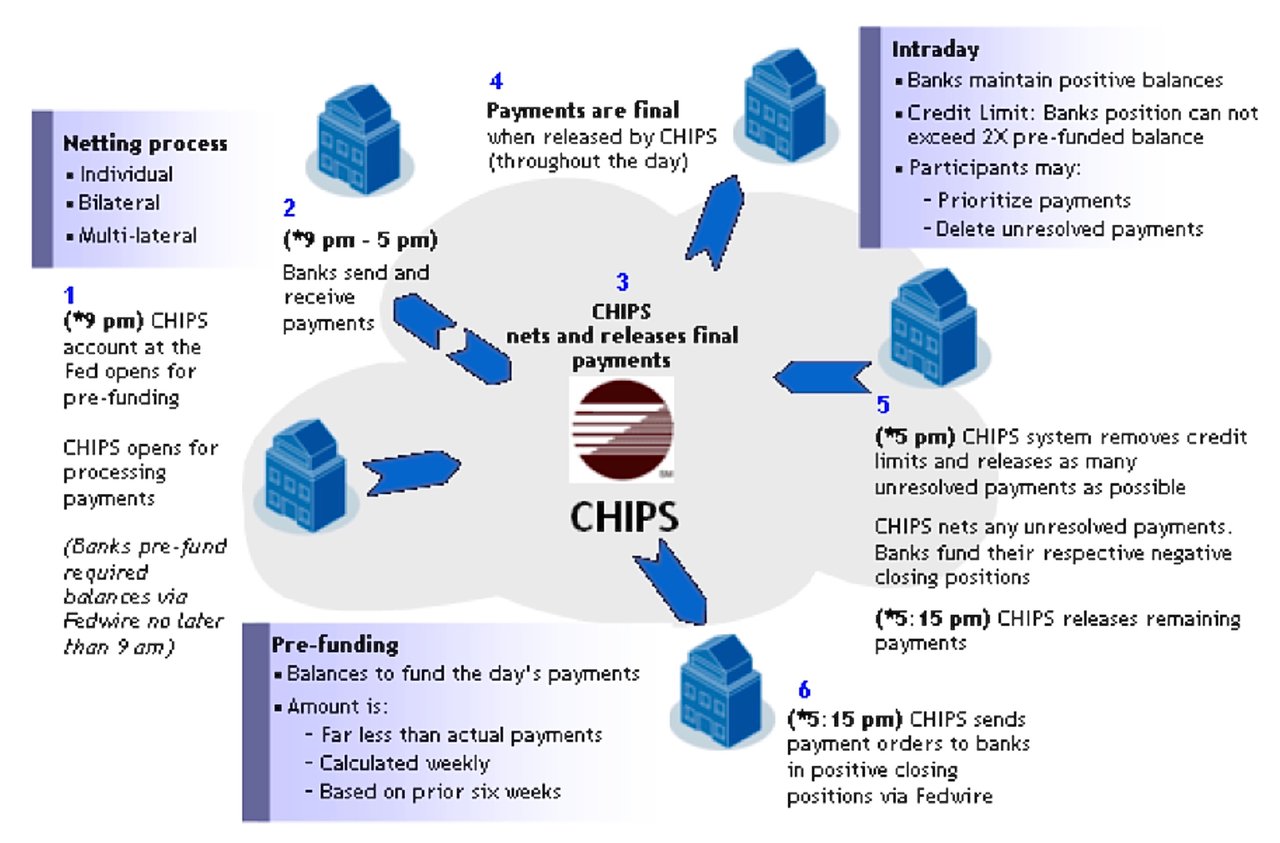
CHIPS (Clearing House Interbank Payments System) is a large-scale, private-sector United States Dollar (USD) clearing system that is operated by The Clearing House, a banking association and payments company owned by several large U.S. commercial banks. The system handles both domestic and international payments, clearing and settling an average of about USD 2 trillion per day in 2025. CHIPS plays a vital role in the smooth functioning of the U.S. and global financial systems by facilitating secure, efficient, and rapid interbank transactions.
The main features and operation of CHIPS can be summarized as follows:
- Fast and final payments: CHIPS releases payments continuously during the day against prefunded balances. A payment is final as soon as CHIPS releases it. This provides certainty and reduces risk for participating banks.
- Efficient liquidity savings mechanism: CHIPS employs a patented algorithm that matches and nets payments, significantly increasing the efficiency of the clearing process. Netting is a process where multiple transactions between two parties are offset against each other, resulting in a single net payable or receivable amount for each participant. This reduces the overall number of transactions to be settled, which in turn lowers the amount of liquidity (cash or cash equivalents) required to settle these transactions. This is particularly beneficial for banks, as it helps them manage their liquidity more effectively and reduces the need for costly intra-day borrowing.
- Participation and eligibility: CHIPS is a membership-based system open to banks with a regulated office in the United States. To participate in CHIPS, banks must meet specific eligibility criteria, including financial strength, operational capability, and regulatory compliance. The Clearing House is responsible for overseeing and ensuring the compliance of its members.
- Security and risk management: CHIPS has strong security measures and risk management practices in place to ensure the integrity and stability of the system. CHIPS is designated as a systemically important financial market utility and is supervised by the Federal Reserve.
- Complementary to other payment systems: CHIPS operates alongside other major payment systems, such as Fedwire, complementing their services and providing an alternative channel for large-value USD transactions. While Fedwire is a real-time gross settlement (RTGS) system operated by the Federal Reserve, CHIPS is a private sector system focused on netting transactions for increased efficiency.
In summary, CHIPS is a large-scale, private-sector clearing system for USD payments, both domestic and international. It provides fast and final payments, employs an efficient liquidity savings mechanism through a patented netting algorithm, and maintains high standards of security and risk management. CHIPS operates alongside other payment systems, serving as a crucial component of the U.S. and global financial infrastructure.

Similarities and differences between FED-wire and CHIPS transfers.
Both of these systems are essential to the functioning of the US financial system, facilitating the movement of large sums of money between banks and other financial institutions.
- FED-wire, or the Federal Reserve Wire Network, is a real-time gross settlement (RTGS) system operated by the Federal Reserve in the United States. It provides immediate, final, and irrevocable settlement of funds transfers between participating banks.
- CHIPS, or the Clearing House Interbank Payments System, is a privately owned and operated high-value payment system. It is owned by The Clearing House, which is a consortium of the largest US banks and some international banks. CHIPS is not a gross settlement system like Fedwire; it matches and nets payments continuously during the day against prefunded balances held at the Federal Reserve, with a final end-of-day closing.
Similarities between FED-wire and CHIPS:
- Both are electronic funds transfer systems used to facilitate large-value transactions between banks and financial institutions in the United States.
- Both are essential for the smooth functioning of the US financial system and are critical for maintaining the stability and efficiency of the US dollar as a reserve currency.
- Both systems are subject to regulation and oversight by relevant authorities, such as the Federal Reserve.
Differences between FED-wire and CHIPS:
Ownership and operation:
- FED-wire is operated by the Federal Reserve, the central bank of the United States, while CHIPS is owned and operated by a private consortium of banks (The Clearing House).
Settlement mechanism:
- FED-wire is a real-time gross settlement (RTGS) system, providing immediate and final settlement for each transaction. CHIPS, on the other hand, uses a liquidity-saving netting mechanism: payments are matched and offset against each other and released continuously.
Finality of transactions:
- Both systems provide finality: a Fedwire payment is final when settled, a CHIPS payment when released. CHIPS does not unwind payments.
Access:
- Access to FED-wire is generally limited to banks that have an account with the Federal Reserve, while access to CHIPS is limited to its member banks, which include both domestic and international financial institutions.
Volume and value of transactions:
- Fedwire settles a larger total value per day; CHIPS handles a large share of international US-dollar payments.
Use cases:
- While both systems are used for large-value transactions, FED-wire is commonly used for transactions like government securities settlements, and interbank transfers, while CHIPS is often used for international transactions, such as foreign exchange transactions and trade finance.
FED-wire and CHIPS are both essential components of the US financial system, playing crucial roles in facilitating large-value transactions. They share some similarities but have key differences in ownership, operation, and settlement mechanisms.



Next step
Request an introduction
Tell us in a few lines who you are and what you have in mind. Your enquiry goes directly to the bank and is treated in confidence.
Prefer to talk? Book a 30-minute videoconference.
If you want to know more about how to transfer funds through the RTGS system to your accounts with us, please get in contact with our Head of Central Bank Relations Henry Kofi.