
Anatomy of the “Visa Direct Developer” Sandbox Scam
The entire scam is predicated on a deliberate and deceptive conflation of two fundamentally distinct things: the “Visa Direct Developer” sandbox environment and the actual Visa Direct production payment network.
Fraudsters exploit the term “Visa Direct Developer” (which merely refers to a free-access, simulated testing environment provided by Visa for software developers) as if it were equivalent to the real Visa Direct rail, which is the licensed, regulated infrastructure used by banks and payment institutions to move actual funds across the VisaNet system.
In reality, the Visa Direct Developer portal has absolutely no technical, financial, or operational connection to VisaNet. It cannot access live funds, initiate real transactions, or interact with any real payment card or banking system. The entire environment is a sandbox, a software simulator, designed exclusively for testing code. Every transaction “sent” within that environment returns hardcoded, pre-fabricated responses in JSON format, entirely fictitious, for the sole purpose of assisting programmers with software integration.
No real money is ever moved, no transaction reaches a live card or account, and no identifier shown in the sandbox exists on any real Visa system.
Thus, any individual claiming to have already “sent funds” using Visa Direct Developer, especially while showing screenshots from the developer portal or JSON output containing fields such as “transactionIdentifier”, is unequivocally presenting fake information. It is a fraudulent tactic designed to mimic legitimate fund flows, when in fact no payment has ever been made, nor could it be. The sandbox is no more connected to the financial system than a calculator app is connected to your bank account.
Below is a forensic walk-through of how fraudsters weaponise that misunderstanding.
| Phase | Fraudster’s tactic | Why it looks plausible | What actually happens |
|---|---|---|---|
| 1 – Set-up | Registers a developer account (no licence, no due-diligence) and generates sample API keys & test card numbers. | Anyone can do this in minutes, lending an aura of legitimacy. | Sandbox keys are isolated from the live network; no funds can move. |
| 2 – Fake “Proof of Funds” | Runs a PushFunds call in the sandbox, captures the HTTP 200 OK response and the fabricated transactionIdentifier. Presents these as screenshots or PDF “receipts”. | The response payload looks identical to a live Original Credit Transaction (OCT). | The identifier exists only inside the sandbox database; it is never propagated to Visa Net. |
| 3 – Trigger the victim’s commitment | Claims that the funds are “already en-route but pending compliance” and demands an advance fee (tax, release charge, AML clearance, etc.). | Victim can verify the PAN in the payload belongs to his card; the JSON confirms the exact amount: potent psychological proof. | No acquiring BIN in the call is live, so the payment can never clear. |
| 4 – Delay & excuses | Cites “cross-border throttling”, “Visa queue backlog” or “receiving bank not Visa-Direct-enabled” to buy time after fees have been paid. | Technical jargon obfuscates the issue, and the victim lacks the schema knowledge to refute it. | Eventually communication ceases or the fraudster requests further payments. |
Red Flags
| Indicator | Why it is impossible in production |
|---|---|
| “Sent via Visa Direct Developer from our treasury” | Developer portal ≠ live push-payment rail. |
| Screenshots show test Acquiring BIN (normally 4 × 0 or 4 × 9) | Test BINs are never routable over Visa Net. |
| No licensed sponsor/acquirer named; sender is an individual or obscure LLC | Visa mandates acquirer sponsorship before any project moves to production. |
| Up-front “release” fee required | Classic advance-fee fraud pattern; legitimate OCTs reach the beneficiary without extra victim charges. |
How to Verify Authenticity (Technical Checklist)
- Request the live Original Credit Transaction (OCT) record from the sender’s acquirer; it will not exist.
- Ask your issuing bank whether a matching Visa transaction identifier exists on the live network; a sandbox identifier will not.
- Inspect the BIN in the acquiringBin field: values such as 408999, 000000 or anything unmatched in the public BIN database indicate test data.
- Ask your issuing bank or the sender’s acquirer to confirm whether the transactionIdentifier exists on the live network.
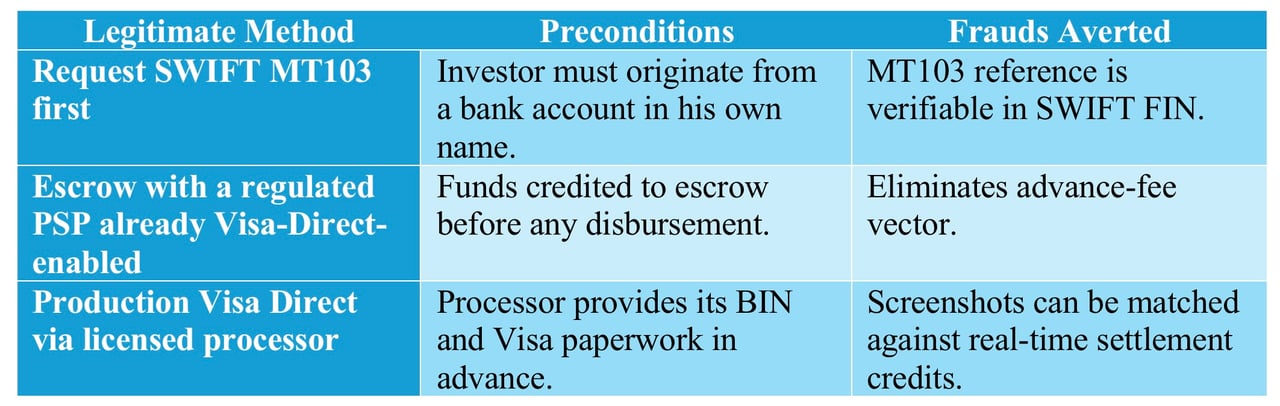
Mitigation & Alternative Secure Paths
Executive One-Liner
If a counter-party claims to “have sent money through Visa Direct Developer” and supports the claim with sandbox screenshots, treat it as definitive evidence of an advance-fee fraud: the sandbox is a demonstrator, not a payments rail, and no funds can ever arrive.



Next step
Request an introduction
Tell us in a few lines who you are and what you have in mind. Your enquiry goes directly to the bank and is treated in confidence.
Prefer to talk? Book a 30-minute videoconference.