The architecture of modern money
Off-balance sheet mechanics, money creation and the final Basel framework
Contents: 1. How banks create money · 2. When contingent becomes actual · 3. Central bank money · 4. Hidden leverage and 2008 · 5. The final Basel framework · 6. The output floor and shadow banking · 7. What this means for IFB
When a company draws on its credit line, the money does not come from a vault. It comes from a keystroke: the bank books a loan as an asset and a deposit as a liability, and both its balance sheet and the money supply grow. This conversion of off-balance sheet commitments into on-balance sheet positions is the engine of modern credit creation, and the final Basel framework (known as Basel IV, or the Basel III Endgame in the United States) examines it more closely than any rule in a generation.
The stakes go beyond accounting. According to the Financial Stability Board’s December 2025 report, non-bank financial intermediation has grown to $256.8 trillion, 51% of global financial assets, and its links with banks were tested in the March 2020 dash for cash, the Archegos collapse in 2021 and the UK LDI crisis of 2022. Knowing how contingent exposures become real obligations, creating money and sometimes concentrating risk, is now basic knowledge for any serious market participant.
1. How banks create money
In 2014 the Bank of England set out what many textbooks still miss: commercial banks do not simply pass savers’ money on to borrowers. They create money by lending. In 2017 the Deutsche Bundesbank put it plainly: “banks can create book money just by making an accounting entry.”
The entries are symmetrical. The loan is an asset, a claim on the borrower; the new deposit is a liability, an obligation to the depositor. Both sides grow by the loan amount. No prior deposit is needed, and no reserve constrains the loan when it is made. When the Bank of England wrote its paper, about 97% of the money held by the UK public consisted of bank deposits created in this way rather than notes and coins.
A committed credit facility is therefore latent money: it does not exist yet, but appears the moment the borrower draws. Unused commitments at US banks run to several trillion dollars, each a potential addition to the money supply, depending on borrower behaviour and the terms of the facility. In March and April 2020 companies drew roughly half a trillion dollars on their credit lines within weeks. That was not existing money changing hands; it was new deposits, created as off-balance sheet promises became on-balance sheet loans.
2. When contingent becomes actual
The conversion happens through several channels, each with its own risk and regulatory treatment.
Drawdowns. When a borrower draws on a revolving facility, a commitment disclosed only in the notes becomes a loan on the balance sheet, matched by a new deposit. In 2008–09 commercial and industrial loans on US bank balance sheets rose while new originations fell, largely because borrowers drew on existing lines.
Guarantees. A standby letter of credit or financial guarantee remains a contingent liability until the customer defaults and the beneficiary calls it. The bank then pays, books a receivable of uncertain value against the defaulted customer, and needs cash or new credit to do so.
Derivatives. IFRS and US GAAP already put derivatives on the balance sheet at fair value. Regulation adds two measures: replacement cost (today’s mark-to-market) and potential future exposure over the remaining life of the contract. Daily variation margin turns potential exposure into cash; initial margin creates collateral positions on the balance sheet.
Credit conversion factors. For capital purposes, regulators translate off-balance sheet amounts into credit-equivalent exposures with prescribed credit conversion factors (CCFs). The final framework recalibrates them as follows:
| Off-balance sheet item | Credit conversion factor |
|---|---|
| Unconditionally cancellable commitments | 10% |
| General commitments | 40% |
| Short-term trade letters of credit | 20% |
| Transaction-related contingencies | 50% |
| Direct credit substitutes (SBLCs, guarantees) | 100% |
| All securitisation exposures | 100% |
Two changes stand out. Unconditionally cancellable commitments, previously at 0%, now carry 10%, because a bank that may cancel a line in law often cannot do so in practice without damaging the relationship or breaching consumer protection rules. Other commitments carry a single 40%, replacing the former 20% (up to one year) and 50% (over one year), a calibration drawn from crisis periods in which drawdowns far exceeded earlier assumptions.
3. Central bank money
Central banks create money differently, though the two systems interlock through reserves and monetary policy. When a central bank buys government bonds from a pension fund under quantitative easing, two things happen: the pension fund’s bank credits its account with a new deposit (broad money), and the central bank credits reserves to that bank (base money). The central bank’s balance sheet grows on both sides. The new reserves do not multiply mechanically into new loans; they are settlement balances between banks. As the ECB puts it, it “does not actually print new banknotes to purchase these assets, but rather creates money electronically in the form of bank reserves.”
The difference matters for regulation. Central bank money carries no default risk in its own currency. Commercial bank money is a claim on an institution whose solvency depends on its loan book, its capital and its funding. Deposit insurance and capital requirements exist to keep commercial bank deposits convertible into central bank money at par.
4. Hidden leverage and the lessons of 2008
“Incognito leverage” describes off-balance sheet structures that keep reported leverage low while risk builds up, to be revealed only under stress. Before 2008, structured investment vehicles (SIVs) financed some $400 billion of largely mortgage-related assets with thin capital, funding long-term assets with short-term asset-backed commercial paper. When that market froze after BNP Paribas suspended three funds on 9 August 2007, sponsoring banks had to take the assets back onto their balance sheets, consuming capital just when it was most needed. Lehman Brothers ran leverage above 30 to 1 before its failure, helped by the SEC’s 2004 change to net capital rules and by derivatives and mortgage holdings that obscured its exposures. The lesson: leverage hidden off the balance sheet comes back to the sponsor at the worst possible moment.
Today’s rules respond on several fronts. The Basel III leverage ratio sets a non-risk-based minimum of 3% Tier 1 capital against on- and off-balance sheet exposures, with off-balance sheet items converted at no less than 10%. Global systemically important banks hold an additional leverage buffer of half their risk-based G-SIB surcharge. The output floor limits how far internal models can reduce risk-weighted assets, and consolidation rules stop sponsors from keeping vehicles off the balance sheet while retaining control or exposure.
5. The final Basel framework
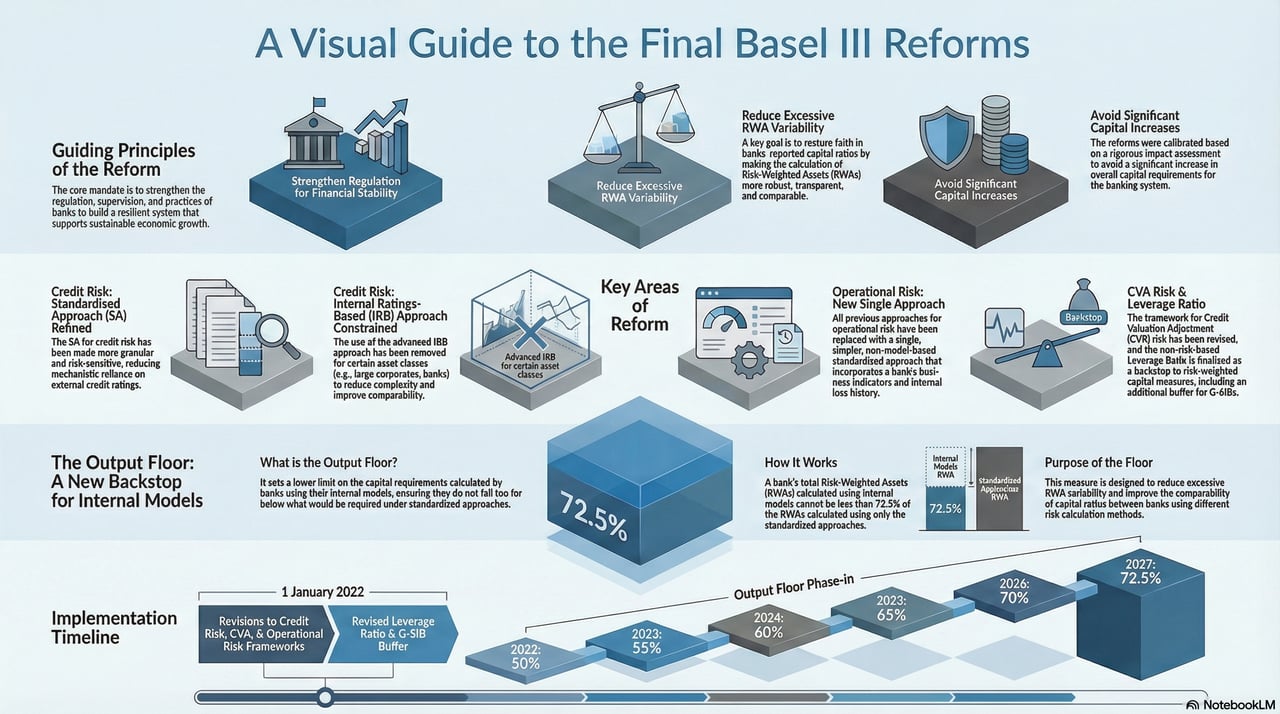
Formally the finalisation of Basel III, this framework is the broadest recalibration of capital rules since 2010. If the original Basel III was emergency repair, this is a revision of the building code, informed by a decade of experience of where stress concentrates and how it spreads. In the United States the agencies re-proposed their version in March 2026; the final rule is still pending.
Credit risk. The use of internal models is restricted in favour of a more risk-sensitive standardised approach:
- Bank exposures no longer receive a uniform weight. Where external ratings cannot be used, banks are graded A, B or C by capital adequacy and buffer compliance; well-capitalised Grade A banks attract lower weights.
- Real estate weights depend on the loan-to-value ratio, and differ according to whether repayment depends materially on the cash flows of the property itself.
- Subordinated debt and capital instruments other than equity are weighted at 150%, against 100% under most earlier standards.
Operational risk. The Advanced Measurement Approach is abolished. A single standardised approach combines the Business Indicator, a financial-statement proxy for the volume of interest, lease, dividend and fee business, with the Internal Loss Multiplier, which scales the requirement by the bank’s own losses over the preceding ten years. Banks with higher losses hold more capital.
Market risk and CVA. The Fundamental Review of the Trading Book replaces value at risk with expected shortfall, which captures tail losses in severe stress better. A revised framework for credit valuation adjustment (CVA) risk covers losses from changes in counterparties’ credit spreads on derivatives.
6. The output floor and shadow banking
The output floor. To reduce the wide variation in risk-weighted assets between banks, the framework sets an output floor: requirements calculated with internal models may not fall below 72.5% of the standardised result. Under the Basel timetable the floor is phased in from 2023 and reaches 72.5% on 1 January 2028; the European Union applies a longer transition, reaching 72.5% in 2030.
Shadow banking. Non-bank intermediaries perform credit and maturity transformation without formal access to central bank liquidity, and remain a source of fragility. Bank lending and committed lines to these entities have grown markedly over the past decade, creating channels through which stress can pass in both directions. The framework requires banks to hold adequate capital against the liquidity backstops and credit lines they provide, so that a run in the shadows does not destabilise the core.
7. What this means for IFB
For IFB these rules are a specification, not a hurdle. Where corporate leverage is high, interest-rate changes act more strongly on investment across the economy, and a bank’s liquidity and capital must be able to absorb that. We apply strict due diligence and Basel capital standards so that we can support clients throughout the cycle.
The framework calls for decisions, not mechanical compliance:
- Capital allocation matters more as the output floor limits the benefit of internal models.
- Business model: different capital charges change the relative pricing of lending.
- Operational risk requires better collection and analysis of loss data.
- Exposure to non-banks calls for closer due diligence as supervisory scrutiny increases.
In short. If Basel III was the safety code for a skyscraper, the final framework is the inspection that checks the foundation is equally thick on every floor, including the hidden parts that some builders once skimped on. The conversion of off-balance sheet commitments into on-balance sheet positions is how modern banking creates money and, under stress, how latent risk becomes real. The framework’s logic is simple: leverage should be visible, not concealed; capital should be demonstrated, not merely modelled; and links to non-banks should be managed explicitly. IFB builds those principles into its planning, its risk appetite and its allocation of capital.