
Corporate Products
Structured Instrument Finance
Instrument-Supported Financing
Businesses frequently approach International Finance Bank believing that a bank guarantee, standby letter of credit or similar financial instrument represents an immediately realisable financial asset. This assumption has become widespread through years of misleading internet advertising promoting so-called “monetisation programmes”, “leased SBLCs” and promises of instant liquidity.
The reality within institutional banking is considerably different.
A financial instrument is not money. It is a contractual undertaking issued by a financial institution under defined legal conditions. Whether that undertaking has any commercial financing value depends not only upon the document itself, but upon the issuing institution, the governing law, the underlying commercial transaction, the rights of the beneficiary, market conditions and the willingness of a financial institution to accept the associated risks.
For this reason, International Finance Bank does not operate a standardised “monetisation programme”. Every proposed transaction is analysed individually and subjected to an extensive legal, commercial, operational and regulatory assessment before any financing structure can even be considered.
In many cases the conclusion is that the instrument, although genuine, is unsuitable for financing. Authenticity alone is never sufficient.
The principal question is therefore not whether an instrument exists, but whether it is capable of supporting a legitimate financing transaction under accepted banking practice.
International Finance Bank approaches every proposal from the perspective of a credit institution rather than a broker. Our objective is not to purchase documents, but to determine whether a financial instrument can prudently enhance the credit quality of a wider commercial transaction.
Where appropriate, a qualifying instrument may contribute to structured trade finance, project finance, working capital facilities or other institutional financing arrangements. The instrument itself does not become cash. Rather, it may strengthen the overall credit profile of a transaction, allowing the Bank to evaluate financing that would otherwise not be commercially acceptable.
This distinction is fundamental. Guarantees support credit. They are not themselves a substitute for credit.
Every proposal therefore begins with full due diligence.
The Bank first establishes the identity and legitimacy of the applicant, the beneficial ownership of the transaction and the commercial purpose for which financing is requested. Particular attention is paid to the underlying economic activity. Financing is intended to support genuine business, not speculative financial engineering.
Once the commercial background has been understood, the Bank independently examines the financial instrument itself. This process includes verification of the issuing institution, analysis of legal enforceability, assessment of transferability where relevant, review of applicable rules and governing law, operational feasibility, regulatory considerations and the overall credit standing of the issuer.
Independent verification forms an essential component of this process. International Finance Bank does not rely solely upon documentation supplied by applicants, intermediaries or brokers. Whenever appropriate, information is verified directly through banking channels or other reliable institutional sources.
Only after satisfactory completion of legal, compliance, operational and credit review does the Bank consider whether a commercially viable financing structure exists.
Even where an instrument is authentic, financing may nevertheless be declined. Commercial feasibility depends upon numerous factors extending well beyond the document itself, including jurisdictional risk, enforceability, liquidity considerations, market appetite, sanctions exposure, regulatory restrictions and the Bank’s own internal risk policies.
For this reason, International Finance Bank cannot indicate in advance whether any particular instrument will qualify for financing, nor can advance rates or financing structures be discussed before due diligence has been completed.
Prospective clients should exercise considerable caution regarding organisations claiming that every bank guarantee or standby letter of credit can automatically be “monetised” at predetermined percentages of its face value. Such representations bear little resemblance to established banking practice. Responsible financial institutions evaluate each transaction individually. They do not purchase financial instruments solely because they exist, nor do they promise funding before completing independent analysis.
International Finance Bank likewise does not participate in schemes involving leased financial instruments, purported non-recourse monetisation programmes, broker-driven funding structures, private placement programmes lacking genuine commercial substance or similar arrangements that are inconsistent with prudent banking practice.
Our objective is straightforward: to determine whether a proposed transaction is legally sound, commercially justified, operationally feasible and consistent with responsible institutional banking.
Where these conditions are satisfied, International Finance Bank will work closely with the client to structure an appropriate financing solution. Where they are not satisfied, the Bank will decline the proposal irrespective of the nominal value of the instrument presented.
This disciplined approach protects not only the Bank, but also legitimate clients seeking professional banking services based upon transparency, sound risk management and internationally recognised banking standards.
Instrument-Supported Financing (“Monetisation”)
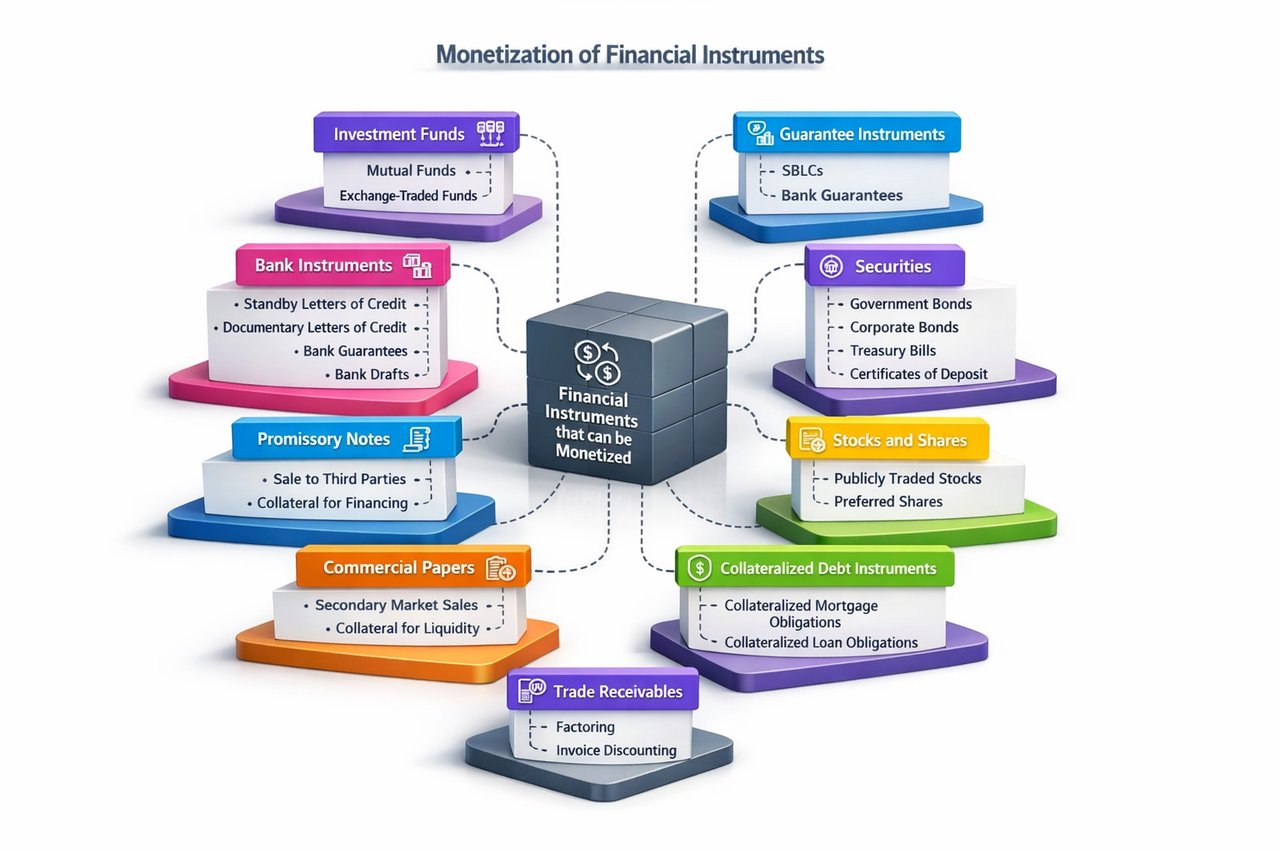
The term monetisation is widely used in commercial finance to describe the process of converting an asset or financial instrument into liquidity. In practice, however, the term is often used imprecisely. Many transactions described as “monetisation” are, in reality, outright sales, redemptions, collateral-supported lending, securities financing or structured credit facilities. From a banking perspective, these distinctions are important because each type of transaction is governed by different legal, commercial and regulatory considerations.
International Finance Bank therefore does not operate a generic “monetisation programme”. Instead, every proposed transaction is assessed individually to determine whether a particular asset or financial instrument may legitimately support a financing transaction. The existence of an instrument alone does not create an entitlement to financing. Authenticity, legal enforceability and commercial value are necessary but not sufficient conditions. The Bank evaluates the entire transaction, including the client, the underlying commercial purpose, the issuing institution, regulatory requirements and the Bank’s own credit and risk policies.
The following overview describes the principal categories of assets and financial instruments that may, under appropriate circumstances, be converted into liquidity or support financing.
Bank Instruments
Bank-issued instruments are among the most frequently misunderstood financial products. A Standby Letter of Credit (SBLC), Bank Guarantee (BG) or Documentary Letter of Credit (DLC) is not cash, nor is it a negotiable investment security. These instruments represent contractual undertakings issued by banks under specific legal conditions. Their primary purpose is to support commercial transactions by providing payment assurance or credit enhancement rather than serving as independent funding instruments.
An irrevocable and unconditional demand Standby Letter of Credit issued by a bank of recognised standing, such as a Global Systemically Important Bank (G-SIB), with an investment-grade long-term rating may, in limited institutional circumstances, be accepted as collateral supporting a separately underwritten financing facility. The financing is extended against the overall credit quality of the transaction rather than by “purchasing” or “cashing” the SBLC itself. Performance-related, project-specific or conditional SBLCs are generally unsuitable for such purposes.
Similarly, certain clean, unconditional demand Bank Guarantees issued by highly rated banks may occasionally be recognised as collateral supporting structured financing. By contrast, performance guarantees, advance payment guarantees and other contract-specific guarantees are generally unsuitable because their value depends upon performance under the underlying contract.
Documentary Letters of Credit serve an entirely different function. They facilitate international trade by securing payment against compliant shipping documents. Financing associated with documentary credits forms part of established trade finance and may include pre-shipment finance, post-shipment finance, discounting of accepted drafts or confirmation facilities. Such financing remains inseparable from the underlying commercial transaction and does not constitute monetisation of the Letter of Credit itself.
Bank Drafts likewise do not constitute financing instruments. They represent immediately payable payment instruments and are ordinarily redeemed or cleared at face value rather than financed.
Government and Corporate Securities
Marketable securities issued by sovereign governments and highly rated corporations constitute one of the most established forms of collateral within international financial markets. Government bonds, Treasury Bills, Bubills, BTFs and comparable sovereign debt instruments may be sold in the secondary market or pledged as collateral supporting secured borrowing. Their liquidity, valuation and financing terms depend upon market conditions, residual maturity, issuer creditworthiness and applicable collateral policies.
Corporate bonds issued by investment-grade borrowers may similarly be sold or pledged, although financing terms reflect issuer quality, market liquidity and prevailing credit spreads.
Certificates of Deposit issued by regulated banks normally mature into cash at redemption. Depending upon the contractual terms, certain certificates may also serve as collateral for secured lending.
Listed Equity Securities
Publicly traded shares may readily be converted into liquidity through sale on recognised securities exchanges. They may also support margin lending or securities-backed credit facilities, subject to lender-specific eligibility criteria, collateral haircuts and concentration limits. Preferred shares are assessed according to the same principles, although their liquidity and market acceptance may differ from common equity.
Negotiable Debt Instruments
Certain negotiable promissory notes and commercial paper issued by sovereigns, regulated financial institutions or investment-grade corporate obligors may support financing or be sold within established secondary markets. Privately issued promissory notes lacking institutional credit quality or marketability generally possess little or no collateral value and are rarely accepted by regulated financial institutions.
Structured Credit Products
Structured credit instruments, including Collateralised Mortgage Obligations (CMOs), Collateralised Loan Obligations (CLOs) and similar securitised products, may support financing through secondary market sale or secured borrowing. Their valuation depends upon the quality of the underlying asset pool, market liquidity, credit ratings, structural complexity and applicable regulatory capital treatment. Because of these factors, financing against structured products frequently involves conservative collateral margins.
Investment Funds
Units in regulated investment funds represent another category of financial assets capable of generating liquidity. Open-ended mutual funds ordinarily provide liquidity through redemption with the fund manager, whereas closed-end funds and Exchange-Traded Funds (ETFs) may be sold on recognised securities markets. In certain circumstances these investments may also support collateralised lending.
Life Insurance Policies
Whole-life insurance policies possessing a demonstrable cash surrender value may provide liquidity through policy loans or surrender to the issuing insurance company. In jurisdictions where legally permitted, certain policies may also be transferred through life settlement transactions. Such arrangements are insurance transactions rather than banking facilities.
Trade Receivables
Commercial receivables frequently support working capital finance through established receivables finance techniques. Factoring involves the sale of receivables to a financial institution or specialised factor, while invoice discounting generally involves borrowing against receivables while retaining legal ownership. Supply chain finance programmes similarly provide liquidity based upon verified commercial invoices. Each structure differs legally and commercially but serves the common objective of accelerating cash flow from legitimate trade.
Real Estate-Related Securities
Publicly traded Real Estate Investment Trusts (REITs) may be sold in securities markets or accepted as collateral under appropriate lending policies. Mortgage-Backed Securities (MBS) similarly derive liquidity through secondary market trading or secured financing, subject to valuation, regulatory eligibility and market conditions.
Derivative Instruments
Futures and options derive their value from underlying assets rather than representing assets in their own right. Liquidity is ordinarily realised through closing positions or exercising contractual rights. Although derivatives play an essential role in financial markets, they are generally not regarded as standalone collateral unless incorporated within broader collateral management arrangements.
Precious Metal Holdings
Allocated holdings of gold, silver and other precious metals maintained with recognised custodians may provide liquidity through sale or collateral-supported lending. The decisive consideration is legal ownership of specifically allocated metal. Unallocated holdings or privately issued certificates frequently provide significantly less legal certainty and may therefore be unsuitable as collateral.
Trade Documentation
Certain commercial documents, including Bills of Lading and Trust Receipts, play an essential role within international trade finance. These documents evidence title, possession or temporary custody of goods and may support trade finance facilities as part of an underlying commercial transaction. They are not independent financial assets capable of generating liquidity in isolation.
Letters of Indemnity similarly serve to allocate commercial risk within shipping and logistics transactions. They are contractual undertakings rather than financial assets and possess value only within the commercial relationships for which they were issued.
General Principles
Regardless of the category of asset or financial instrument presented, International Finance Bank applies the same fundamental principles. Every proposed transaction is assessed according to legal enforceability, ownership, transferability, regulatory admissibility, commercial substance, issuer credit quality, marketability and operational feasibility. Independent due diligence is performed wherever appropriate, and the Bank reserves the right to obtain information directly from issuing institutions or other reliable sources.
The existence of an asset or financial instrument does not guarantee financing, nor does it establish any predetermined advance rate or valuation. Financing terms are determined only after completion of full legal, compliance, operational and credit review. Depending upon the nature of the transaction, the most appropriate solution may consist of an outright sale, redemption, collateral-supported lending, structured finance, trade finance or another financing arrangement specifically designed for the client’s commercial objectives.
International Finance Bank is committed to prudent institutional banking. Every transaction is evaluated on its individual merits, with the objective of providing legally sound, commercially justified and professionally structured financing solutions consistent with international banking standards.

Documentary Letters of Credit, a special case
Discounting Rather than Monetisation
Documentary Letters of Credit occupy a unique position within international banking. Although the term monetisation is frequently encountered in commercial discussions, it does not accurately describe how liquidity is obtained from a Documentary Letter of Credit. In orthodox banking practice, a Documentary Letter of Credit is not bought, sold or converted into cash as an independent financial asset. Instead, liquidity is obtained through discounting, a well-established trade finance technique whereby a bank advances funds against the beneficiary’s right to receive payment under a compliant documentary credit.
In a discounting transaction, the bank purchases or advances against the future payment obligation represented by the Documentary Letter of Credit at an agreed discount. The beneficiary receives immediate liquidity, while the bank assumes the payment risk of the issuing bank, subject to the terms of the credit and the applicable financing agreement. The transaction therefore constitutes trade finance rather than monetisation in the conventional sense.
Because the financing bank assumes both documentary and credit risk, discounting is available only under carefully controlled conditions.
Acceptable Issuing Bank
The credit must normally be issued, confirmed or otherwise supported by a bank acceptable to the financing institution. The issuing bank’s financial strength, international reputation, regulatory standing and country risk form an essential part of the credit assessment. Where the issuing bank is considered insufficiently creditworthy, the financing institution may require confirmation by another internationally recognised bank before considering discounting.
Irrevocable Documentary Credit
The Documentary Letter of Credit should ordinarily be irrevocable and subject to internationally recognised rules, most commonly the Uniform Customs and Practice for Documentary Credits (UCP 600) published by the International Chamber of Commerce. Irrevocability provides certainty that the issuing bank cannot unilaterally amend or cancel its payment undertaking without the agreement of all parties.
Documentary Compliance
Banks deal exclusively with documents rather than the underlying goods or services. Accordingly, payment depends entirely upon the presentation of documents that comply strictly with the terms and conditions of the Documentary Letter of Credit. Bills of lading, commercial invoices, insurance certificates, inspection certificates and any other stipulated documents must be presented within the prescribed time limits and without material discrepancies. Documentary discrepancies may delay, reduce or entirely prevent payment.
Genuine Underlying Commercial Transaction
Documentary Letters of Credit exist to facilitate genuine international trade. Discounting is therefore available only where the underlying commercial transaction is legitimate, properly documented and economically substantive. The financing institution will ordinarily review the commercial background, contractual arrangements, shipping documentation and other evidence demonstrating that the receivable arises from an authentic trade or service transaction.
Client Relationship and Due Diligence
Discounting is generally offered only to clients with whom the financing institution has established a banking relationship and for whom full Know Your Customer (KYC), Anti-Money Laundering (AML) and Counter-Terrorist Financing (CTF) procedures have been completed. The financing institution must understand the customer’s business activities, ownership structure, source of funds and expected transaction profile before extending any form of trade finance.
Availability for Negotiation
Whether a Documentary Letter of Credit may be discounted depends upon its terms and conditions. Credits available by negotiation generally permit a nominated bank to negotiate compliant documents before reimbursement from the issuing bank. In other cases, financing may depend upon confirmation, reimbursement arrangements or separate agreements between the banks involved. Transferability, where applicable, concerns the substitution of beneficiaries and should not be confused with discounting itself.
Absence of Conflicting Security Interests
Where the receivable arising under the Documentary Letter of Credit has already been assigned, pledged or otherwise encumbered, the financing institution may decline to provide discounting until the legal position has been clarified. The bank must ensure that it obtains an enforceable and undisputed interest in the receivable supporting the financing.
Commercial Terms
The amount advanced under a discounting facility depends upon numerous commercial factors, including the credit quality of the issuing or confirming bank, the tenor of the credit, country risk, documentary risk, transaction size, market conditions and the overall relationship with the client. Advance rates therefore vary from transaction to transaction and cannot be predetermined by reference to a fixed percentage.
Presentation and Examination of Documents
Before funds are advanced, the beneficiary must present the required documents to the financing institution. The bank examines the documents in accordance with UCP 600 and its own internal procedures. Once satisfied that the presentation complies with the Documentary Letter of Credit and the financing agreement, the bank may advance funds and subsequently obtain reimbursement from the issuing or confirming bank upon maturity or payment.
A Distinct Form of Trade Finance
Discounting a Documentary Letter of Credit is one of the oldest and most established forms of international trade finance. It enables exporters to accelerate cash flow while preserving the fundamental legal purpose of the Documentary Letter of Credit as a secure payment mechanism.
Unlike the so-called “monetisation programmes” frequently advertised on the Internet, Documentary Letter of Credit discounting does not involve the sale, securitisation or speculative trading of the instrument itself. Rather, it represents prudent bank financing based upon a verified commercial transaction, compliant documentation, reputable banking counterparties and full credit assessment. As such, it remains a specialised banking service reserved for legitimate commercial transactions conducted within internationally recognised banking and trade finance standards.
Standby Letters of Credit and Bank Guarantees – A Special Case
Collateral-Supported Financing Rather than “Monetisation”
Few areas of international banking generate more misunderstanding than the so-called “monetisation” of Standby Letters of Credit (SBLCs) and Bank Guarantees (BGs). The expression is widely used in commercial marketing and on the Internet, but it does not accurately describe how regulated financial institutions evaluate these instruments.
An SBLC or Bank Guarantee is not a financial asset comparable to cash, a negotiable security or a bond. It is a contingent contractual undertaking issued by a bank to secure the obligations of its applicant. Its primary purpose is to provide payment assurance or credit support should specified contractual conditions occur. Consequently, an SBLC or BG is not ordinarily purchased, traded or converted directly into cash.
In limited institutional circumstances, however, certain high-quality instruments may support a separate financing transaction. In such cases, the financing institution does not acquire or “cash” the instrument itself. Instead, it assesses whether the instrument may provide acceptable collateral or credit enhancement for a carefully underwritten lending facility. The financing decision is based upon the overall quality of the transaction rather than upon the existence of the instrument alone.
For this reason, International Finance Bank does not operate a generic SBLC or BG monetisation programme. Every proposal is evaluated individually through full legal, commercial, operational and credit due diligence.
Independent Verification
The first stage of any assessment is the independent verification of the instrument and its issuing institution. Authenticity alone is insufficient. The financing institution must also establish that the issuing bank is properly licensed, financially sound, internationally recognised and acceptable under its own internal credit policies.
Verification may include direct confirmation through established interbank communication channels, examination of the applicable issuance documentation and review of the issuing institution’s regulatory status, credit standing and country risk. No financing decision is based solely upon copies of documents supplied by applicants or intermediaries.
Nature of the Instrument
The legal characteristics of the instrument are then examined. Particular attention is given to whether the undertaking is irrevocable, unconditional where appropriate, legally enforceable and subject to recognised international banking rules such as ISP98 or UCP 600 where applicable.
The Bank also reviews the purpose of the instrument. Performance guarantees, advance payment guarantees, bid bonds and other contract-specific undertakings generally possess limited or no value as collateral because their enforceability depends upon specific contractual events. By contrast, certain clean demand undertakings issued by highly rated international banks may, in exceptional circumstances, be considered as one component within a broader financing structure.
Commercial Background
Equally important is the underlying commercial transaction. Financing institutions are concerned primarily with the economic substance of the proposed transaction rather than the nominal value of the instrument. Accordingly, the applicant must demonstrate the legitimate commercial purpose for which financing is requested, the contractual relationships involved and the intended use of proceeds.
Transactions lacking genuine commercial substance, speculative funding structures or arrangements designed solely to generate liquidity without an identifiable business purpose are ordinarily declined.
Client Due Diligence
As with every banking relationship, full Know Your Customer (KYC), Anti-Money Laundering (AML) and Counter-Terrorist Financing (CTF) procedures must be completed before any financing proposal can be considered. The Bank must establish the identity of the client, beneficial ownership, source of wealth, source of funds and expected transaction profile. Enhanced due diligence may be required depending upon the jurisdictions, counterparties and transaction characteristics involved.
Credit Assessment
Once the legal and compliance reviews have been completed, the Bank performs a full credit assessment. This analysis considers the financial strength of the issuing institution, the legal enforceability of the undertaking, country and jurisdictional risk, market conditions, transaction tenor, repayment structure, regulatory capital implications and the Bank’s overall risk appetite.
The existence of a genuine SBLC or BG does not guarantee financing. Many authentic instruments are unsuitable for collateral-supported lending because the overall transaction does not satisfy prudent banking standards.
Financing Structure
Where the proposed transaction successfully satisfies all legal, commercial, operational and credit requirements, the Bank may consider extending a financing facility supported in part by the instrument. Depending upon the nature of the transaction, this may take the form of structured lending, project finance, trade finance, revolving credit or another individually negotiated facility.
The financing is based upon the Bank’s independent credit decision rather than upon any predetermined percentage of the instrument’s nominal value. Advance rates, collateral values, pricing, repayment terms and other commercial conditions vary according to the complete risk profile of the transaction and cannot be determined by reference to standard market percentages.
Ongoing Monitoring
Following completion of the financing transaction, the Bank continues to monitor both the facility and the supporting collateral throughout the life of the transaction. This includes periodic review of the issuing institution, the underlying commercial activity, regulatory developments and any material changes affecting the enforceability or value of the supporting instrument.
Where financing has been fully repaid and all contractual obligations have been satisfied, the collateral arrangements are released in accordance with the financing documentation.
Institutional Banking Rather than Internet “Monetisation”
International Finance Bank does not participate in programmes involving leased SBLCs, guaranteed cash release, fixed monetisation percentages, broker-driven funding structures or similar arrangements frequently advertised on the Internet. Such representations do not reflect established international banking practice.
Legitimate financing supported by Standby Letters of Credit or Bank Guarantees is a specialised form of institutional credit requiring full legal analysis, independent verification, regulatory compliance, prudent underwriting and genuine commercial substance. The financing institution evaluates the transaction as a whole, not merely the instrument presented.
Only where these requirements are satisfied can an SBLC or BG contribute to a professionally structured financing solution consistent with sound international banking practice.
Documentation Requirements for Instrument-Supported Financing
Introduction
Instrument-supported financing is a specialised banking process. It may involve the sale, redemption, discounting or collateral-supported financing of a qualifying financial asset or instrument. In commercial language this is often described as “monetisation”, although the term is frequently imprecise and should not be understood as an automatic conversion of an instrument into cash.
International Finance Bank assesses each proposed transaction individually. The Bank does not rely on the existence of an instrument alone. It reviews the client, the ownership structure, the commercial purpose, the issuing institution, legal enforceability, regulatory acceptability, marketability and overall credit quality of the transaction.
No financial instrument creates an entitlement to financing. Financing terms are considered only after completion of legal, compliance, operational and credit due diligence.
Client Classification
The first step is to establish the nature of the applicant. The client may be a private individual, a corporate entity, a regulated institution, an investment fund, a trust, a family office or another legal arrangement. This classification determines the onboarding process, the applicable due diligence standard and the documentation required.
Private clients must provide valid government-issued identification, proof of residential address, tax identification information and evidence of source of wealth and source of funds.
Corporate clients must provide constitutional documents, evidence of incorporation, current corporate registry extracts, authorised signatory evidence, board resolutions or powers of attorney authorising the transaction, ownership charts and identification documents for directors, officers, shareholders and ultimate beneficial owners.
Institutional clients, including regulated financial institutions, funds and trust structures, must provide evidence of regulatory status, licensing or registration where applicable, formation documents, governing documents, authorised signatory evidence, fund or trust documentation, Legal Entity Identifier where applicable and proof that the proposed transaction falls within their legal powers and investment mandate.
International Finance Bank applies enhanced due diligence where the transaction involves complex ownership structures, high-risk jurisdictions, politically exposed persons, unusual transaction patterns, sanctioned regions or instruments whose provenance is unclear.
Description of the Financial Instrument
The client must provide a precise description of the financial instrument or asset proposed for financing. This includes the instrument type, face value, currency, issue date, maturity date, issuer, governing law, applicable rules, reference number and any registry, custody or clearing information.
Where the instrument is a marketable security, the client should provide the ISIN, CUSIP, common code or other recognised securities identifier, together with evidence of custody through an acceptable custodian, clearing system or regulated financial intermediary.
Where the instrument is a bank undertaking, such as a Standby Letter of Credit, Bank Guarantee, Demand Guarantee or Documentary Letter of Credit, the client must provide the complete instrument text, issuing bank details, applicable rules, expiry date, beneficiary information and all amendments or related communications.
Where the asset is a receivable, insurance policy, fund interest, precious metal holding or other financial asset, the client must provide the relevant contractual, custodial, valuation and ownership documentation sufficient for legal and commercial review.
The Bank reserves the right to determine whether the instrument is capable of supporting financing at all. Many instruments are genuine but unsuitable for bank financing.
KYC, AML and Compliance Documentation
Before any financing proposal can be considered, International Finance Bank must complete Know Your Customer, Anti-Money Laundering, Counter-Terrorist Financing and sanctions compliance procedures.
The client must provide full identification documentation, beneficial ownership information, tax residency declarations, source-of-wealth evidence, source-of-funds evidence and a clear explanation of the intended use of proceeds.
Corporate and institutional applicants must disclose all ultimate beneficial owners, controlling persons, directors, authorised signatories and relevant connected parties. The Bank may request organisational charts, shareholder registers, audited accounts, regulatory filings, trust deeds, fund documentation or equivalent materials.
The client must disclose whether any party to the transaction is a politically exposed person, subject to sanctions, involved in litigation, associated with adverse media or connected to a restricted jurisdiction.
International Finance Bank conducts its own screening against sanctions, politically exposed person databases, adverse media sources, regulatory records and internal risk systems. The Bank may decline a transaction without detailed explanation where compliance concerns arise.
Evidence of Financial Standing
Where the proposed transaction involves lending, collateral-supported financing or a credit facility, the Bank will assess the financial standing of the applicant. The client may be required to provide audited financial statements, management accounts, bank statements, proof of liquidity, credit reports, existing debt schedules, asset statements, business plans, cash-flow projections and evidence of repayment capacity.
For corporate clients, the Bank may request financial statements for the previous two or three financial years, interim accounts, auditor confirmations, tax filings and details of existing banking relationships.
For private clients, the Bank may request a statement of net worth, bank references, investment portfolio statements, tax documentation or independent accountant confirmations.
For institutional clients, the Bank may request regulatory capital information, assets under management, fund performance records, audited fund accounts, custodian confirmations and investor or mandate documentation.
A strong instrument does not remove the need to understand the client’s own financial profile. The Bank evaluates the transaction as a whole.
Ownership, Title and Encumbrances
The client must prove lawful ownership, beneficial entitlement or authorised control over the instrument or asset. The Bank must be satisfied that the applicant has the legal right to sell, pledge, assign, discount or otherwise use the instrument in the proposed financing structure.
Evidence may include custody statements, account statements, assignment agreements, beneficiary confirmations, securities registry extracts, title documentation, purchase agreements, transfer records or issuer confirmations.
The client must also confirm that the instrument is free from liens, pledges, charges, assignments, competing claims, litigation, injunctions, blocking orders or prior financing arrangements. Where necessary, the Bank may require lien searches, custodian confirmations, issuer confirmations, legal opinions or affidavits.
Any existing encumbrance, restriction, pledge, assignment, adverse claim or contractual limitation must be disclosed. Failure to disclose such matters will normally result in immediate rejection of the transaction.
Instrument Terms and Legal Review
The complete legal text of the instrument must be made available for review. The Bank will analyse governing law, jurisdiction, enforceability, transferability, assignment restrictions, payment conditions, expiry provisions, amendment procedures, documentary requirements and any clauses affecting the instrument’s value as collateral.
For Standby Letters of Credit, ISP98 or UCP 600 may be relevant depending on the structure. For Demand Guarantees, URDG 758 may be relevant. For Documentary Letters of Credit, UCP 600 will usually be the applicable framework. For securities, the Bank will review the prospectus, offering circular, indenture, terms and conditions, custody arrangements and transfer restrictions.
The Bank does not require every instrument to be transferable or divisible. Such characteristics may be relevant in some structures but are not universal requirements. The decisive issue is whether the instrument is legally enforceable and commercially suitable for the proposed financing structure.
Independent Verification
International Finance Bank does not rely solely on copies, screenshots, broker representations or applicant statements. The Bank performs independent verification where appropriate.
For bank instruments, verification may occur through controlled bank-to-bank communication, direct institutional confirmation, authenticated SWIFT communication or other acceptable interbank channels.
For securities, verification may occur through custodians, clearing systems, regulated brokers, trustees, paying agents, depositories or recognised market data systems.
For receivables and trade-related assets, verification may involve debtors, buyers, insurers, carriers, inspection companies, customs documents, shipping documents or other transaction counterparties.
The Bank reserves the right to contact issuing institutions, custodians, legal advisers, auditors, trustees, regulators or other reliable third parties. Applicants and intermediaries must not attempt to control or restrict the Bank’s independent verification process.
Legal Opinions and External Review
Depending on the transaction, International Finance Bank may require independent legal opinions from qualified counsel. Such opinions may address corporate authority, valid issuance, enforceability, ownership, transferability, governing law, perfection of security, regulatory restrictions, tax issues, sanctions considerations and the legality of the proposed structure.
Where multiple jurisdictions are involved, the Bank may require separate opinions from counsel in the jurisdiction of the client, the issuer, the governing law of the instrument and the jurisdiction where enforcement may occur.
Legal opinions must be issued by reputable counsel acceptable to the Bank and may need to be addressed to or expressly relied upon by International Finance Bank. The Bank may also instruct its own counsel at the client’s cost where appropriate.
Regulatory and Cross-Border Requirements
Transactions involving financial instruments may trigger regulatory obligations under banking, securities, sanctions, tax, foreign exchange, investment, data protection and anti-money laundering laws.
Where securities are involved, the Bank will consider applicable private placement, transfer restriction, prospectus, custody and investor classification rules. Where trade finance is involved, the Bank will consider applicable trade, customs, shipping, insurance and sanctions requirements. Where cross-border payments are involved, tax transparency, FATCA, CRS, withholding tax and foreign exchange controls may be relevant.
The client must provide all information required for regulatory assessment and reporting. This may include tax residency forms, CRS self-certifications, FATCA forms, Legal Entity Identifier, corporate tax numbers, regulatory registrations, investment mandate confirmations and securities-law representations.
International Finance Bank will not proceed with any transaction that cannot be structured within a lawful, transparent and regulatorily acceptable framework.
Commercial Purpose and Use of Proceeds
The client must provide a clear explanation of the commercial purpose of the proposed financing and the intended use of proceeds. Financing is intended to support legitimate business, investment, trade, project, working-capital or treasury activity.
Transactions designed merely to generate cash from an instrument without genuine economic substance are unlikely to qualify. The Bank may request contracts, invoices, project documentation, business plans, acquisition documents, investment mandates, budget schedules, drawdown plans or other materials evidencing the commercial rationale.
The use of proceeds must be lawful, transparent and consistent with the client’s business profile.
Bank Instruments: Special Note
Standby Letters of Credit, Bank Guarantees and similar bank undertakings are often misunderstood. They are not cash equivalents and are not automatically monetisable. They are contingent contractual obligations issued for defined purposes.
In limited circumstances, a high-quality bank undertaking may support a separate financing transaction as collateral or credit enhancement. The Bank will assess the issuer, the terms, the governing rules, enforceability, jurisdictional risk, commercial purpose and repayment structure.
International Finance Bank does not participate in leased SBLC programmes, guaranteed cash-release schemes, broker-led monetisation structures, fixed loan-to-value promises, private placement programmes without commercial substance or arrangements based solely on the nominal face value of an instrument.
Commercial Terms
International Finance Bank does not publish fixed advance rates, standard loan-to-value ratios or predetermined pricing tables. Commercial terms depend on the nature of the asset, issuer quality, marketability, legal enforceability, jurisdiction, tenor, repayment source, collateral structure, client profile, regulatory treatment and prevailing market conditions.
Terms are considered only after completion of due diligence and internal approval. Until formal documentation is executed and all conditions precedent are satisfied, no financing commitment exists.
Summary
A complete documentation package is essential for any instrument-supported financing proposal. The client must provide clear evidence of identity, authority, ownership, lawful origin, commercial purpose, financial standing, regulatory compliance and instrument quality.
International Finance Bank uses this information to determine whether the proposed transaction is legally sound, commercially justified, operationally feasible and consistent with prudent institutional banking practice.
The Bank’s process is deliberately rigorous. It protects the client, the Bank and the integrity of the financial system. Genuine transactions with transparent parties, verifiable instruments and legitimate commercial substance can be reviewed professionally. Incomplete, opaque, speculative or broker-driven proposals will not proceed.



Next step
Request an introduction
Tell us in a few lines who you are and what you have in mind. Your enquiry goes directly to the bank and is treated in confidence.
Prefer to talk? Book a 30-minute videoconference.