
Please download our presentation
Ensuring Certainty of Repayment in Sovereign & Quasi-Sovereign Project Finance
Security Architecture and Enforcement Road-Map
I. The Four Pillars of a Resilient Security Package
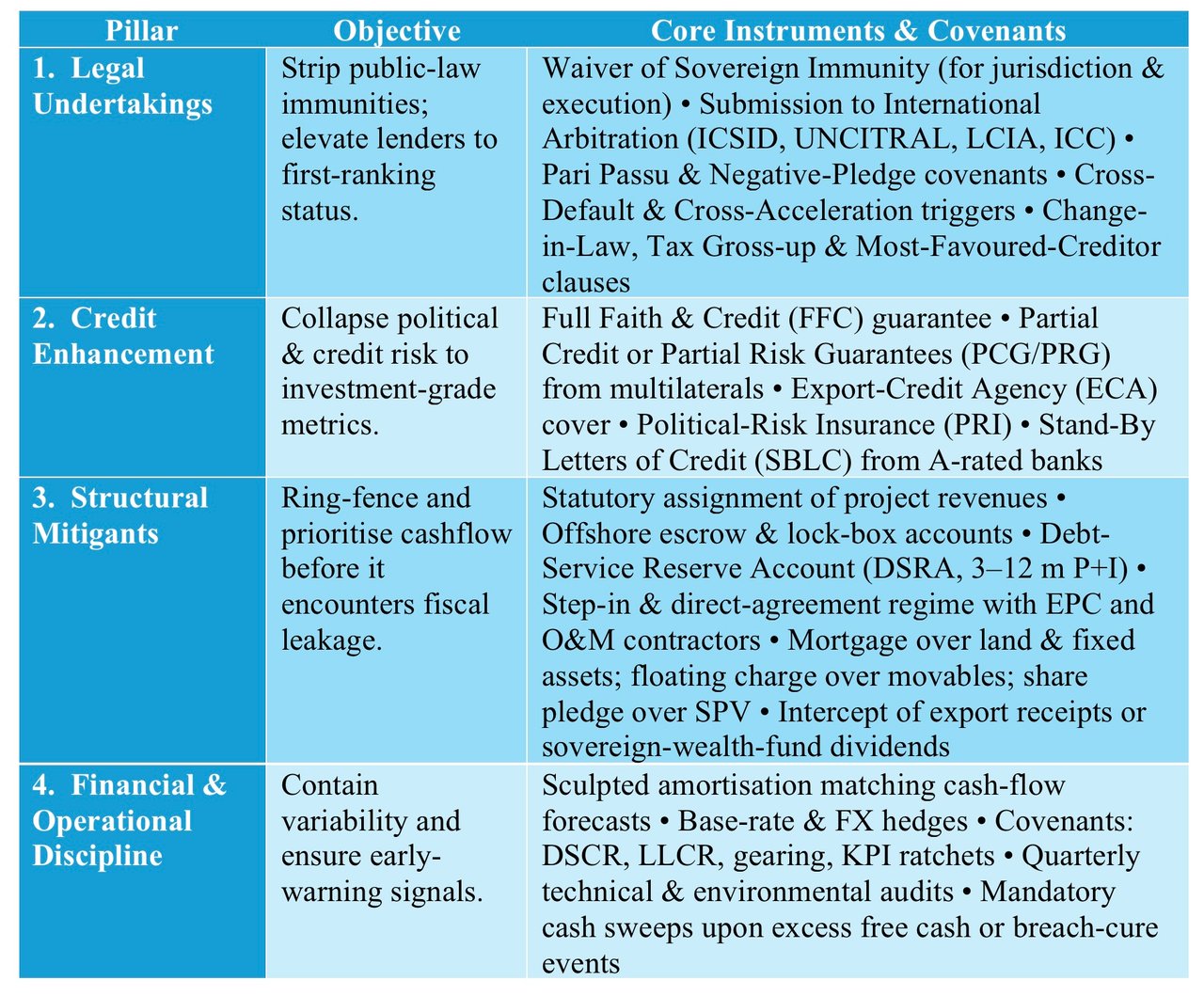
II. Enforcement Trajectory vis-à-vis a Government Counterparty
1. Contractual Acceleration
Upon an Event of Default (payment, covenant, expropriation, MAC, cross-default), lenders declare all sums immediately due.
- Notification served on Borrower and Guarantor.
- Automatic drawing on SBLC or call on PRG if cure not achieved within grace period.
2. Arbitral Award Procurement
Disputes are channelled to neutral fora: most commonly:
- ICSID (International Centre for Settlement of Investment Disputes) – awards are binding and must be recognised as final judgments in all Contracting States (Art. 54 ICSID Convention); domestic courts may not re-examine the merits, but immunity from execution remains governed by local law (Art. 55).
- UNCITRAL/LCIA/ICC ad-hoc or institutional arbitration seated in London, Paris, Singapore or The Hague; enforcement via the 1958 New York Convention.
3. Recognition & Enforcement
- File the award in jurisdictions where the sovereign holds assets in use for commercial purposes, e.g. commercial receivables or commercial property of the State itself. Central-bank assets are generally immune from execution (US FSIA §1611(b)(1); UK SIA 1978, s. 14(4)), and assets of separate state-owned entities are reachable only in limited cases.
- Rely on the doctrine of restrictive sovereign immunity (codified in UK State Immunity Act 1978, US FSIA 1976, Singapore SIA 1979): the sovereign enjoys immunity for sovereign acts (jure imperii) but not for commercial acts (jure gestionis); immunity from execution is narrower still.
4. Attachment & Garnishment
- Third-party debt orders (England) or turnover orders (US) against bank accounts the sovereign holds for commercial purposes.
- Arrest of state-owned commercial cargoes where permitted. Courts are often restrictive: the Hong Kong Court of Final Appeal applied absolute immunity in FG Hemisphere v DRC (2011), and ITLOS ordered Ghana to release the Argentine naval vessel ARA Libertad (2012), detained at the request of NML Capital.
- Seizure of sovereign-owned commercial property (hotels, telecom stakes) not used for diplomatic purposes.
5. Escrow & Lock-Box Control
- Where revenues are paid into offshore accounts governed by English or New York law and subject to account-control agreements, a security trustee can apply them upon default without a court order in the borrower’s country.
- Tripartite account-control agreements with off-taker or commodity purchaser trigger automatic redirection of payments.
6. Step-In & Substitution Rights
- Lenders (or their nominee) may replace the operator via direct agreements once a remedy period expires, preserving asset value and cash flow.
- Government consent is given in advance in the direct agreement, reducing the risk of later obstruction.
7. Termination Compensation in PPPs
- The concession agreement typically obliges the State to pay a lump-sum Termination Payment, usually at least Senior Debt plus break costs on termination for authority default or political force majeure; on termination for contractor default, compensation is usually lower.
- The obligation can be supported by a guarantee from a highly rated institution or a multilateral (e.g. ADB, IDA).
8. Drawing on Guarantees & Insurance
- PCG/PRG: lenders present Notice of Claim + arbitration award (or, for PRG, sometimes mere payment default) and are paid within the period specified in the guarantee agreement.
- PRI covers expropriation, currency inconvertibility, breach of contract; insurers subrogate and pursue the sovereign post-payment.
9. Collective-Action & Trust-Deed Enforcement (Capital-Market Take-Out)
- Should the loan be refinanced by a bond, insert single-limb CACs (Collective Action Clauses) to reduce hold-out risk while preserving trustee-driven enforcement until acceleration.
III. Practical Choreography of Security-Perfection
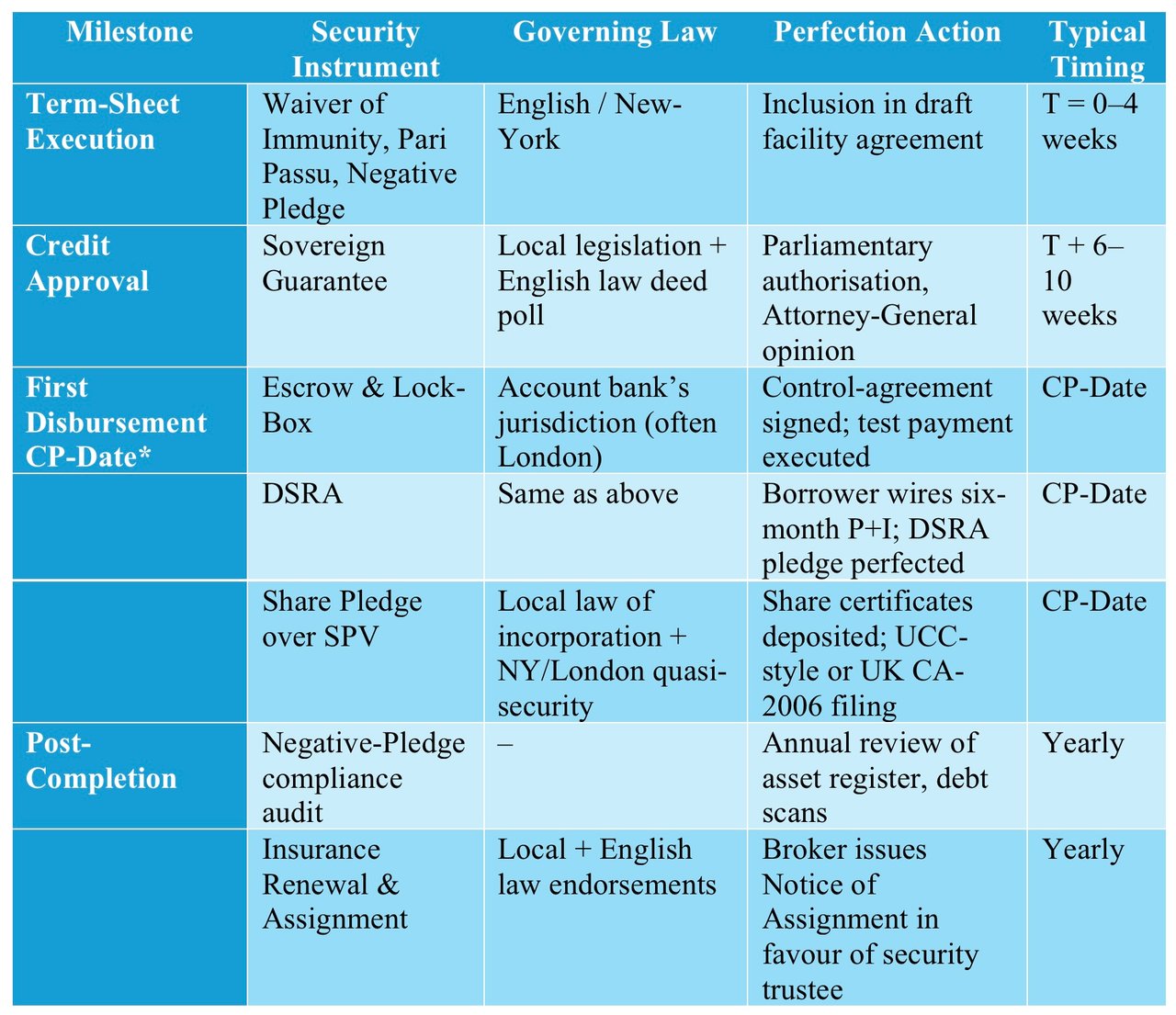
* CP = Conditions Precedent.
IV. Risk-Sensitive Enhancements
1. Commodity-Price Volatility
- Mitigant: Pre-agreed hedge mandate with bank’s commodity desk; swap settlement collateralised by export receivables.
2. FX Mismatch
- Mitigant: Synthetic local-currency tranche created via cross-currency swap; margin calls funded from a Liquidity Support Facility replenished semi-annually.
3. Force-Majeure & Political Events
- Mitigant: PRI + PRG layering; termination payment sized at “Debt + Projected Breakage on Hedges”.
4. Basel Output-Floor Capital Drag
- Mitigant: Export-credit-agency cover or multilateral guarantees, which can lower risk weights under the applicable capital rules.
V. Complementary Clauses that Fortify Enforcement
- Explicit Waiver of the “Act of State” Doctrine (US law) – addresses a defence occasionally invoked to resist enforcement.
- “No Counter-Claim” Undertaking – bars sovereign from offsetting unrelated tax or tort claims against debt service.
- Currency-Indemnity Clause – obliges sovereign to top-up if a judgment must be converted into local currency for enforcement.
- Information Covenants with Automatic Margin-Step-Up – late submission of fiscal data triggers a margin step-up (e.g. +25 bp).
- Investment Covenant for DSRA – the Debt Service Reserve Account must be invested in permitted instruments, and any shortfall below the required reserve balance must be topped up.
In short
By layering legal undertakings, third-party credit wraps, hard-wired cash-flow intercepts and early-warning covenants, lenders can reduce expected loss and improve recovery prospects; they cannot remove the underlying sovereign credit risk. Should the sovereign nevertheless falter, a calibrated enforcement ladder (starting with soft triggers (cash sweeps), escalating to arbitral awards, and culminating in global asset attachment) is designed to preserve the lenders’ priority of payment without precipitating a geopolitical confrontation. In short, a well-designed security architecture both discourages default ex ante and gives financiers internationally recognised remedies ex post.
Closing Reflection
The incremental pages a sovereign appends (parliamentary authorisations, ESG audits, FPIC sign-offs, climate stress-tests) may feel onerous during gestation, yet they can reduce both the probability of default and the loss given default in a way margin alone cannot. Investors tend to trust a borrower who writes these protections into a deal, which makes enforcement less likely to be needed. That is the difference between a merely structured transaction and a truly bankable one.
Strategic Counsel: Three Last Messages to a Sovereign Borrower
1. “Bankability is a moving target.”
The acceptable risk allocation will change as the Basel III output floor is phased in and climate-adjusted ratings and political-risk premia evolve. Bake-in review triggers every twenty-four months.
2. “Structure dictates spread more than rating.”
A transaction with weak security can price wider than one from a lower-rated sovereign that has escrow, PRG and step-in rights. Rating matters, but architecture matters too.
3. “Front-load transparency, back-load risk.”
Governments that disclose every contingent liability at parliamentary stage and quarantine political risk behind multilateral wraps tend to find broader investor demand. Opacity tends to bring surcharges, or silence.
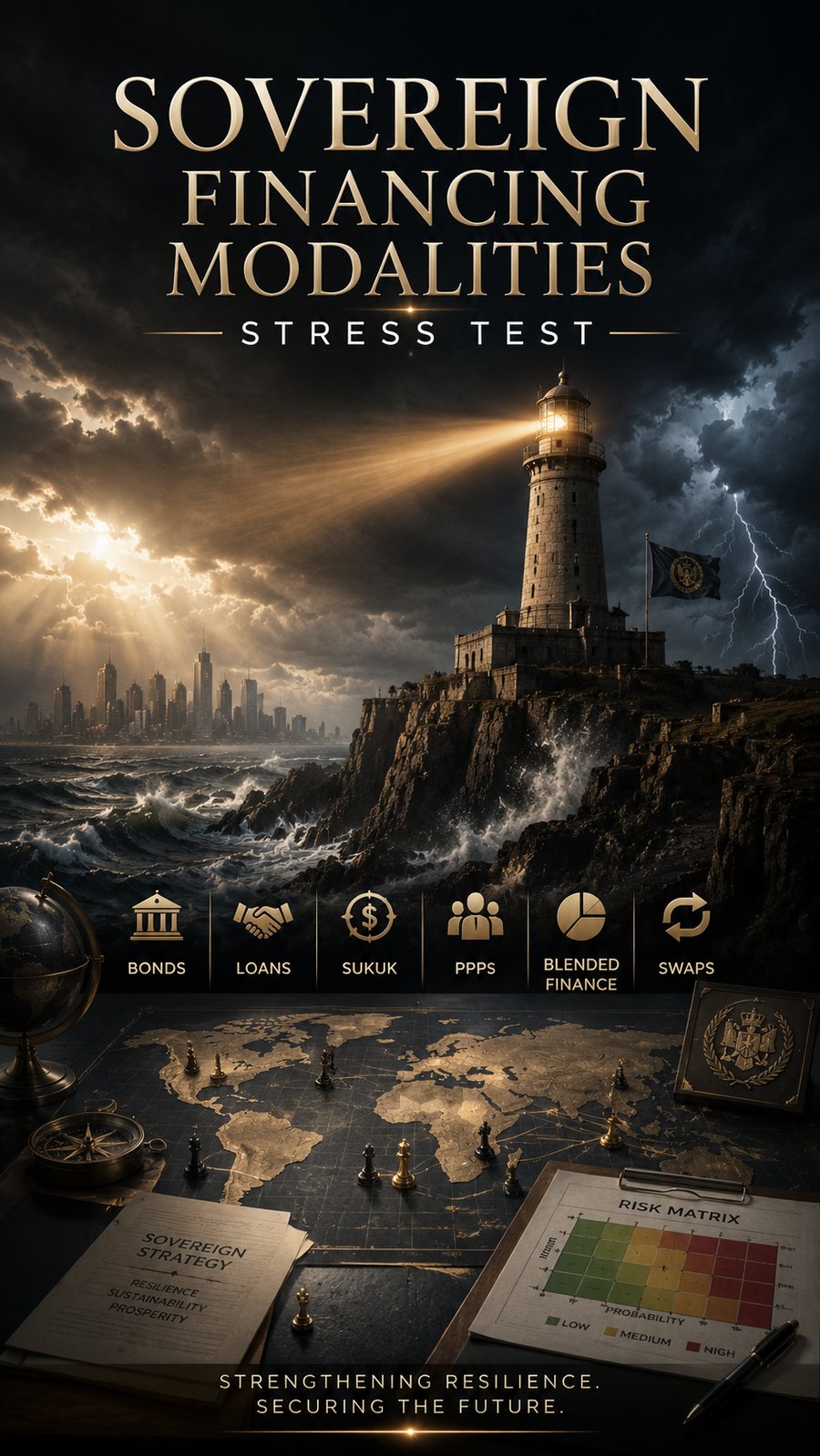
Sovereign Financing
Ten questions that narrow the modalities to the main five that fit your situation – and stress-test the coverage ratio while you are there.
Ready for a Zoom Video Conference?