The Myth of the sole SWIFT MT103 and downloading from Common Account
Understanding “Common Account(s)”
In precise banking terminology, the expression “common account” is not a formally recognised concept in banking. It is typically a colloquial or intermediary term. What it usually refers to is:
- A Nostro account held by the bank with one of its correspondents, which the bank designates as the primary settlement channel for incoming third-party transfers before funds are booked into the final client account.
- When a bank maintains multiple Nostro accounts with different correspondent banks, one account is usually selected as the operational default for a given currency and corridor. That account may be referred to by “intermediaries” as the “common account” because all client activation fees or pre-activation transfers are directed there, on the bank’s responsibility, until settlement into individual client accounts is permissible.
Key distinctions:
- Nostro accounts – Each is a current account maintained by the bank with a correspondent institution, used for clearing and settlement in foreign currencies.
- Common account – An informal designation for the specific Nostro account the bank instructs counterparties to use for initial or pooled flows. It is “common” only in the sense that multiple clients’ activation fees or prefunding amounts may be received there, strictly under the bank’s control, before allocation.
- Regulatory restriction – No client has ownership rights over a “common account”. Funds in such an account remain the property of the bank until booked into the client’s activated account. Settlement on a client’s behalf is not legally permissible until due diligence and activation are complete.
Understanding the Limitations of SWIFT Messaging in national and International Fund Transfers
In the world of international finance, SWIFT messages such as the MT103 are often misunderstood and overestimated in their role and capability. A common misconception persists that sending an MT103 message alone is sufficient to transfer funds across borders and that the details of the transaction can be manually downloaded from a common account upon the message’s receipt. This belief is not only inaccurate but also overlooks the complexities and multi-layered processes that underpin cross-border transactions. To dispel this myth, it is crucial to delve deeper into what an MT103 represents, the limitations of SWIFT messaging, and the true mechanisms of international fund transfers.
What is an MT103?
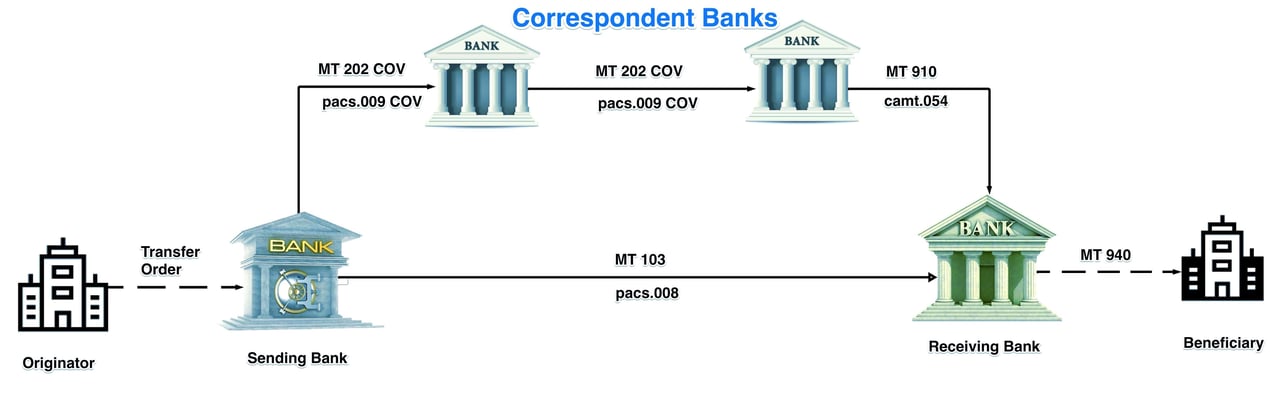
An MT103 (replaced for cross-border payments since November 2025 by the ISO 20022 message pacs.008) is a standardised SWIFT message format used for international wire transfers between financial institutions. It provides detailed information about the payment, including the sender and recipient details, transaction amount, currency, and reference numbers. The MT103 is widely used because it offers transparency and traceability, serving as a record of the payment order. However, it is important to understand that the MT103 is merely a communication tool: a digital instruction set relayed between banks.
The Role and Limitations of the MT103
While the MT103 contains critical information about a transaction, it does not, in itself, initiate the actual transfer of funds. It is analogous to sending a detailed letter of intent with all the parameters of the transaction but not the funds themselves. The SWIFT network is a secure messaging platform that allows banks to communicate with one another regarding payment instructions, confirmations, and other financial information. It does not move the money; it merely facilitates the communication that supports the movement of funds through other channels.
The Myth of the MT103 and Manual Download
A prevalent misconception is that once an MT103 is sent and received, the transaction details can be immediately downloaded manually from a common account, implying or believing that the funds are already accessible in the common account of the bank. This belief is fundamentally flawed because it conflates the messaging component with the actual fund movement process. The receipt of an MT103 does not equate to the receipt of funds.
For the funds to be available in the Nostro (common) account, several additional steps must occur:
- Verification and Reconciliation: The bank receiving the MT103 must verify the message and reconcile it with other corresponding messages, such as the MT202 COV (which provides the cover payment details) and the MT910 (confirmation of credit entry), or their ISO 20022 equivalents pacs.009 COV and camt.054.
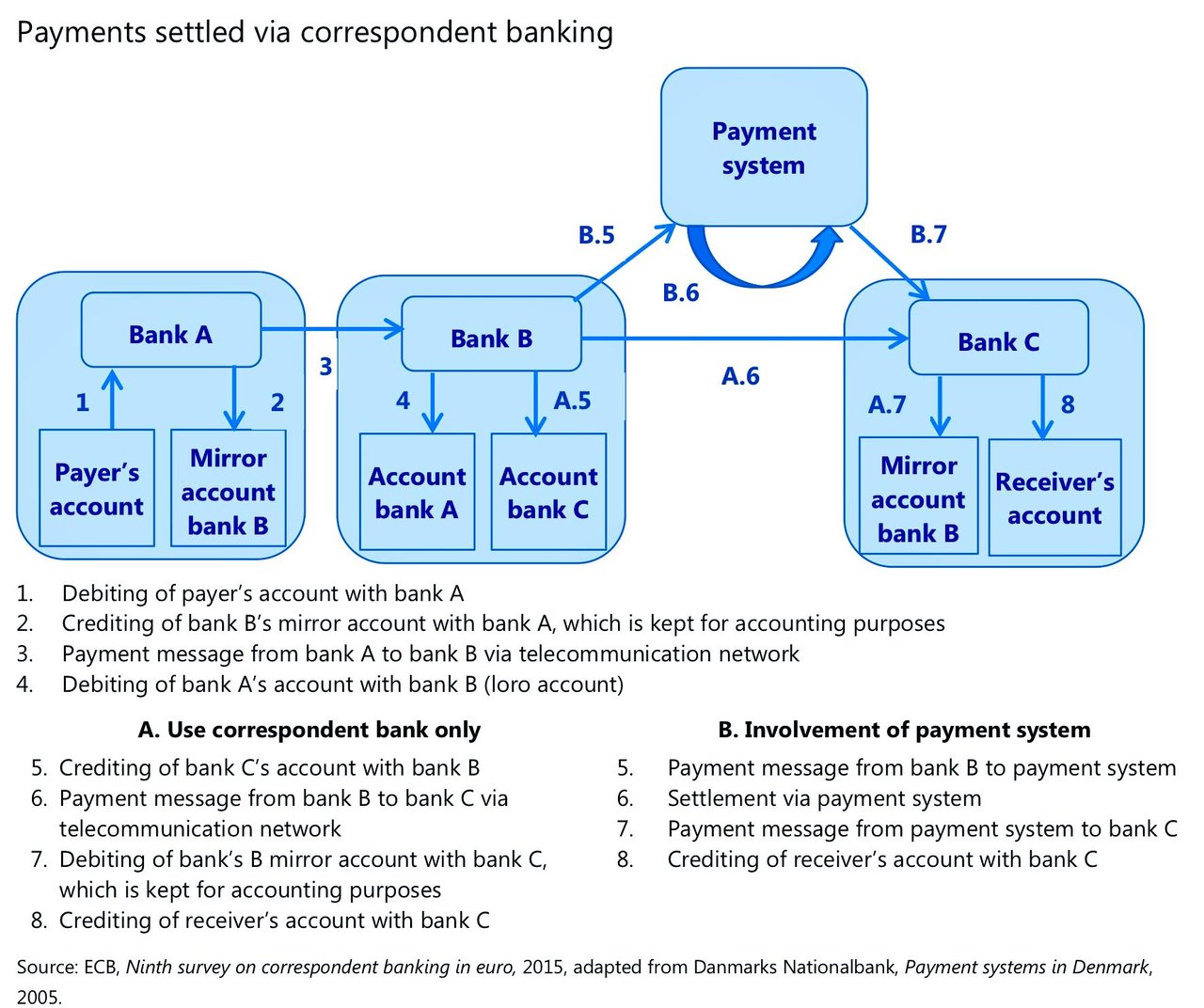
- Actual Fund Movement: Beyond the exchange of messages, the actual funds must move through the correspondent banking network, central bank settlement accounts, or real-time payment systems. This involves a series of debits and credits across various accounts, either directly between banks or through intermediaries.
- Alignment of Systems: All relevant systems, including those for messaging, fund settlement, and account reconciliation, must align smoothly for the funds to be credited to the common account. Only after these conditions are met can the bank manually download and access the transaction details.
The Deeper Mechanics of International Fund Transfers
To fully grasp the limitations of the MT103 and the process of international fund transfers, it is essential to understand the broader context in which these transactions occur.
Correspondent Banking Networks
Most international transactions rely on a network of correspondent banks that facilitate the transfer of funds between banks that may not have direct relationships with one another. In this system, the funds are moved through a series of bilateral agreements, with each bank in the chain debiting and crediting accounts as the funds progress toward their final destination. This process is not instantaneous and requires careful coordination and verification at each step.
Settlement Accounts in Central Banks
For large financial institutions, the settlement of international transactions often occurs through central banks using Real-Time Gross Settlement (RTGS) systems. These systems ensure the immediate transfer of funds on a gross basis, reducing settlement risk and ensuring liquidity in the financial markets. However, even RTGS systems require a series of confirmations and verifications that go beyond the mere transmission of an MT103 message.
Real-Time Payment Systems
In some cases, real-time payment systems (RTP) may be used to facilitate the immediate settlement and availability of funds. These systems provide near-instantaneous clearing and settlement, but they too operate within a framework that requires more than just an MT103 message to effectuate the transfer of funds.
The Reality: SWIFT Messages vs. Actual Fund Movement
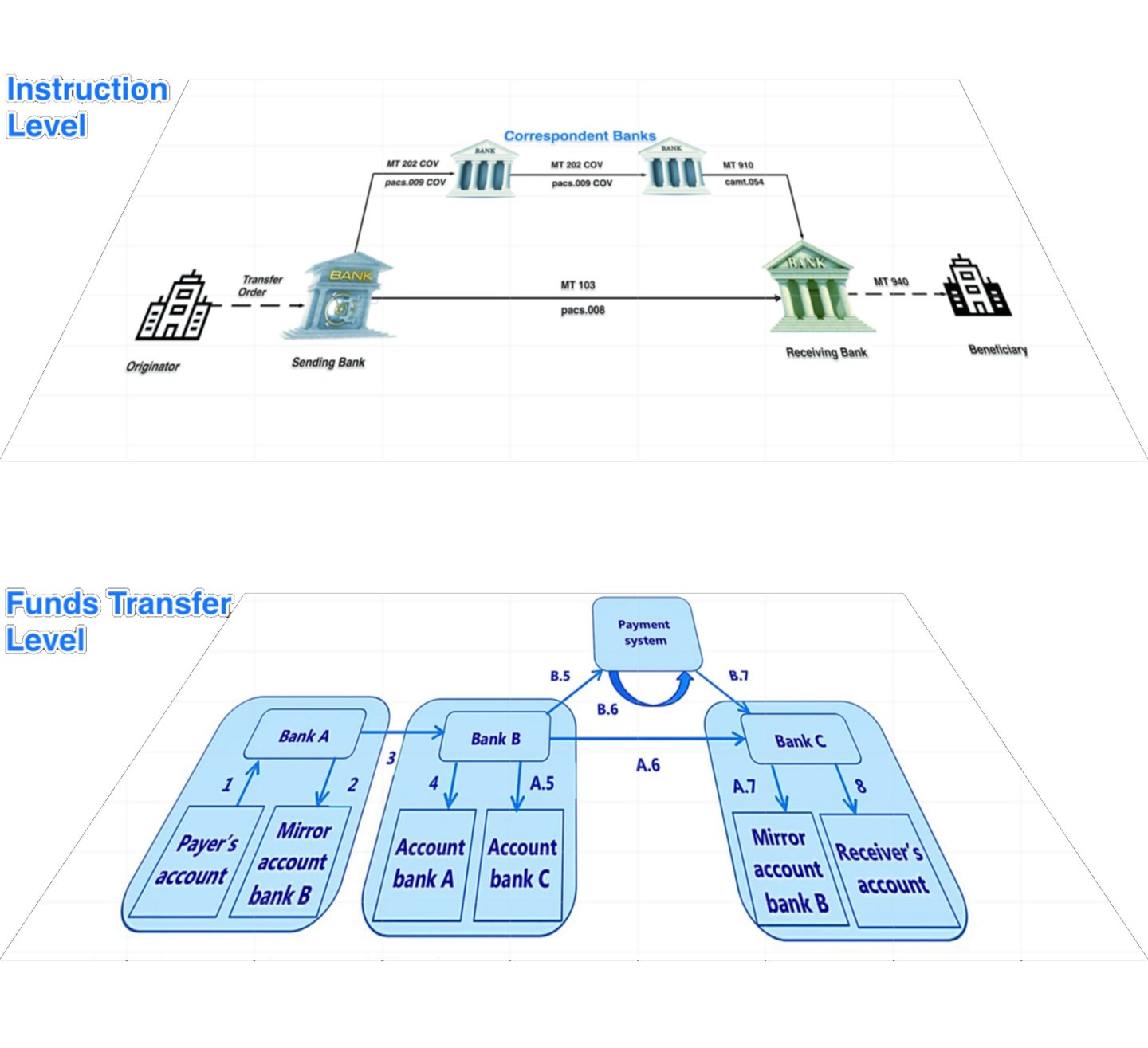
It is crucial to emphasize that SWIFT messages are not synonymous with the movement of funds. They are tools that facilitate communication between financial institutions, providing the necessary information to support the fund transfer process. The actual movement of money involves a deeper and more complex process of debiting and crediting accounts within a network of banks, central bank settlement systems, or real-time payment mechanisms.
Believing that a single MT103 message can alone transfer funds or that transaction details can be downloaded manually from a common account without the underlying funds being in place reflects a fundamental misunderstanding of how international banking works. SWIFT messages, while essential, are only part of a larger, multi-faceted process that ensures the secure and efficient movement of funds across borders.
The Need for Complete Understanding
The myth of the MT103, believing that it alone can transfer funds and provide immediate access to transaction details, is a misconception that can lead to confusion and unmet expectations. It is vital for businesses and individuals involved in international transactions to understand the broader financial infrastructure and the interplay between SWIFT messaging and actual fund movements.
To master the complexities of international finance effectively, one must recognize that SWIFT messages are only a communication tool. The real transfer of funds involves a sophisticated system of correspondent banking, central bank settlements, and real-time payment systems, all of which must work in unison to achieve the desired outcome. Only by appreciating these intricacies can one truly grasp the realities of cross-border transactions and the limitations of relying solely on an MT103 message.
Other Variations
Authentic SWIFT Message Types typically utilised in Scams
These are well-documented and partially used instructions in the international banking system:
1. MT 103 – Single Customer Credit Transfer
- Legitimacy: Real
- Purpose: Used for cross-border or domestic wire transfers between banks for customer payments.
- GPI Variant: MT 103 GPI exists as an enhanced version under SWIFT’s Global Payments Innovation (GPI) program. It includes tracking (via UETR), faster processing, and transparency.
2. MT 104 – Direct Debit Request
- Legitimacy: Real, but limited
- Purpose: Used to request debits from a customer account via a correspondent bank, only within bilateral or multilateral agreements between the banks concerned; rarely used for cross-border payments.
- MT104 GPI: Not a standard term. GPI is for credit transfers, not debit instructions. This entry is misleading.
3. MT103.202cov – Cover payment mechanism
- Legitimacy: Partially Real
- Clarification: This is a combined reference, often misused.
- MT 103 is the customer credit message.
- MT 202 COV is used by the sending bank to instruct its correspondent to cover the amount with the beneficiary’s bank.
- “MT103.202cov” is not a SWIFT message itself but a colloquial conflation of two messages in a cover payment structure.
Questionable or Fabricated Entries
4. “Swift GPI Automatic / with UETR Code”
- Legitimacy: Misleading
- Clarification: Since November 2018, every MT 103 sent over the Swift network carries a UETR (Unique End-to-End Transaction Reference), whether or not the banks are gpi members. However, the concept of “Automatic” vs “Manual” GPI is not a SWIFT classification.
- Verdict: Not standard – sounds like internal jargon or a non-standard process.
5. “Swift GPI Semi-Automatic / with UETR Code”
- Legitimacy: Not recognised by SWIFT
- Explanation: The term “semi-automatic” is not part of the SWIFT lexicon. All GPI MT103 messages include UETR by design, but there is no semi-automated transmission mode defined by SWIFT.
6. “Swift GPI MT103.202cov Manual Download / with UETR Code” or “Swift MT103.202cov Manual Download”
- Legitimacy: Fabricated / Misrepresented
- SWIFT messages are never “downloaded” manually in legitimate institutional practice. Messages are transmitted electronically via the secure SWIFT network.
- The terminology raises red flags associated with fraudulent schemes involving falsified SWIFT messages or manual templates.
The Myth of the “Single Payment Platform Direct Debit Protocol” (SPP DDP)
Separating Banking Reality from Fabricated Payment Terminology
Within certain circles of self-described “financial intermediaries”, one increasingly encounters references to an alleged banking mechanism called the “Single Payment Platform Direct Debit Protocol” (SPP DDP), occasionally expanded further into phrases such as “Asseting Assessment Protocol”, “Deep Banking Transfer”, or “International Direct Download Settlement Method”.
These expressions are presented as though they refer to a sophisticated interbank payment infrastructure used quietly by major institutions for high-value transfers outside conventional SWIFT procedures. In reality, no such recognised banking protocol exists.
At IFB, we believe it is essential to distinguish legitimate financial infrastructure from invented terminology designed to create the illusion of institutional sophistication.
No Official Banking Recognition Exists
The term “Single Payment Platform Direct Debit Protocol” is not recognised by:
- SWIFT
- ISO 20022
- SEPA
- TARGET2 / T2
- Federal Reserve payment systems
- CLS
- ECB
- BIS
- correspondent banking frameworks
- any recognised RTGS infrastructure
- any central bank
- any regulated payment scheme
No official rulebook, implementation manual, SWIFT standard, ISO specification, clearing framework, or regulatory publication defines or references “SPP DDP” as an accepted settlement mechanism. This absence is decisive.
Legitimate payment infrastructures are extensively documented because banks require precise operational standards, message formatting rules, legal frameworks, settlement procedures, liquidity controls, and compliance obligations. A payment system that lacks all official documentation is not a hidden system. It is simply not a recognised system.
Confusion with Legitimate Banking Terminology
The persistence of the SPP DDP myth appears to arise from the deliberate mixing of authentic banking terminology with fabricated expressions.
Examples commonly observed include:
| Fabricated or Misused Expression | Actual Banking Concept
| SPP | Often confused with the TARGET2 Single Shared Platform (SSP), replaced by T2 in March 2023
| Direct Debit Protocol | Confused with SEPA Direct Debit schemes
| Downloading Funds | Misunderstanding of reconciliation or account posting
| Common Account | Informal misunderstanding of Nostro settlement accounts
| Deep Banking | Non-existent term in regulated finance
| Asseting Assessment | No recognised banking meaning
| MT103 Download | Misrepresentation of SWIFT messaging functionality
This technique creates the appearance of complexity and exclusivity while remaining detached from actual banking operations.
SWIFT Does Not Transfer Money
One of the most persistent misconceptions associated with SPP DDP narratives is the belief that SWIFT messages themselves transfer funds or permit banks to “download” money from a so-called common account.
This is incorrect.
As explained in IFB’s article on common accounts, SWIFT is fundamentally a secure interbank messaging network, not a fund-holding institution or settlement engine.
An MT103 message is merely a payment instruction. Settlement still requires:
- correspondent banking relationships;
- Nostro/Vostro account adjustments;
- liquidity availability;
- reconciliation procedures;
- compliance verification;
- central-bank or RTGS settlement where applicable.
No bank can manually “download” funds from an undefined global platform solely because a SWIFT message exists.
Why Banks Reject These Requests
When individuals approach regulated institutions requesting SPP DDP transactions, banks typically cannot process the request because:
- the terminology is not recognised internally;
- no operational framework exists;
- no compliance procedure exists;
- no settlement scheme exists;
- no legal basis exists;
- no standard message format exists;
- no recognised counterparty infrastructure exists.
This does not indicate that banks are “hiding” the system or that only “high-level bankers” understand it. It simply reflects that the requested mechanism is not part of regulated banking practice.
The “Deep Banking” Illusion
A recurring theme surrounding SPP DDP claims is the suggestion that major banks secretly operate hidden settlement layers inaccessible to ordinary staff.
This narrative often includes references to:
- “Level 14 bankers”
- “private banking servers”
- “global servers”
- “off-ledger liquidity”
- “humanitarian transfer platforms”
- “private settlement windows”
- “receivers”
- “special clearing codes”
These concepts are not recognised components of international banking operations. They belong to a broader ecosystem of financial mythology frequently associated with monetisation frauds, advance-fee schemes, fake investment programmes, and pseudo-sovereign narratives.
Real International Payment Infrastructure
Legitimate cross-border payments occur through recognised systems such as:
- SWIFT messaging;
- correspondent banking;
- SEPA;
- TARGET services;
- ACH networks;
- RTGS systems;
- CLS settlement;
- ISO 20022 frameworks.
These systems are heavily regulated, operationally documented, audited, and globally standardised.
There are no hidden parallel systems permitting unrestricted international transfers outside AML, KYC, sanctions screening, liquidity controls, and settlement verification.
The Compliance Reality
Modern banking operates under increasingly strict AML and CFT obligations. Any transaction lacking:
- clear economic purpose;
- identifiable counterparties;
- contractual justification;
- source-of-funds evidence;
- compliance transparency;
will trigger enhanced scrutiny or outright rejection.
This is particularly true for alleged “receiver transactions”, “humanitarian settlements”, “download procedures”, or undefined high-value incoming transfers.
In short
The “Single Payment Platform Direct Debit Protocol” (SPP DDP) is not a recognised banking protocol, settlement infrastructure, or regulated payment mechanism.
Its terminology appears to be a synthetic construction derived from fragments of authentic banking language combined with fictional concepts designed to create an illusion of exclusivity and institutional secrecy.
In international finance, complexity is often mistaken for legitimacy. Yet genuine banking systems do not rely on hidden terminology, secret procedures, or undefined protocols. They rely upon documented standards, regulatory oversight, correspondent relationships, and legally enforceable settlement frameworks.
Where documentation, standards, and institutional recognition are absent, the safest assumption is not that the system is secret, but that the system does not exist.



Next step
Request an introduction
Tell us in a few lines who you are and what you have in mind. Your enquiry goes directly to the bank and is treated in confidence.
Prefer to talk? Book a 30-minute videoconference.