The Shadow Banking System in Europe, the United States, and Asia
Structures, Functions, and Systemic Implications
1. Conceptual Definition and Economic Function
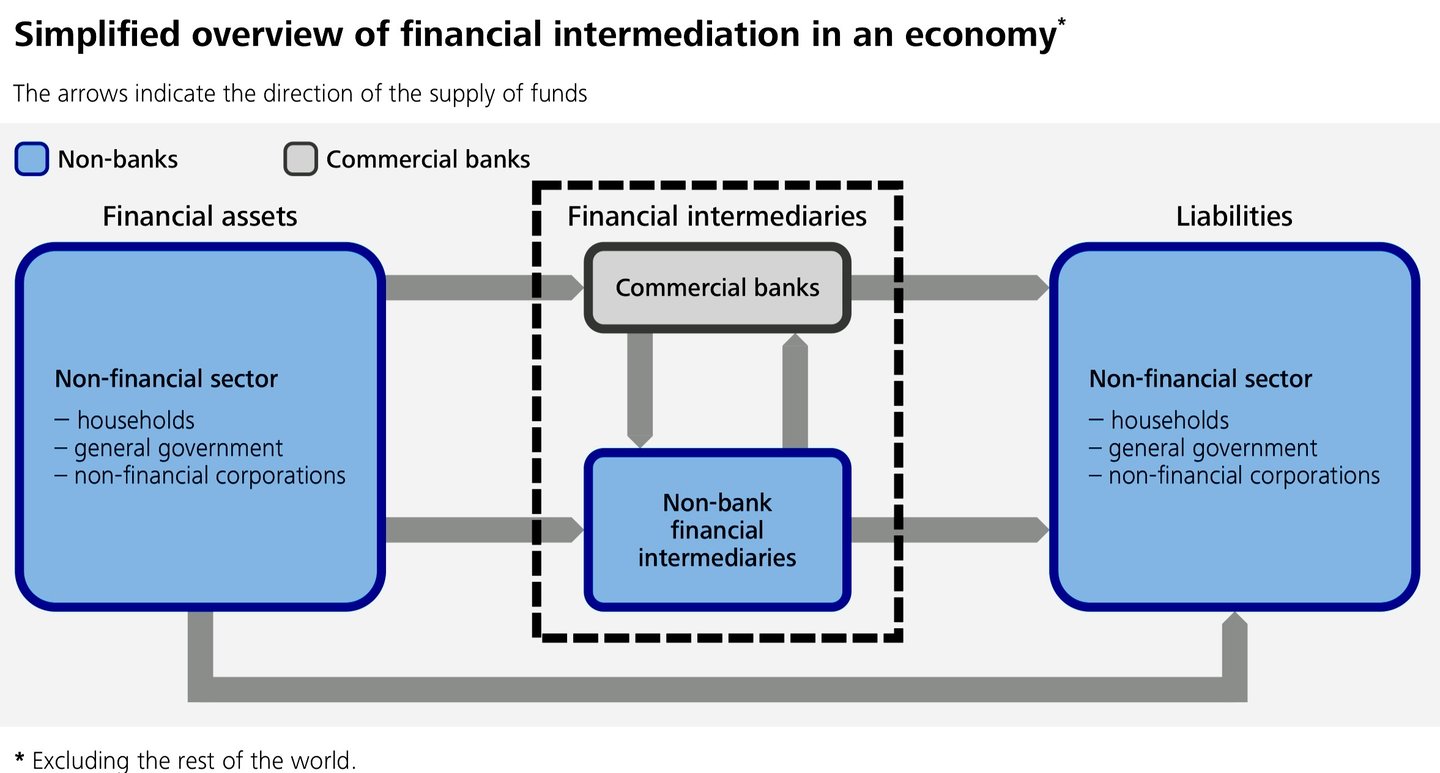
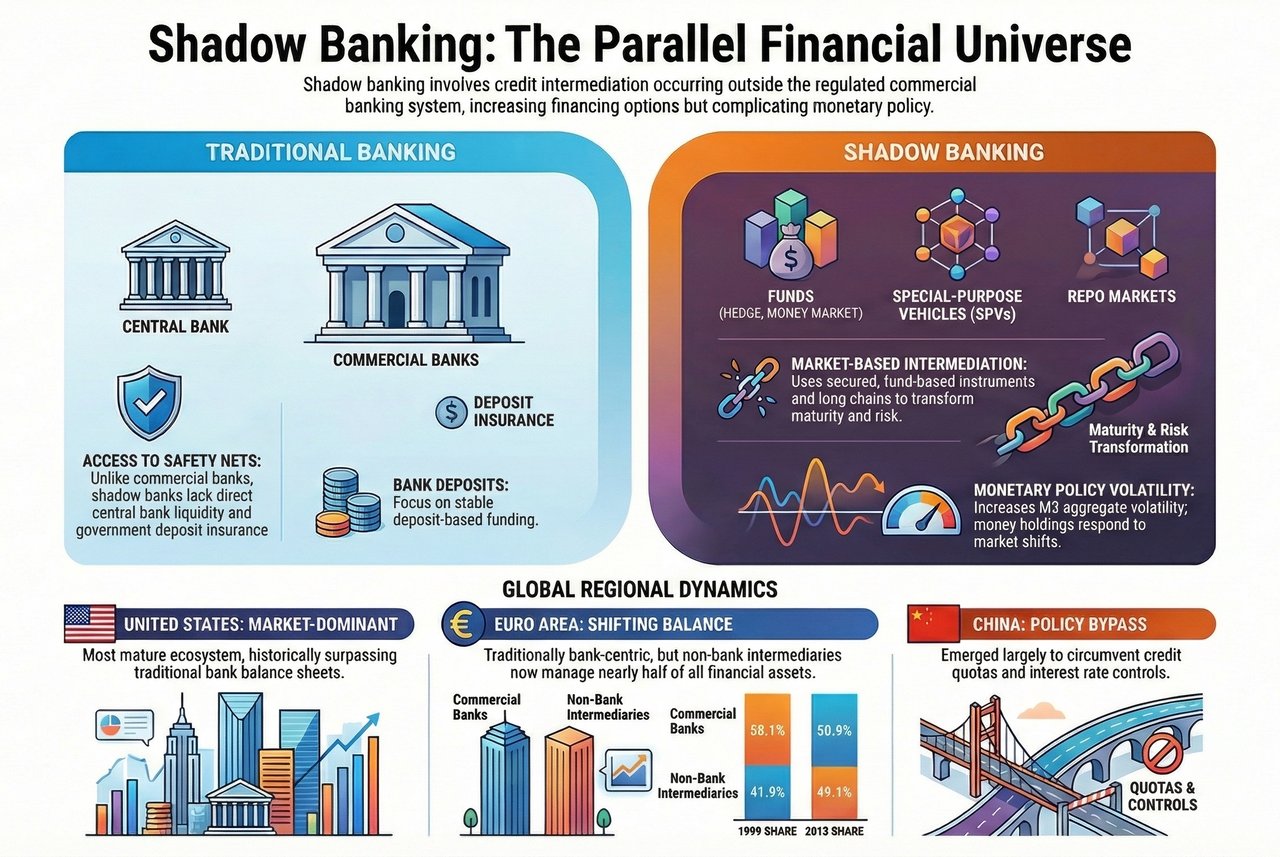
The shadow banking system – since 2018 referred to by the Financial Stability Board as non-bank financial intermediation (NBFI) – refers to credit intermediation activities conducted outside the perimeter of the regulated commercial banking sector. It encompasses entities and activities that perform maturity, liquidity, and risk transformation without direct access to central bank liquidity, deposit insurance, or the full scope of prudential regulation applicable to banks.
Core components typically include:
- Money market funds
- Investment and hedge funds
- Special-purpose vehicles (SPVs) and securitisation conduits
- Repo and securities lending markets
- Finance companies and certain insurance and pension fund activities
From an economic perspective, shadow banking performs a complementary function to traditional banking by broadening funding channels, improving allocative efficiency, and meeting demand for market-based finance. From a systemic perspective, it introduces opacity, leverage, and procyclicality.
2. Europe: Bank-Centric Systems with Expanding Market-Based Intermediation
Structural Characteristics
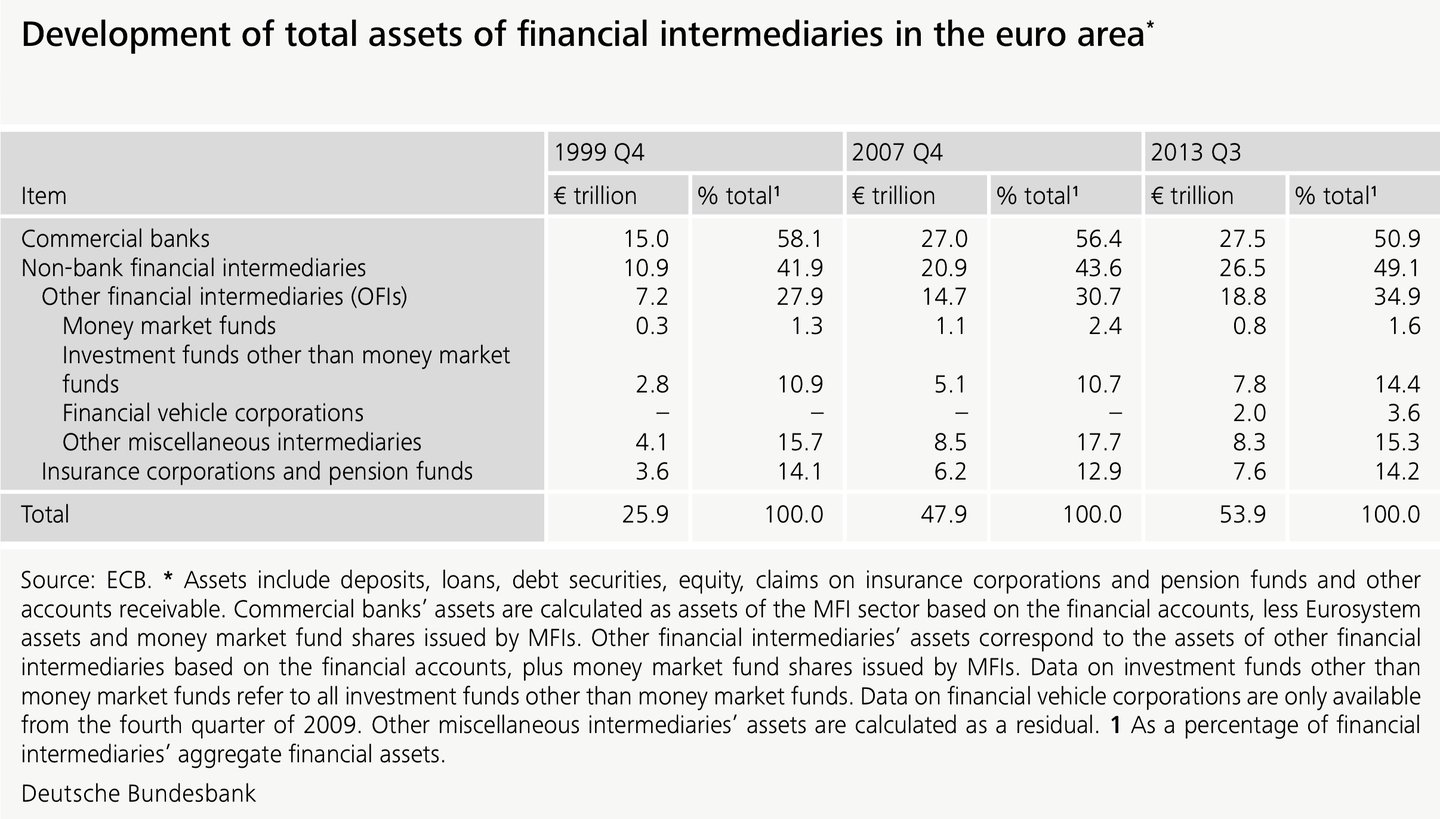
Europe’s financial system remains predominantly bank-based, particularly within the euro area. Nevertheless, shadow banking has expanded materially since the late 1990s, largely through:
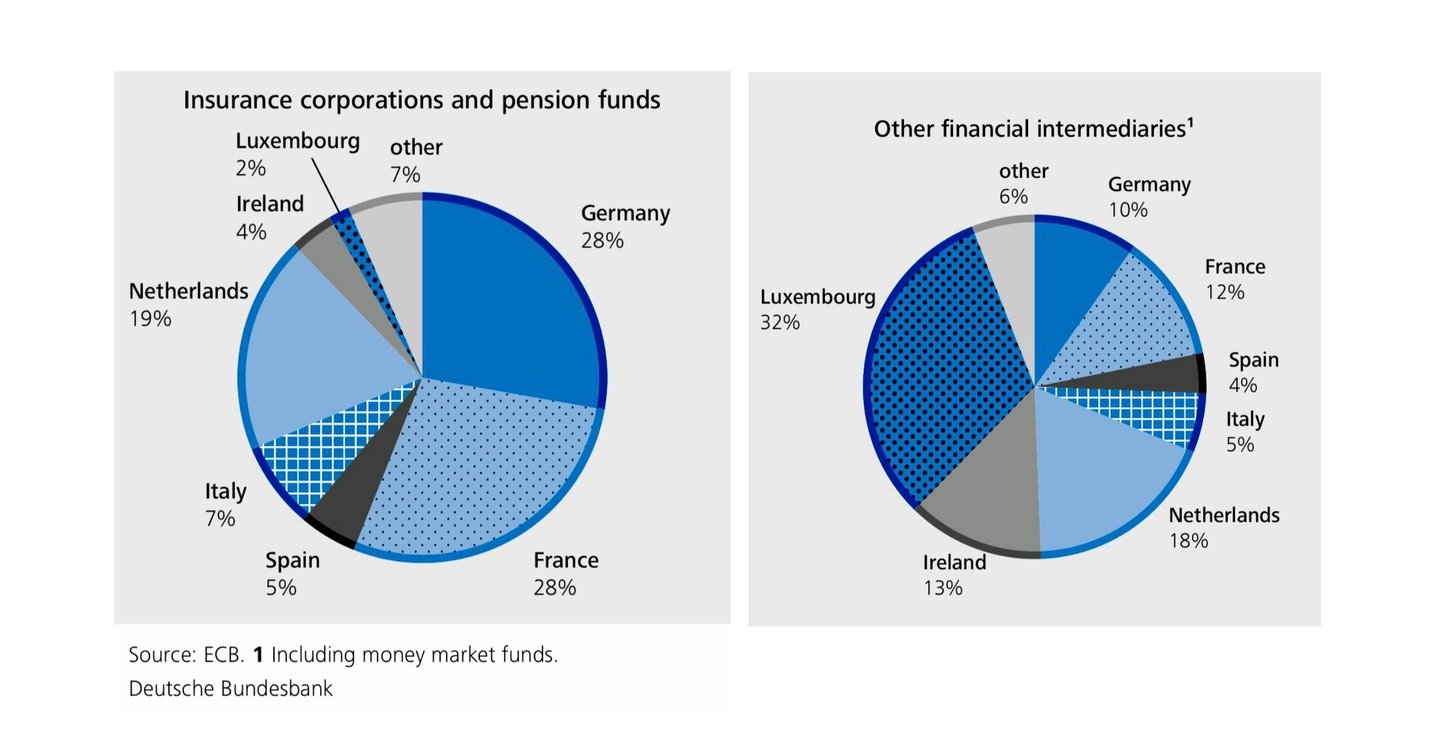
- Investment funds (especially domiciled in Luxembourg and Ireland)
- Securitisation vehicles
- Repo-based wholesale funding structures
Europe has long operated under a universal banking model. Consequently, activities that would be classified as “shadow banking” in the US may legally reside within banking groups and appear on regulated balance sheets, complicating measurement and comparison.
Monetary Policy and Stability Implications
According to analysis by the Deutsche Bundesbank and the European Central Bank, shadow banking in Europe:
- Weakens the information content of traditional monetary aggregates
- Alters monetary transmission by shifting financing toward asset prices rather than bank lending
- Increases interconnectedness between banks and non-bank intermediaries, especially via repos and securitisation
Bundesbank analysis indicates that deposits held by non-bank financial intermediaries correlate more strongly with asset prices than with real economic activity, increasing volatility in aggregates such as M3.
3. United States: Market-Based Finance as the Dominant Model
Structural Characteristics
The United States represents the most mature and systemically significant shadow banking ecosystem globally. Key features include:
- A historically fragmented banking system
- Deep capital markets
- Heavy reliance on securitisation and repo funding
Before the 2007–2009 financial crisis, the gross liabilities of the US shadow banking system (about USD 20 trillion at the peak in 2007–2008) exceeded those of the traditional banking system (about USD 14 trillion), according to Federal Reserve Bank of New York research (Pozsar et al., 2010).
Principal components include:
- Broker-dealers funded through overnight repo
- Asset-backed commercial paper conduits
- Money market funds functioning as deposit substitutes
Crisis Experience and Regulatory Response
The global financial crisis demonstrated that US shadow banking was vulnerable to run dynamics analogous to bank runs, but without lender-of-last-resort protection. The collapse of wholesale funding markets forced extraordinary intervention by the Federal Reserve System.
Post-crisis reforms (Dodd-Frank Act, money market fund reform, enhanced repo oversight) have reduced some vulnerabilities, but have not reversed the structural dominance of market-based intermediation.
4. Asia: State-Influenced Growth with Regional Divergence
China: Shadow Banking as Policy Bypass
In China, shadow banking emerged primarily as a response to:
- Credit quotas
- Interest rate controls
- Regulatory constraints on state-owned banks
Key instruments include:
- Trust products
- Wealth management products (WMPs)
- Entrusted loans and off-balance-sheet vehicles
Unlike Western systems, Chinese shadow banking is closely intertwined with state objectives and implicit guarantees, creating moral hazard rather than pure regulatory arbitrage. Periodic regulatory crackdowns, notably the 2018 asset-management rules, have reduced growth but not eliminated the system.
Japan and Emerging Asia
- Japan’s shadow banking sector is relatively contained, with significant involvement by institutional investors rather than opaque vehicles.
In emerging Asian economies, shadow banking remains smaller but is growing rapidly alongside capital market development.
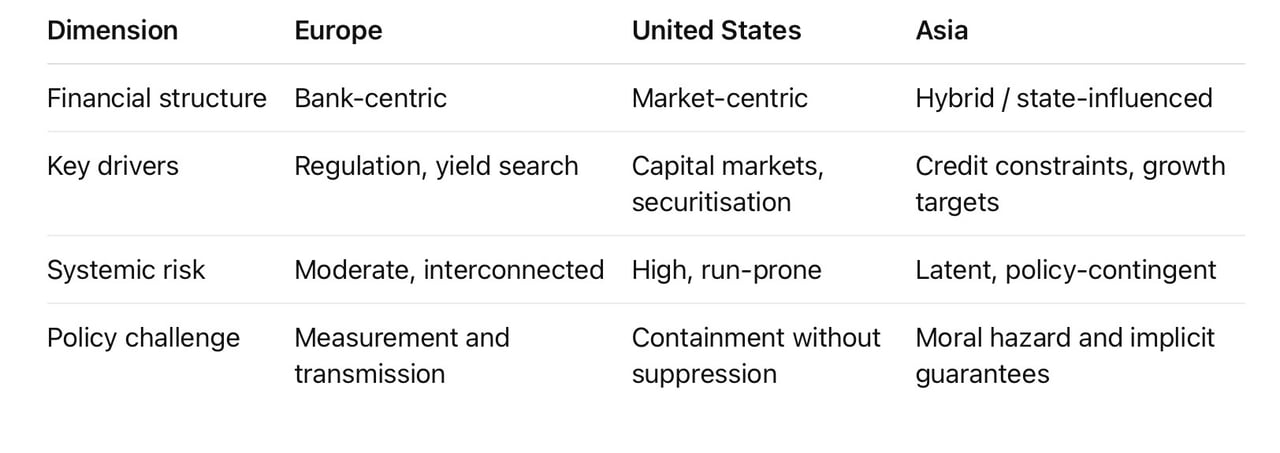
5. Comparative Assessment
6. Policy and Strategic Implications
Across all regions, shadow banking:
- Dilutes the effectiveness of bank-focused monetary policy
- Increases reliance on asset price channels
- Amplifies financial cycles through procyclical leverage
The strategic challenge for regulators is not elimination but containment:
- Narrowing regulatory arbitrage
- Improving statistical coverage
- Applying macroprudential tools proportionately across banks and non-banks
Shadow banking is not an aberration but a structural feature of modern financial capitalism. Attempts to suppress it entirely tend to relocate risk rather than remove it. The rational objective is disciplined integration into the broader financial architecture.
In short
The shadow banking system reflects enduring economic forces: demand for liquidity, yield, and balance-sheet flexibility. Its form varies across Europe, the United States, and Asia, but its systemic relevance is universal. Sound policy requires precision, not prohibition.