
Off-balance-sheet (OBS) Operations
Off-balance-sheet (OBS) activities refer to activities that are not recorded on the balance sheet of a bank but affect the bank’s financial status and risk profile. OBS activities can both generate income and expose the bank to various risks.
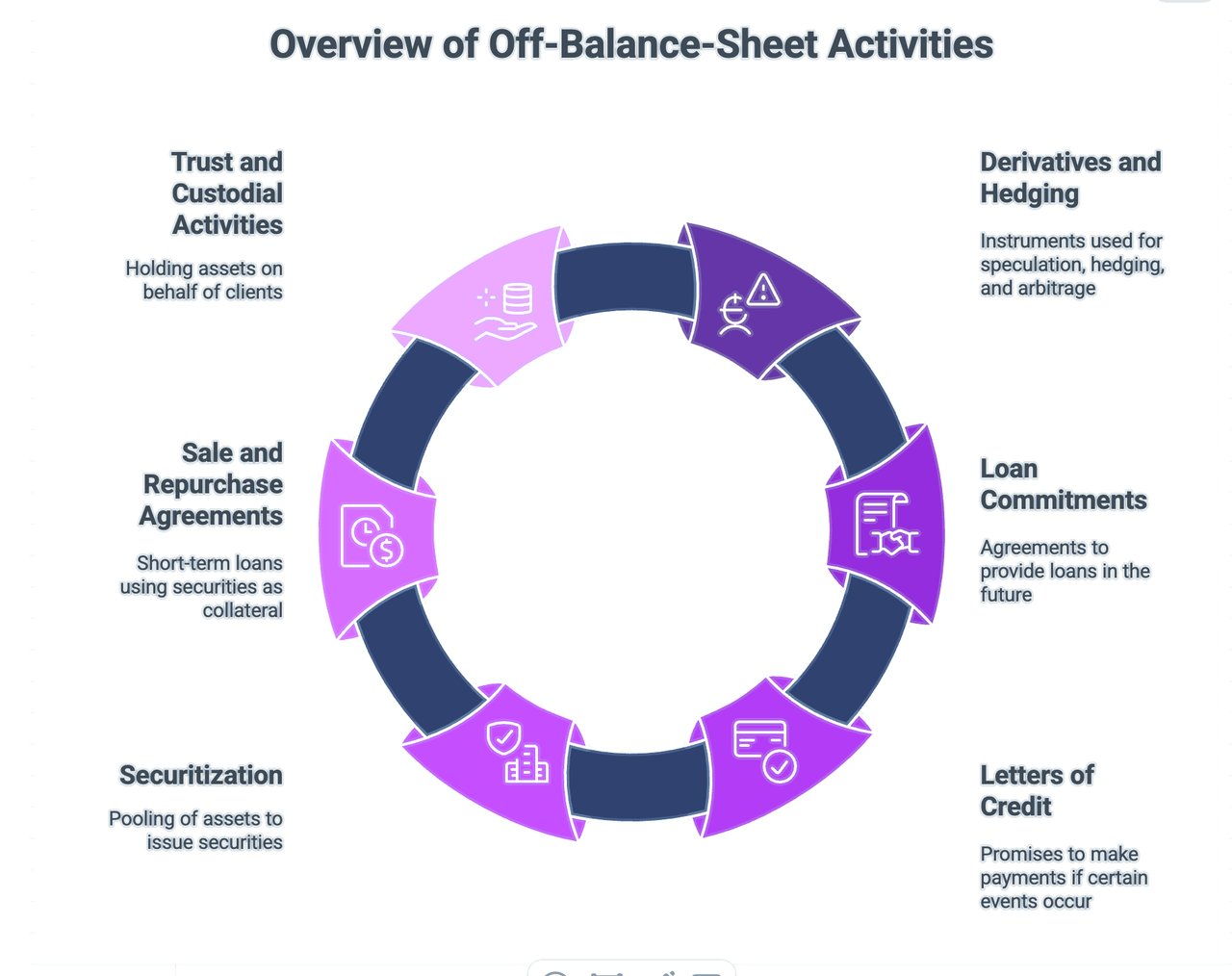
Common types of off-balance-sheet activities in banking include:
- Derivatives and Hedging Activities: These are instruments whose value is derived from underlying assets, liabilities, or indices. Common derivatives include futures, options, swaps, and forward contracts. They are used for speculation, hedging, and arbitrage. For example, a bank might use a currency swap to hedge against exchange rate risk. Under IFRS 9, derivatives are carried at fair value on the balance sheet, but their notional amounts – often many times larger – are reported only in the notes, which is why derivatives are traditionally counted as off-balance-sheet business.
- Loan Commitments: These are agreements by a bank to provide a loan at a future date under specified terms. The bank does not record a loan on its balance sheet until it disburses the funds. However, the commitment can still expose the bank to risk significantly if the borrower’s creditworthiness deteriorates before the loan is paid.
- Letters of Credit and Financial Guarantees: These are promises by a bank to make payment to a third party if a specific event occurs. For example, a bank might issue a letter of credit guaranteeing payment to a supplier if the bank’s client fails to pay. These instruments can create contingent liabilities for the bank that are not recorded on the balance sheet.
- Securitization and Asset-Backed Securities: In a securitization transaction, a bank might pool loans or other assets and sell them to a special purpose entity (SPE), which then issues securities backed by the cash flows from the assets. If the bank does not control the SPE (IFRS 10), the SPE is not consolidated and its assets and liabilities do not appear on the bank’s balance sheet. However, if the bank provides credit enhancements or liquidity support to the SPE, it can expose the bank to risk.
- Sale and Repurchase Agreements (Repos): A repo is a transaction in which one party sells a security to another party with an agreement to repurchase it at a specified price on a specified date. For the seller, a repo is effectively a short-term loan with the security serving as collateral. From a balance sheet perspective, the seller usually continues to recognise the security as an asset and records a liability for the repurchase obligation – so a repo is on balance sheet for the cash borrower, while the related commitments are disclosed off balance sheet.
- Trust and Custodial Activities: Banks often act as trustees or custodians, holding assets on behalf of clients. These assets do not belong to the bank and are not recorded on its balance sheet, but the bank may earn fees for providing these services.
While these off-balance-sheet activities can provide banks with additional sources of income and ways to manage risk, they can also expose banks to significant risks. These risks can include credit risk (the risk of loss from a borrower’s failure to repay a loan), market risk (the risk of loss from changes in market prices), operational risk (the risk of loss from inadequate or failed processes, people, and systems), and legal risk (the risk of loss from litigation or non-compliance with laws and regulations).
Off-Balance-Sheet Sovereign Finance
The Hidden Architecture of Public Debt
Understanding LGFVs, Public Authorities and Quasi-Fiscal Borrowing
In modern finance, sovereign indebtedness is often considerably larger than official government debt statistics suggest. Across numerous jurisdictions, governments have historically relied upon affiliated entities, public corporations, special-purpose vehicles and infrastructure authorities to finance expenditures beyond the confines of formal state budgets.
This phenomenon is generally referred to as off-balance-sheet public-sector financing, quasi-fiscal borrowing, or hidden sovereign debt.
Whilst such structures can provide flexibility and accelerate infrastructure development, they can also obscure fiscal realities, distort risk assessments and create substantial contingent liabilities for banking systems and taxpayers.
What Is Off-Balance-Sheet Government Borrowing?
Off-balance-sheet borrowing occurs when liabilities are incurred by entities that are legally separate from the sovereign or local government itself, yet remain economically dependent upon public support.
Examples include:
- Local Government Financing Vehicles (LGFVs)
- Municipal infrastructure corporations
- Public development authorities
- State-owned enterprises (SOEs)
- Public utility companies
- Regional development agencies
- Special-purpose infrastructure vehicles
- Public-private partnership entities with implicit state guarantees
Although the debt may not formally appear within government budget accounts, investors frequently assume that the underlying government will ultimately support these obligations.
The result is the emergence of substantial contingent liabilities that may not be immediately visible in official debt metrics.
The Chinese LGFV Model
The most significant contemporary example is found in the People’s Republic of China through the use of Local Government Financing Vehicles (LGFVs).
LGFVs are state-owned entities established by provincial, municipal and local governments to fund infrastructure projects, urban development schemes, transportation networks, industrial parks and land development initiatives.
Historically, Chinese local governments faced restrictions on direct borrowing. To circumvent these limitations, financing activities were transferred to legally distinct corporate entities.
These entities raised capital through:
- Bank loans
- Corporate bond issuance
- Trust financing
- Wealth-management products
- Shadow banking channels
- Asset-backed structures
The liabilities therefore appeared on the balance sheets of the LGFVs rather than on the official balance sheets of local governments.
Economically, however, markets largely treated the debt as carrying an implicit governmental guarantee.
The International Monetary Fund and numerous academic studies have repeatedly identified LGFV liabilities as one of the principal sources of China’s hidden public-sector debt burden.
International Parallels
China is not unique.
Various forms of off-budget public financing have appeared across both developed and emerging economies.
United States
Numerous infrastructure projects are financed through:
- Port authorities
- Airport authorities
- Toll-road authorities
- Water districts
- Transportation agencies
- Municipal bond issuers
Whilst generally transparent and legally regulated, these entities often operate outside direct government balance sheets.
Spain
Following the European sovereign debt crisis, several autonomous communities and affiliated public-sector entities were found to have accumulated liabilities that exceeded previously reported fiscal positions.
Portugal
The Madeira regional debt crisis exposed significant unreported liabilities associated with regional entities and public-sector structures, leading to substantial fiscal repercussions.
India
State-owned electricity distribution companies accumulated large debt burdens supported by explicit and implicit state guarantees, ultimately requiring restructuring and public intervention.
Brazil
State-owned enterprises and regional public institutions have historically been used as channels for quasi-fiscal financing, creating contingent liabilities for federal authorities.
Why Governments Use Such Structures
The rationale is usually straightforward.
Governments seek to:
- Accelerate infrastructure investment
- Circumvent borrowing limits
- Preserve fiscal ratios
- Avoid political resistance to higher public debt
- Finance long-term projects through specialised vehicles
- Attract private capital participation
In many cases these objectives are legitimate.
Infrastructure projects often require financing horizons that exceed ordinary budget cycles.
Special-purpose entities can improve operational efficiency and facilitate project execution.
The difficulty arises when economic substance diverges from legal form.
The Core Risk: Hidden Sovereign Exposure
The principal concern is not necessarily the existence of these entities.
The concern arises when markets, regulators or taxpayers underestimate the extent of governmental support obligations.
When public-sector affiliates become financially distressed, governments frequently face three unattractive options:
- Bail out the entity.
- Permit default and risk systemic instability.
- Transfer liabilities onto the sovereign balance sheet.
As a result, debt that was previously considered separate can rapidly become sovereign debt.
This process was observed repeatedly during the Global Financial Crisis, the European sovereign debt crisis and more recently in several Chinese provinces experiencing LGFV distress.
Banking Sector Implications
For financial institutions, the distinction between legal liability and economic liability is critical.
Credit analysis must evaluate:
- Ownership structures
- Government support mechanisms
- Revenue independence
- Fiscal linkages
- Political importance
- Implicit guarantees
- Refinancing dependence
A legally independent borrower may in reality function as an extension of the public sector.
Conversely, some public-sector entities operate on a genuinely commercial basis and should not automatically be viewed as sovereign risks.
The distinction requires rigorous balance-sheet analysis rather than reliance upon legal classifications alone.
Summary
The history of public finance demonstrates a recurring principle:
Debt does not disappear merely because it is transferred to a different balance sheet.
Whether through Chinese LGFVs, municipal authorities, public enterprises or infrastructure corporations, off-balance-sheet financing structures remain economically relevant when governments retain ultimate responsibility for their survival.
For investors, banks and policymakers, understanding these contingent obligations is essential to assessing sovereign risk, financial stability and the true condition of public-sector balance sheets.
In modern credit analysis, the most important liabilities are often those that do not immediately appear in official debt statistics.



Next step
Request an introduction
Tell us in a few lines who you are and what you have in mind. Your enquiry goes directly to the bank and is treated in confidence.
Prefer to talk? Book a 30-minute videoconference.