
Strategic Finance Architecture for Sovereigns
Institutional frameworks for long-tenor national financing capacity under modern fiscal, monetary, and geopolitical constraints.
The Sovereign Constraint Environment
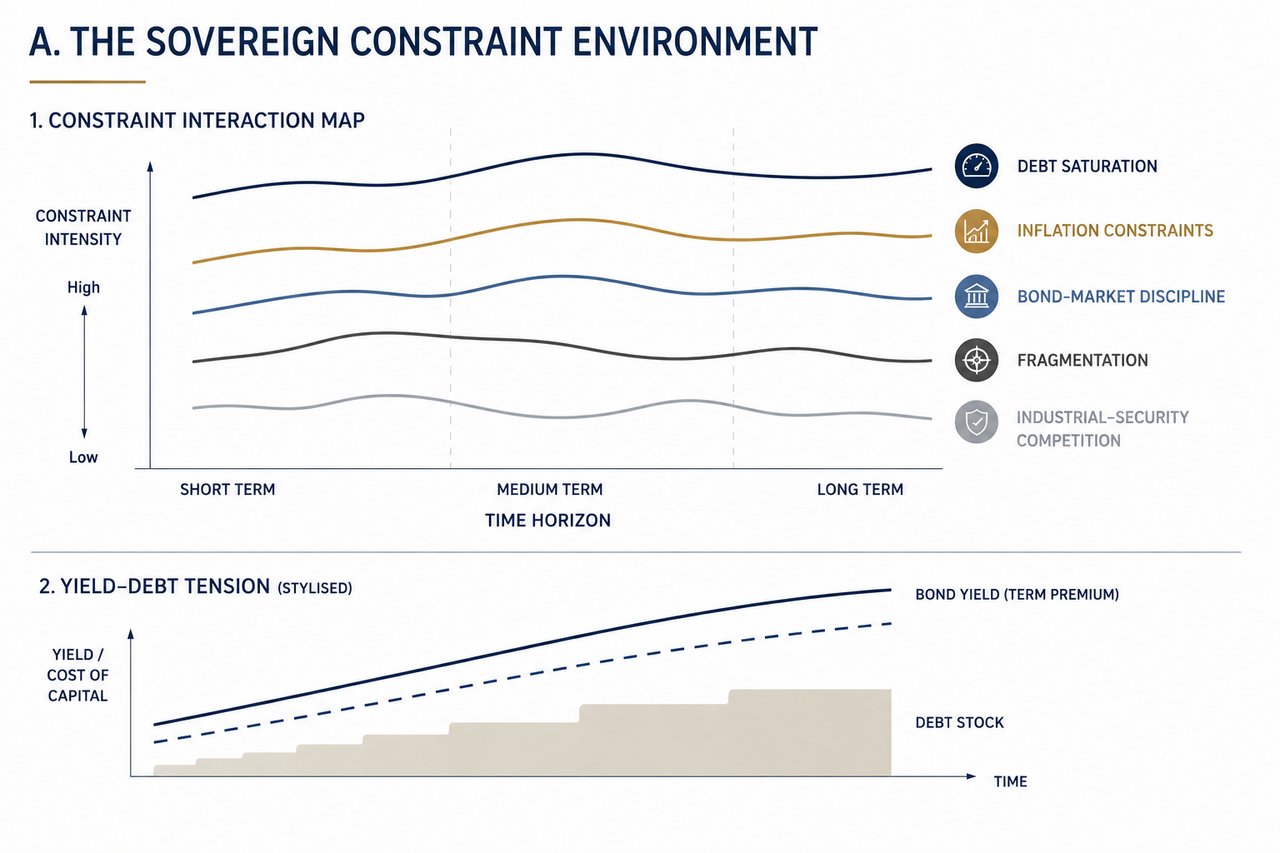
Sovereign finance is operating within a materially altered constraint environment. The combination of elevated debt levels, inflation sensitivity, market discipline, geopolitical fragmentation, and rising industrial-security demands has fundamentally changed the conditions under which states can finance long-term strategic objectives.
Debt saturation limits the capacity for conventional fiscal expansion without triggering adverse market reactions. Inflation has re-emerged as a binding constraint, restricting the use of monetary accommodation and increasing the sensitivity of policy to expectations rather than realised outcomes. Bond markets now impose immediate discipline on fiscal trajectories, with long-end yields reflecting not only current issuance but forward credibility.
At the same time, the global system is fragmenting. Trade, capital flows, technology, and financial infrastructure are increasingly shaped by geopolitical alignment rather than pure economic efficiency. This fragmentation raises the cost of capital, reduces the reliability of external supply chains, and introduces structural uncertainty into sovereign planning.
Overlaying these dynamics is a renewed phase of industrial and security competition. Defence capability, energy security, critical minerals, technological infrastructure, and resilient supply chains now require sustained, long-tenor investment at scale.
The result is a structural tension: financing requirements are rising precisely as traditional financing channels become more constrained. Sovereigns must therefore move beyond single-instrument solutions toward integrated financing architectures capable of operating within these constraints.
The Four-Layer Architecture
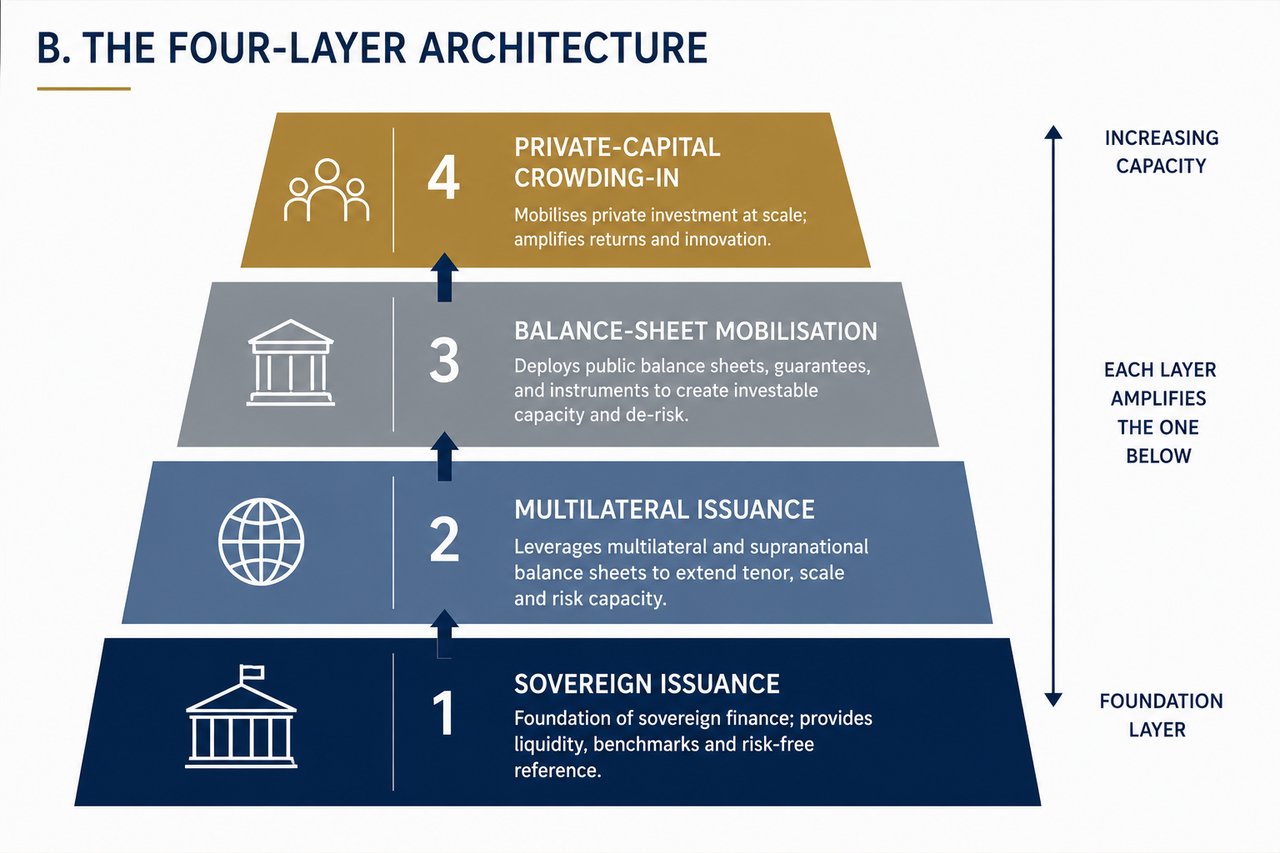
Effective sovereign financing is no longer achieved through a single channel. It requires a layered architecture in which each component performs a distinct and complementary function.
The first layer remains sovereign issuance. Government debt markets continue to provide the base level of funding, offering scale, liquidity, and benchmark pricing. However, their capacity is bounded by debt sustainability, market absorption, and interest-rate sensitivity.
The second layer consists of multilateral and supranational issuance. Institutions with pooled credit strength and preferred creditor status extend financing capacity beyond individual sovereign limits. These structures can provide scale and duration, but depend on political alignment and institutional mandates.
The third layer is balance-sheet mobilisation. This is the structural core of modern sovereign finance. It involves the disciplined use of public-sector balance sheets, development institutions, guarantee capacity, and strategic assets to generate long-tenor financing without relying solely on direct sovereign borrowing. Properly structured, this layer expands capacity while remaining within legal, accounting, and market constraints.
The fourth layer is private-capital mobilisation. Private capital is not a substitute for sovereign financing, but an amplifier of it. Where revenue visibility, risk allocation, and institutional credibility are sufficient, private capital can scale investment beyond what public balance sheets alone can support. Where these conditions are absent, it does not enter.
The effectiveness of the system depends on sequencing and interaction. Each layer must be used for the purpose it is structurally suited to perform. Misallocation – for example, expecting private capital to replace sovereign demand, or expecting sovereign issuance to carry all financing requirements – leads to instability.
The Classification Problem
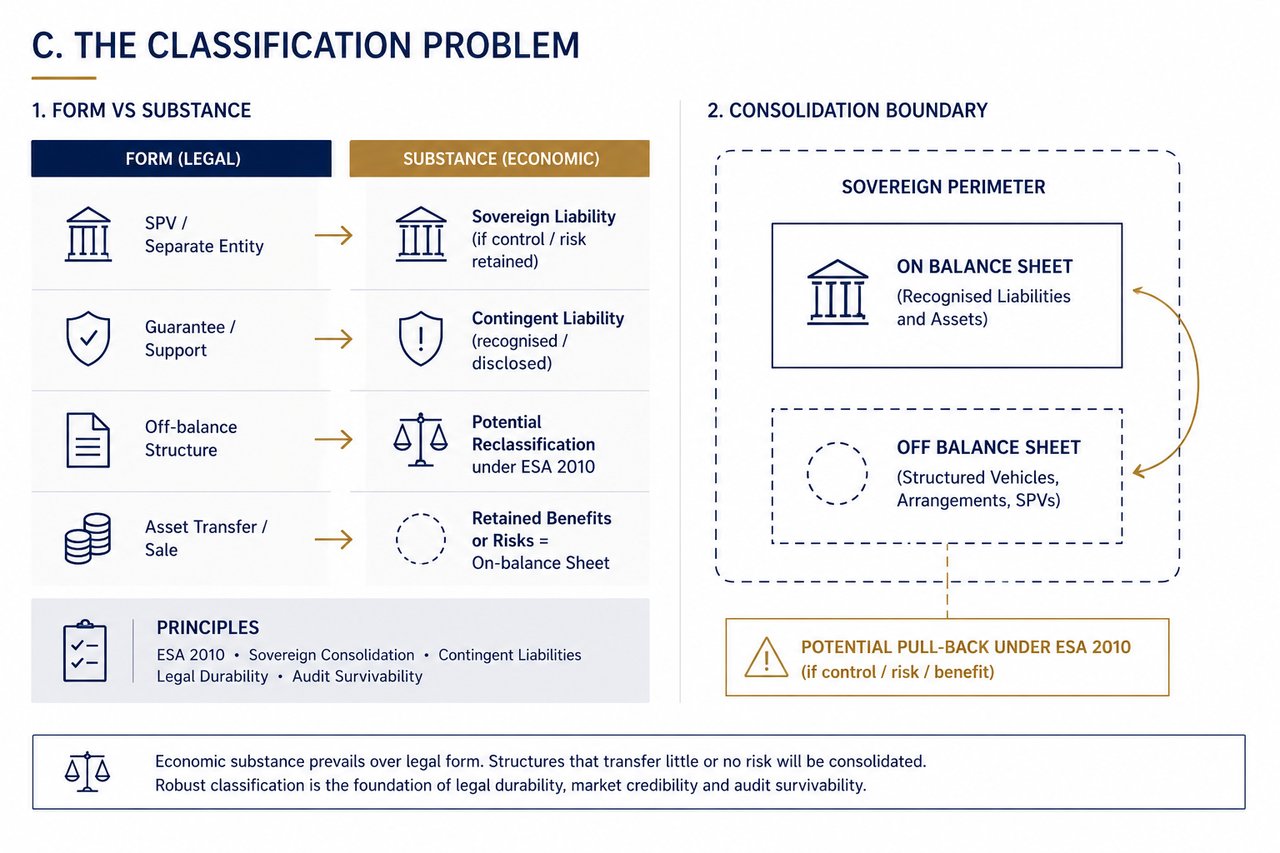
At sovereign scale, the decisive constraint is not access to capital but classification of risk.
Financial structures are ultimately governed not by their legal form but by their economic substance. Under frameworks such as ESA 2010, exposures are assessed based on control, risk transfer, and economic reality. Where the public sector retains effective control or bears material downside risk, liabilities are treated as sovereign in substance, irrespective of formal structuring.
This creates a fundamental discipline. Structures that attempt to shift liabilities off balance sheet without transferring underlying risk are inherently unstable. They are subject to reclassification, audit challenge, and loss of market credibility.
Contingent liabilities play a central role in this dynamic. Guarantees, first-loss positions, and support mechanisms can expand financing capacity, but they are not free. They represent latent fiscal exposure that must be recognised, priced, and managed.
Legal durability becomes a primary design criterion. Financing structures must withstand adversarial legal review, regulatory scrutiny, and potential political change. Mechanisms dependent on reversible conditions, uncertain legal standing, or contested asset claims do not provide reliable financing capacity.
Audit survivability is equally critical. Any structure must be capable of passing independent audit without qualification. If a structure cannot be defended under rigorous accounting and disclosure standards, it cannot form part of a credible sovereign financing framework.
This classification discipline distinguishes strong financing architecture from financial engineering. The objective is not to minimise visible debt metrics, but to construct structures that are economically real, legally sound, and institutionally credible.
Strategic Finance Institution Design
To operationalise a multi-layered financing architecture, sovereigns increasingly require dedicated strategic-finance institutions designed for long-tenor capital deployment.
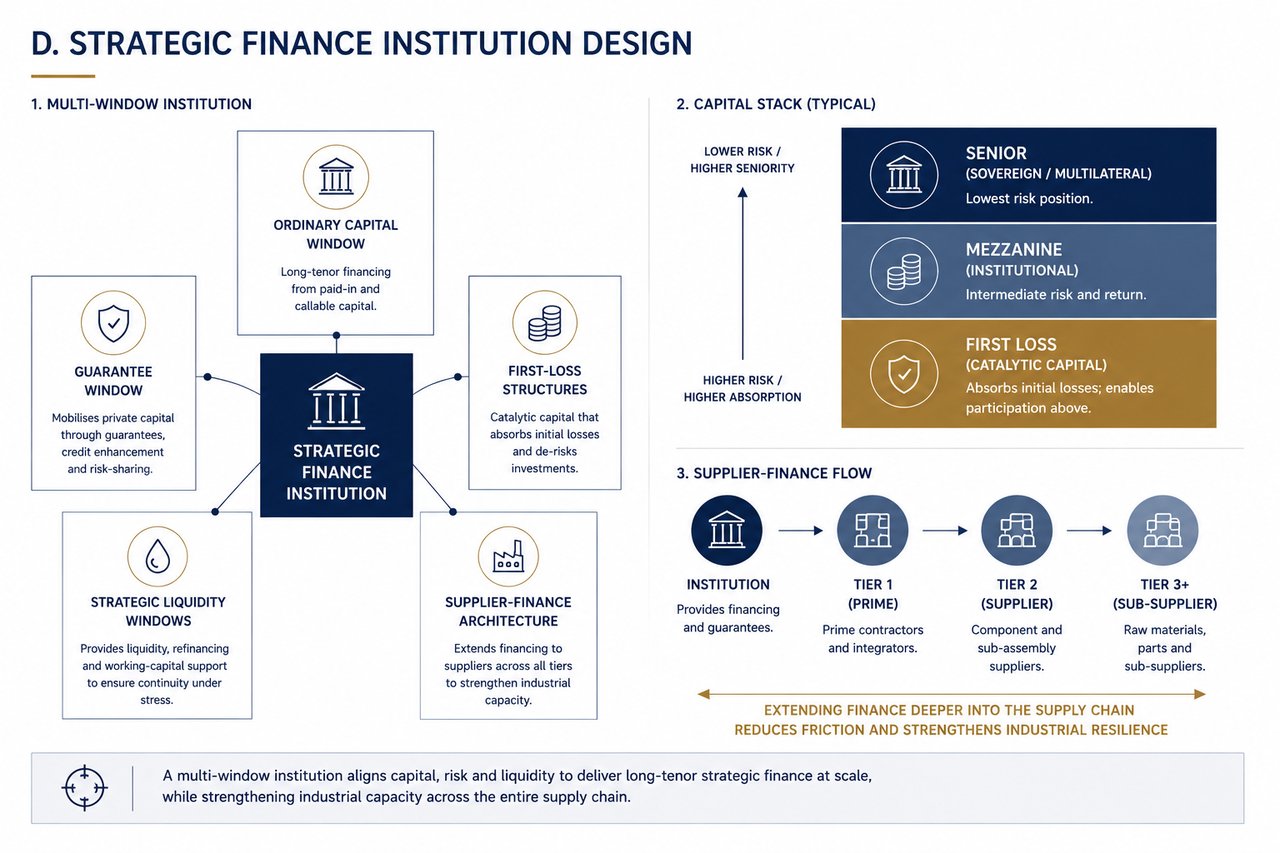
These institutions are not conventional banks. They are structured as multi-window balance-sheet platforms, each component designed to address a specific financing function.
The ordinary capital window provides senior lending capacity based on paid-in and callable capital. It delivers long-term funding aligned with sovereign credit quality and institutional mandates.
The guarantee window extends risk capacity by supporting private lending and investment through partial guarantees, credit enhancement, and risk-sharing mechanisms. Its purpose is to mobilise capital that would not otherwise enter strategic sectors.
First-loss structures provide catalytic capital. By absorbing defined initial losses, they enable institutional investors to participate in assets that would otherwise fall outside acceptable risk parameters. The key requirement is transparency: risk must be explicitly allocated, not obscured.
Strategic liquidity windows ensure continuity under stress. They provide refinancing capacity, working-capital support, and stabilisation mechanisms to prevent disruption of critical supply chains and production systems.
Supplier-finance architecture extends financing beyond primary contractors into second- and third-tier suppliers. This is essential, as production bottlenecks typically occur at these levels rather than at prime contractors.
The design of such institutions must be aligned with legal frameworks, accounting standards, and market expectations from inception. The objective is not to create parallel structures outside the system, but to build institutions that operate fully within it while expanding its effective capacity.
When properly constructed, these institutions form the operational backbone of sovereign strategic finance, translating policy objectives into executable, scalable, and durable financing programmes.
Sovereign Financing
Ten questions that narrow the modalities to the main five that fit your situation – and stress-test the coverage ratio while you are there.