
Financial Fraud
Card Network Uploads

The Myth of Funds uploaded to the Cloud of Visa, Mastercard, and other Payment Networks
Understanding the Reality
In the world of financial transactions, there is a persistent myth surrounding companies like Visa, Mastercard, American Express, and others: that they somehow “store” funds in their cloud or servers, and individuals can access vast amounts of money by tapping into these networks directly. This misconception is rooted in a misunderstanding of the roles these companies play within the financial ecosystem. It’s crucial to clarify that Visa, Mastercard, American Express, Diners, Union Pay, Discover, and similar entities do not hold or manage funds themselves, but instead, function as essential conduits within the payment process.
The myth of card “protocols” such as ”101.1 to 101.9” and ”201.1 to 201.9” often connected with physical or cloud POS operations is a prime example of misinformation circulating within certain financial circles, often invoking a sense of exclusivity and secretive insider knowledge. These so-called protocols, purported to control or open special transaction privileges or hidden functionalities within payment networks like Visa, Mastercard, and American Express, are entirely fictitious. No manual or documentation from any legitimate financial institution or card issuer references these protocols, nor do they exist within any standard operating procedures for card transactions. In reality, “101” and “201” are genuine three-digit service codes stored on a card’s magnetic stripe: 101 indicates an international card without a chip, 201 an international chip card. Fraudsters misuse these codes, which merely describe a card’s capabilities, to dress up invented “protocols”.
These myths are frequently propagated by fraudsters aiming to exploit the lack of understanding around payment systems, presenting nonexistent codes as a gateway to financial manipulation or hidden wealth. In reality, payment networks operate based on universally recognized standards and security measures, all of which are transparently documented and accessible through proper regulatory channels.
What Exactly Do Visa, Mastercard, and Other Payment Networks Do?
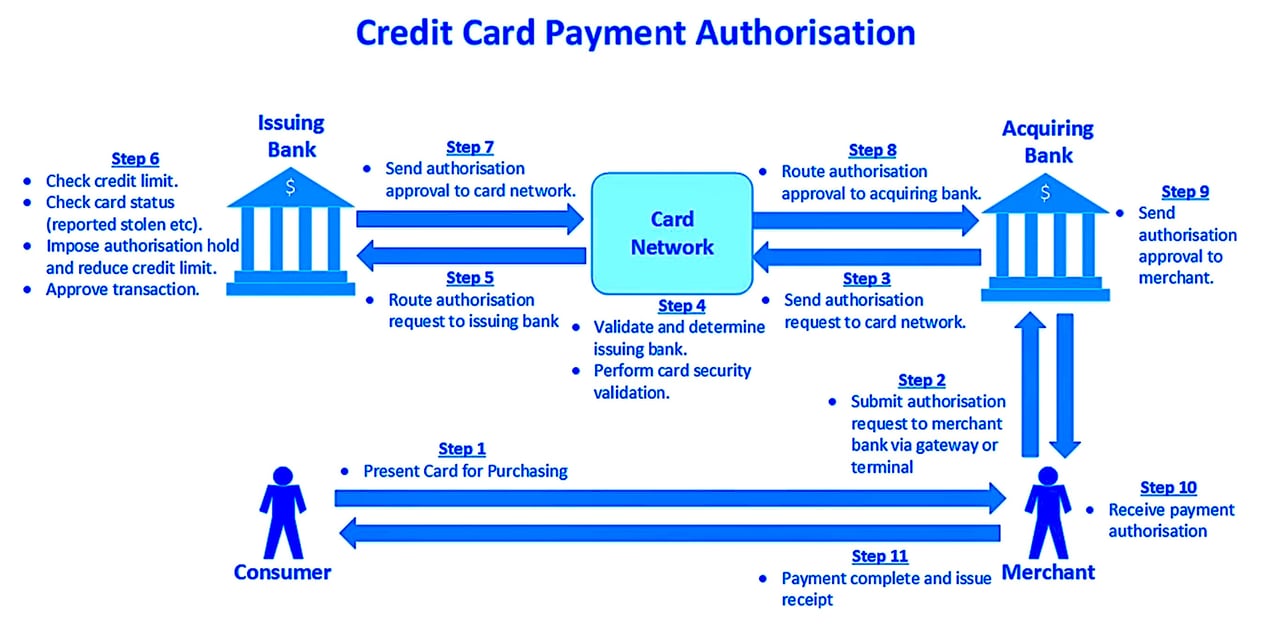
Visa, Mastercard, American Express, and their counterparts operate as payment networks, facilitating the smooth and secure transmission of transaction information between consumers, merchants, and banks. When you swipe a credit or debit card, or enter your card details online, these companies are responsible for routing the payment information from the merchant to the card issuer (typically your bank) and ensuring the transaction is properly authorized, cleared, and settled.
To break it down:
- Visa, Mastercard, and Union Pay are primarily payment networks. They do not issue credit or debit cards directly; instead, they partner with financial institutions like banks that issue cards under their network’s brand. When you use a Visa or Mastercard card, the bank that issued the card is the one authorizing and handling the payment: not Visa or Mastercard themselves. These companies simply ensure that the payment is processed securely and efficiently.
- American Express and Discover play a dual role. Unlike Visa and Mastercard, they are both payment networks *and* card issuers. This means that, in addition to providing the infrastructure to facilitate transactions, they also issue their own cards and handle the payment authorization themselves for those cards.
Pseudo-Technical Card Settlement Schemes
A Structural Analysis of a Persistent Financial Fraud Pattern
Across jurisdictions and sectors, a recurring category of financial fraud has established itself by exploiting the opacity and technical complexity of global card payment systems. These schemes do not rely on forged bank guarantees or fictitious central bank instruments, but instead on the deliberate misrepresentation of how card networks and interbank settlement actually function.
1. The Strategic Use of Complexity
Modern card payment systems are among the most complex yet standardised financial infrastructures in existence. They involve multiple actors, proprietary message formats, and multilayered settlement cycles. Fraud schemes of this class exploit this complexity by selectively borrowing authentic terminology while disconnecting it from its real operational context.
References to systems operated by Visa, Mastercard, or similar networks are used not to describe genuine processes, but to overwhelm non-specialists with jargon that appears authoritative.
The fraud does not depend on technical accuracy. It depends on perceived plausibility.
2. Core Narrative Architecture
While surface details vary, these schemes tend to share a common narrative structure:
- A transaction is described as “special”, “non-standard”, or “off-market”.
- Settlement is portrayed as conditional upon discretionary human action rather than automated systems.
- The process is framed as rare, misunderstood, or known only to insiders.
- Documentation is presented that resembles banking outputs but cannot be independently verified.
The unifying feature is the assertion that funds exist in a liminal state: neither fully unreal nor fully settled, but awaiting some form of acceptance or release.
3. Misrepresentation of Card Network Roles
A central pillar of these schemes is the mischaracterisation of what card networks actually do.
Card networks do not:
- Hold customer funds.
- Initiate payments.
- Credit corporate or personal accounts.
- Operate at branch or account level.
Their role is limited to authorisation messaging, clearing, and net settlement between member institutions. Any narrative that assigns them an active role in delivering funds to an end beneficiary departs from operational reality.
This distinction is fundamental and non-negotiable.
4. The Fiction of Discretionary Settlement
A recurring motif is the claim that settlement depends on manual review or approval by a bank.
In legitimate systems:
- Settlement obligations are mathematical outcomes of cleared transactions.
- Net positions are calculated algorithmically.
- Settlement is executed automatically via predesignated accounts.
There is no procedural step at which a bank employee evaluates whether settlement should occur. Introducing discretion would undermine reconciliation, auditability, and regulatory compliance, rendering the entire system unstable.
The idea of discretionary settlement is not merely inaccurate; it is structurally impossible.
5. Structural Impossibility as the Key Indicator
The decisive test is not whether a document looks genuine, but whether the described process could exist without dismantling decades of financial controls.
For these schemes to be real:
- Card networks would need to abandon net settlement.
- Banks would need to introduce discretionary settlement authority.
- Regulatory audit trails would need to be bypassed.
- Reconciliation processes would need to fail silently.
This combination has never occurred in functioning financial systems.
6. Final Perspective
Pseudo-technical card settlement schemes are not innovative financial instruments, misunderstood legacy processes, or emerging payment technologies. They are narrative constructions that appropriate the language of real systems while violating their core principles.
Understanding how card networks actually function renders these schemes transparent. Their sophistication is linguistic, not financial.
Once the underlying architecture is examined, the illusion collapses.
Do These Networks Hold Your Funds?
No. It’s a common misunderstanding to think that the funds linked to your card are somehow stored in a “cloud” managed by Visa, Mastercard, or American Express. In reality, the funds in your bank account (for debit cards) or the credit available to you (for credit cards) are managed entirely by the financial institution that issued your card. These funds are securely held by your bank, not by the payment networks themselves.
Visa, Mastercard, and similar companies merely provide the infrastructure through which the transaction data is transmitted. They help ensure that when you make a purchase, the request to move money from your account (or credit line) to the merchant’s account is processed efficiently and securely. At no point do these networks hold the actual funds.
Clearing, Authorization, and Settlement: The Real Process
Here’s how a typical transaction works when you use a payment card:
- Authorization: When you make a purchase, the merchant sends the payment details to their bank (called the acquiring bank). The acquiring bank then contacts the payment network (e.g., Visa or Mastercard), which routes the transaction request to your card’s issuing bank (your bank). Your bank checks whether you have sufficient funds or credit and approves or denies the transaction. Visa or Mastercard do not make this decision: they simply pass the request along.
- Clearing: Once the transaction is authorized, the acquiring bank (the merchant’s bank) sends the payment details to the issuing bank (your bank), specifying the exact amount owed. Again, this process is facilitated by the payment network, but the movement of money involves only the banks.
- Settlement: Finally, the issuing bank pays the acquiring bank through settlement accounts whose net positions the network’s settlement service calculates and coordinates; the acquirer then credits the merchant’s account. The network does not hold customer funds.
Setting Standards: The Role of Payment Networks Beyond Transactions
Visa, Mastercard, American Express, Diners, and Union Pay also play a crucial role in establishing standards for how transactions should be processed. They set guidelines for merchants, payment facilitators, and marketplaces, ensuring that transactions are secure and compliant with global financial regulations. These standards protect consumers from fraud and ensure the reliability of the payment system as a whole.
However, even in this regulatory capacity, these companies do not hold or manage the funds themselves. Their role is limited to ensuring that the process of moving funds between banks is smooth and secure. The myth that funds are somehow stored or controlled by these entities is simply a misinterpretation of their actual function.
The Special Case of Cryptocurrency and Digital Wallets
With the rise of digital wallets and cryptocurrency, the myth of “funds stored in the cloud” has gained more traction, but it remains just that: a myth. Even with digital payment services like Apple Pay, Google Pay, or cryptocurrency wallets, the underlying funds are still held by financial institutions or blockchain-based wallets: not by Visa, Mastercard, or any other payment networks. These companies may provide the technology to facilitate faster or more convenient payments, but they still do not hold any actual funds.
In Summary: Payment Networks Are Not Banks
To dispel the myth once and for all: Visa, Mastercard, Diners, Union Pay, American Express, and other similar networks do not store funds in any form. They act as intermediaries, providing the technology and infrastructure necessary to process payments between consumers, merchants, and banks. The actual movement of money happens between the banks that issue and acquire payments, and in the case of American Express and Discover, between their own issuing and acquiring systems.
Understanding this distinction is critical to appreciating the sophisticated yet transparent nature of modern financial transactions. Rather than holding funds, these networks ensure that your money moves securely and efficiently through the system, connecting consumers and merchants around the world.

The Fiction of Secret POS Protocols – 101.x and 201.x
Introduction
In the world of payment processing fraud, few myths are as persistent as the so-called “secret POS protocols,” numbered from 101.1 to 101.9 and 201.1 to 201.9. Promoters of these schemes claim that each code opens a special function in POS terminals or card networks that bypasses standard security, authorisation, and settlement procedures.
These codes are fabrications. They appear in no official Visa, Mastercard, American Express, UnionPay, EMVCo, or ISO 8583 technical specification. They are invented to give an illusion of insider knowledge and to lure intermediaries into paying large “activation” or “licence” fees for access to non-existent capabilities.
The 101.x Series – The Manual Entry Myths
101.1 – “Instant Batch Override”
The Claim:
Fraudsters present “101.1” as a hidden POS function that allows merchants to settle manually entered transactions instantly, bypassing normal acquirer and card network settlement delays. They frame it as a “VIP mode” for high-volume merchants.
The Reality:
All transactions, regardless of input method, must pass:
- Through the acquirer for initial acceptance.
- Through the card network for routing.
- To the issuer for authorisation.
Settlement occurs in network-scheduled batches. There is no instant settlement protocol in Visa, Mastercard, or EMV documentation.
The Target Audience:
Merchants under cash flow pressure; intermediaries seeking a high-margin “exclusive” product.
Why It Works:
Exploits frustration with settlement delays and ignorance of how clearing cycles are fixed.
The Appeal:
“Cash in your account instantly: no waiting, no bank delays.”
101.2 – “Cross-Border Manual Settlement”
The Claim:
“101.2” allegedly forces foreign-issued cards to settle domestically for faster clearance and lower fees.
The Reality:
Cross-border settlement paths are fixed by the card network’s interchange routing tables. Terminals cannot change the route. No such override exists in network architecture.
The Target Audience:
Merchants dealing heavily in international card transactions.
Why It Works:
Offers the fantasy of avoiding foreign interchange fees and delays.
The Appeal:
“Treat any card like a local one: save money and get paid faster.
101.3 – “Duplicate Card Data Injection”
The Claim:
Sending two identical transactions in sequence allegedly tricks the system into auto-approving the second one.
The Reality:
Networks run duplicate detection. Repeated identical transactions are flagged and declined; merchants may be investigated.
The Target Audience:
Intermediaries handling failed transactions who want to “force” a retry.
Why It Works:
Appeals to the gambler’s fallacy: “if the first failed, the second might sneak through.”
The Appeal:
“Turn declines into approvals with a secret sequence insiders use.”
101.4 – “Floor Limit Abuse”
The Claim:
“101.4” supposedly abuses contactless “floor limits” to bypass issuer authorisation for high-value manual entries.
The Reality:
Floor limits apply only to low-value card-present transactions approved offline under terminal and issuer rules. Manual key entry always requires issuer authorisation.
The Target Audience:
Merchants in cash-intensive sectors seeking high-value approvals without issuer involvement.
Why It Works:
Misuses a real term (“floor limit”) to add credibility to an impossible claim.
The Appeal:
“High-value transactions processed instantly: no issuer oversight.”
101.5 – “Merchant ID Override”
The Claim:
A terminal code that switches the merchant account to one with privileged settings.
The Reality:
Merchant IDs are fixed at the acquirer’s back-office level. Terminals cannot alter them locally.
The Target Audience:
Merchants placed in high-risk MCC codes looking to disguise their nature.
Why It Works:
Plays on the idea of changing your “identity” in the payment network to bypass restrictions.
The Appeal:
“Operate under a clean merchant profile at the touch of a button.”
101.6 – “Card-Not-Present Forced Approval”
The Claim:
Converts CNP transactions into card-present status, fooling the issuer into approving them.
The Reality:
Card-present or card-not-present status is signalled in the POS entry mode (ISO 8583 field 22) and verified through chip cryptograms; mismatches are declined.
The Target Audience:
Online merchants with high decline rates.
Why It Works:
Targets those who know card-present has lower fraud checks but don’t understand data-level validation.
The Appeal:
“Make your online sales look like in-store swipes for higher approval rates.”
101.7 – “Manual Refund Exploit”
The Claim:
Allows issuing refunds without an original sale, creating a direct credit to an account.
The Reality:
Refunds are normally linked to an original sale; standalone credits are restricted and closely monitored by acquirers and networks.
The Target Audience:
Fraudsters seeking a cash-out method without sales activity.
Why It Works:
Presents as a “loophole” in refund processing.
The Appeal:
“Credit any account instantly: no sale required.”
101.8 – “Manual Punching POS”
The Claim:
Manual key-in forces approval without issuer verification, using “backdoor merchant IDs.”
The Reality:
Manual entry still requires standard issuer authorisation; no bypass exists.
The Target Audience:
Intermediaries and high-risk merchants rejected by acquirers.
Why It Works:
Appeals to those tired of declines and convinced of insider backdoors.
The Appeal:
“Never get a decline again: every card works.”
101.9 – “Blind Settlement Injection”
The Claim:
Injects settlement data directly into network queues without matching authorisations.
The Reality:
Settlement files are matched to authorisation logs; unmatched entries are rejected.
The Target Audience:
Payment scheme newcomers with little understanding of reconciliation.
Why It Works:
Taps into belief that settlement is just “sending a file” and not a verified process.
The Appeal:
“Upload your own payments directly into the network: no bank required.”
The 201.x Series – The Offline and Pre-Authorisation Fantasies
201.1 – “Delayed Authorisation Sweep”
The Claim:
Batch transactions in a way that avoids real-time authorisation.
The Reality:
Delayed authorisations still require issuer approval before funds release.
The Target Audience:
Merchants in low-connectivity areas.
Why It Works:
Abuses the genuine concept of “store-and-forward” to suggest approval without checks.
The Appeal:
“Approve sales even without a live connection.”
201.2 – “Cross-Acquirer Blind Push”
The Claim:
Routes transactions to another acquirer without the merchant knowing.
The Reality:
Routing is locked by merchant–acquirer agreements; terminals can’t redirect traffic.
The Target Audience:
Merchants wanting lower fees or to avoid scrutiny from their acquirer.
Why It Works:
Suggests a secret way to choose your processor on the fly.
The Appeal:
“Send your transactions to the bank you choose: not the one you’re stuck with.”
201.3 – “Offline POS”
The Claim:
Hidden mode processes offline transactions bypassing authorisation.
The Reality:
Offline transactions still require issuer approval when uploaded; no bypass exists.
The Target Audience:
Merchants with unstable connectivity, shipboard operators, remote service providers.
Why It Works:
Exploits the real concept of offline EMV processing but removes the approval requirement.
The Appeal:
“Keep selling, even cut off from the network: get paid anyway.”
201.4 – “Multi-Card Aggregation”
The Claim:
Combine multiple small transactions into one large one to bypass controls.
The Reality:
Violates network rules and triggers fraud monitoring.
The Target Audience:
Merchants with small-ticket MCCs wanting to run large values.
Why It Works:
Appeals to the logic of “blending in” under threshold limits.
The Appeal:
“Hide large sales inside small-ticket processing.”
201.5 – “Pre-Authorisation + Completion Ratio 1/10000”
The Claim:
One in 10,000 completions is processed without matching pre-authorisation.
The Reality:
Every completion is matched; no statistical bypass exists.
The Target Audience:
Intermediaries chasing high-value single transactions.
Why It Works:
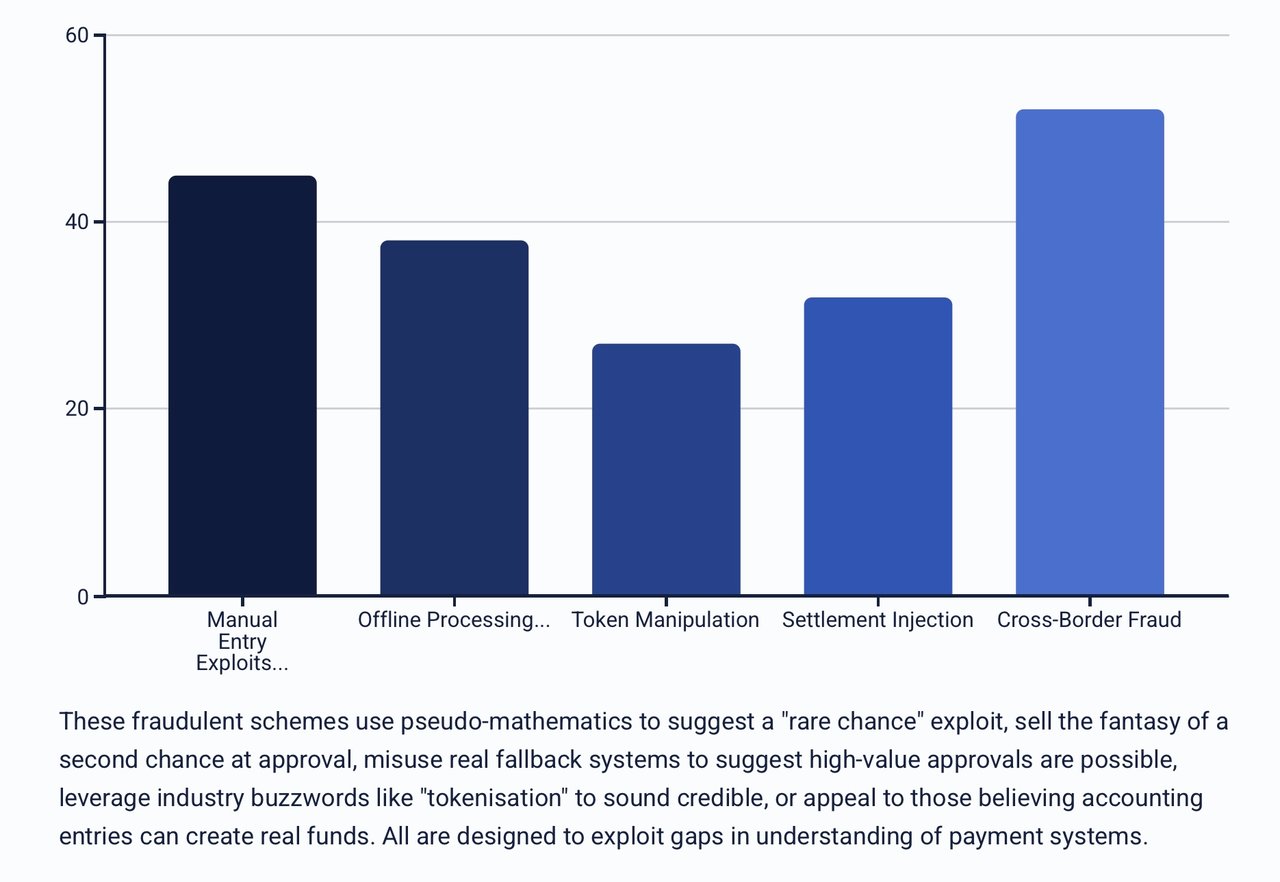
Uses pseudo-mathematics to suggest a “rare chance” exploit.
The Appeal:
“Slip through a high-value sale: 1 in 10,000 odds.”
201.6 – “Cascading Authorisation”
The Claim:
If declined, the transaction retries with another issuer.
The Reality:
BIN-specific routing means only the card’s own issuer can authorise.
The Target Audience:
Merchants with high decline rates.
Why It Works:
Sells the fantasy of a second chance at approval.
The Appeal:
“Never stop at one decline: give your sale another shot.”
201.7 – “Stand-In Exploit”
The Claim:
Force network stand-in processing (STIP) to approve high-value transactions.
The Reality:
STIP limits are issuer-defined and low-value capped.
The Target Audience:
Merchants seeking to approve transactions during issuer outages.
Why It Works:
Misuses a real fallback system to suggest high-value approvals are possible.
The Appeal:
“Approve big sales even if the bank is offline.”
201.8 – “Token Override”
The Claim:
Replace card data with a “trusted” token that always passes.
The Reality:
Tokens are verified against issuer token vaults; mismatches are declined.
The Target Audience:
Fraudsters with invalid card data.
Why It Works:
Leverages industry buzzword “tokenisation” to sound credible.
The Appeal:
“Use a golden key token to open any payment.”
201.9 – “Negative Settlement Offset”
The Claim:
Post a negative transaction to create a credit without a debit.
The Reality:
All clearing entries reconcile to original transactions; unmatched offsets are rejected.
The Target Audience:
Individuals seeking a “cash injection” without sales activity.
Why It Works:
Appeals to those believing accounting entries can create real funds.
The Appeal:
“Credit accounts from thin air with a negative post.”
If you want to read more, please follow the links



Next step
Request an introduction
Tell us in a few lines who you are and what you have in mind. Your enquiry goes directly to the bank and is treated in confidence.
Prefer to talk? Book a 30-minute videoconference.