
Accounts for the Diamond Industry
Our diamond accounts are custody accounts for physical diamonds, comparable to precious-metal accounts. The banking sector is crucial to the diamond industry, as traders rely on banking services for their operations, especially for transferring money to conduct trades.
Recently, however, diamond traders have faced challenges related to banking services. Due to increased regulatory scrutiny and concerns about money laundering, some banks have become wary of providing services to the diamond industry. This has led to issues such as banks closing accounts or refusing to offer basic services to diamond traders. These challenges are not limited to one specific country or region, but have been reported globally, such as in Belgium.
Diamond traders require strong record-keeping and checks due to past scandals and regulations, such as the Kimberley Process Certification Scheme (in force since 2003), which aims to prevent the trade in conflict diamonds.
Diamond traders, like many businesses, rely on a range of banking services to support their operations. Here are a few key services that are particularly important to diamond traders:
- Transaction Services: Diamond traders need to be able to make and receive payments, both domestically and internationally. This includes wire transfers and, where permitted, cheque services. These services are critical for buying from suppliers, selling to customers, and managing day-to-day expenses.
- Foreign Exchange Services: The diamond trade is a global industry, so traders often need to convert currencies. Banks can provide foreign exchange services to facilitate these transactions, offering competitive rates and ensuring that trades are executed in a timely manner.
- Trade Finance: This can include a range of services designed to facilitate international trade, such as letters of credit, which provide assurance of payment to suppliers, and invoice financing, which can help traders manage cash flow by providing advance payment on invoices.
- Loans and Credit Facilities: Diamond traders may need access to credit to finance purchases of inventory, invest in new equipment, or cover operational costs. This could be in the form of business loans, lines of credit, or overdraft facilities.
- Safekeeping and Custody Services: While banks may not typically offer accounts specifically for storing physical diamonds, they do offer safe deposit boxes where traders can securely store valuable items, including diamonds.
- Advisory Services: Banks often offer advisory services to help businesses manage their finances and plan for the future. This can include advice on managing cash flow, hedging foreign exchange risk, or planning for business expansion and challenges regarding money laundering and other risks.
In response to these challenges, we continue to provide our services to the Diamond Sector.
Indicative cost architecture
Costs of diamond custody (large parcels, fair market value of USD 10 million or more)
| Cost component | Usual pricing basis | Range (USD) |
|---|---|---|
| Onboarding and compliance | Flat fee or 0.02%–0.05% of FMV (minimum about 5,000) | 5,000–25,000 |
| Authentication and laboratory re-check | Per stone (USD 100–300) or 0.10% of FMV for bulk parcels | 10,000–75,000 |
| SKR issuance | Flat fee plus notarisation (if required) | 10,000–20,000 |
| Vaulting and custody | 0.15%–0.40% p.a. of insured value | 15,000–400,000 p.a. |
| Insurance (jewellers’ block) | 0.30%–1.00% p.a. of insured value; deductible typically 1% (minimum 100,000) | 30,000–1,000,000 p.a. |
| Periodic audit and revaluation | 0.02%–0.05% p.a. of FMV | 2,000–50,000 p.a. |
| Exceptional services (courier, special handling, legal opinions) | At cost plus 10%–15% administration margin | Variable |
Illustrative worked example
A USD 25 m portfolio of high-quality diamonds held for one year under standard terms will typically incur:
- Onboarding & SKR fee ≈ USD 30 k (0.12 %)*
- Authentication sample ≈ USD 25 k (0.10 %)
- Vaulting (0.25 %) ≈ USD 62.5 k
- Insurance (0.55 %) ≈ USD 137.5 k
- Audit & revaluation ≈ USD 10 k
Total Year-1 cost ≈ USD 265 k (≈ 1.06 % of FMV).
Subsequent years will omit the one-off onboarding/SKR fee, reducing the annual run-rate to about 0.8 %.

Recommended procedure for SKR
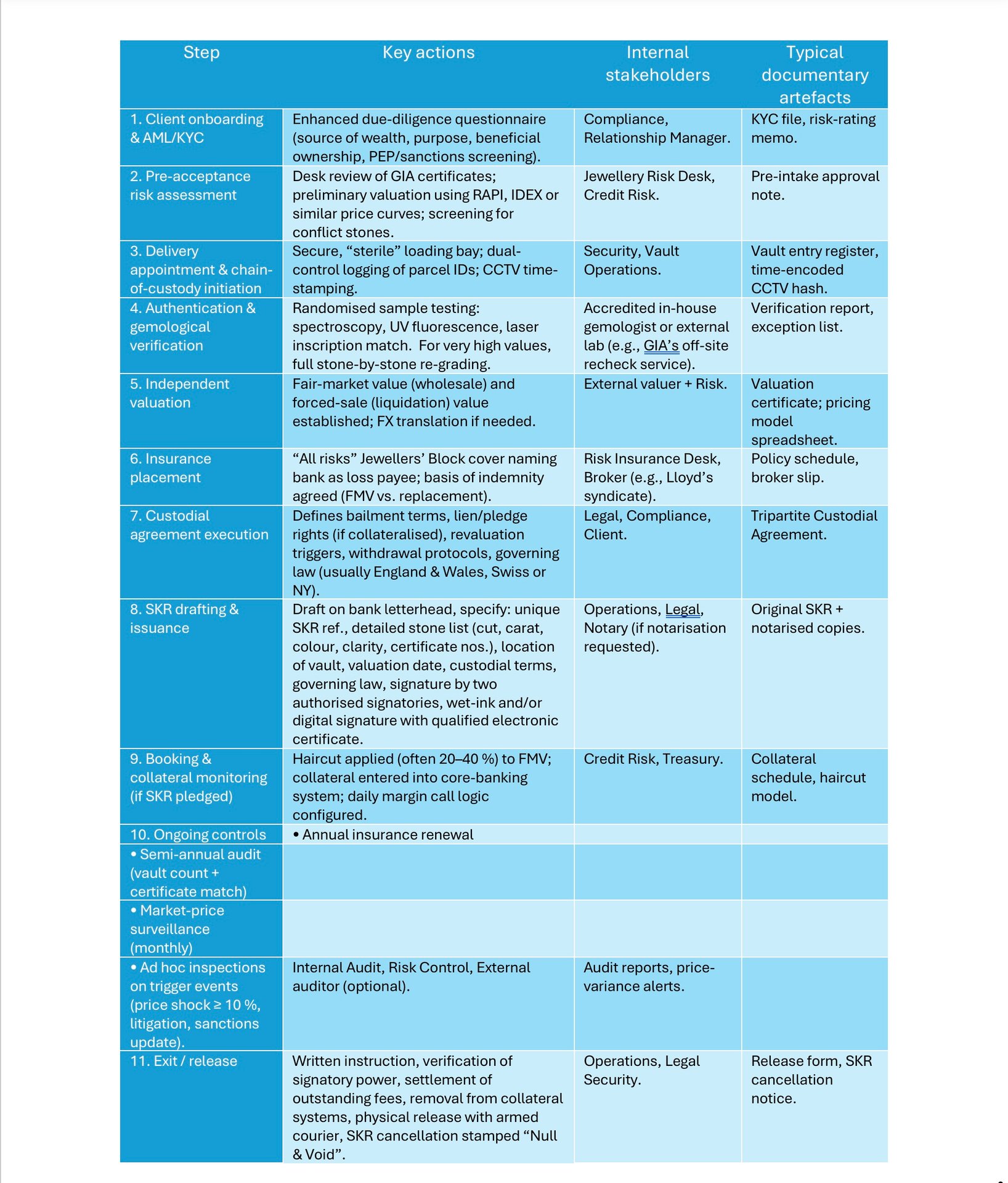
Diamond custody: the process step by step
| Step | Key actions | Internal stakeholders | Typical documents |
|---|---|---|---|
| 1. Client onboarding and AML/KYC | Enhanced due diligence questionnaire (source of wealth, purpose, beneficial ownership, PEP and sanctions screening) | Compliance, relationship manager | KYC file, risk-rating memo |
| 2. Pre-acceptance risk assessment | Desk review of GIA certificates; preliminary valuation using the Rapaport price list, IDEX or similar price references; screening for conflict stones | Jewellery risk desk, credit risk | Pre-intake approval note |
| 3. Delivery and chain of custody | Secure, sterile loading bay; dual-control logging of parcel IDs; CCTV time-stamping | Security, vault operations | Vault entry register, time-encoded CCTV hash |
| 4. Authentication and gemmological verification | Randomised sample testing: spectroscopy, UV fluorescence, laser inscription match; for very high values, full stone-by-stone re-grading | Accredited in-house gemmologist or external laboratory (for example GIA’s off-site recheck service) | Verification report, exception list |
| 5. Independent valuation | Fair market value (wholesale) and forced-sale (liquidation) value; FX translation if needed | External valuer, risk | Valuation certificate, pricing model |
| 6. Insurance placement | “All risks” jewellers’ block cover naming the bank as loss payee; basis of indemnity agreed (FMV or replacement) | Risk insurance desk, broker (for example a Lloyd’s syndicate) | Policy schedule, broker slip |
| 7. Custodial agreement | Bailment terms, lien and pledge rights (if collateralised), revaluation triggers, withdrawal protocols, governing law (usually England and Wales, Switzerland or New York) | Legal, compliance, client | Tripartite custodial agreement |
| 8. SKR drafting and issuance | On bank letterhead: unique SKR reference, detailed stone list (cut, carat, colour, clarity, certificate numbers), vault location, valuation date, custodial terms, governing law; signed by two authorised signatories, wet ink or qualified electronic signature | Operations, legal, notary (if notarisation is requested) | Original SKR and notarised copies |
| 9. Booking and collateral monitoring (if the SKR is pledged) | Haircut applied to FMV (often 20%–40%); collateral entered in the core banking system; daily margin-call logic configured | Credit risk, treasury | Collateral schedule, haircut model |
| 10. Ongoing controls | Annual insurance renewal; semi-annual audit (vault count and certificate match); monthly market-price surveillance; ad hoc inspections on trigger events (price shock of 10% or more, litigation, sanctions update) | Internal audit, risk control, external auditor (optional) | Audit reports, price-variance alerts |
| 11. Exit and release | Written instruction, verification of signatory authority, settlement of outstanding fees, removal from collateral systems, physical release by armed courier, SKR cancelled and stamped “null and void” | Operations, legal, security | Release form, SKR cancellation notice |