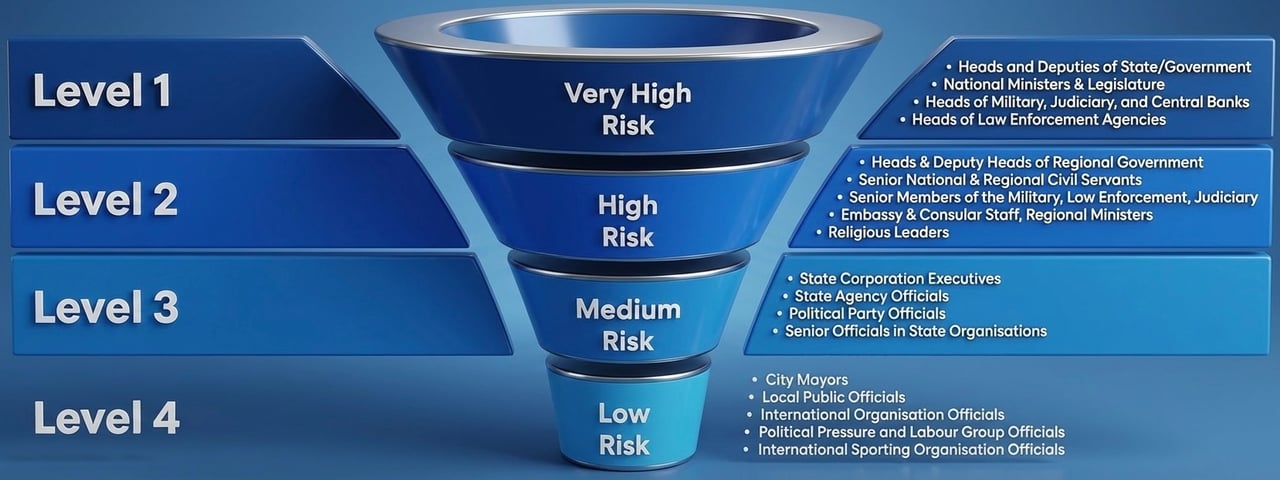
Onboarding procedure for Politically Exposed Persons (PEPs)
IFB accepts Politically Exposed Persons as clients. In line with FATF Recommendation 12, every PEP relationship requires enhanced due diligence, approval by senior management, establishment of the source of wealth and source of funds, and enhanced ongoing monitoring. Within that framework, we offer discreet, professional and personalised service.

“Where other banks perceive only risk, we recognise potential. Politically Exposed Persons merit not exclusion but careful, discreet, and structured partnership”
1. Authorised Representatives and Trusted Intermediaries
Designated Representatives:
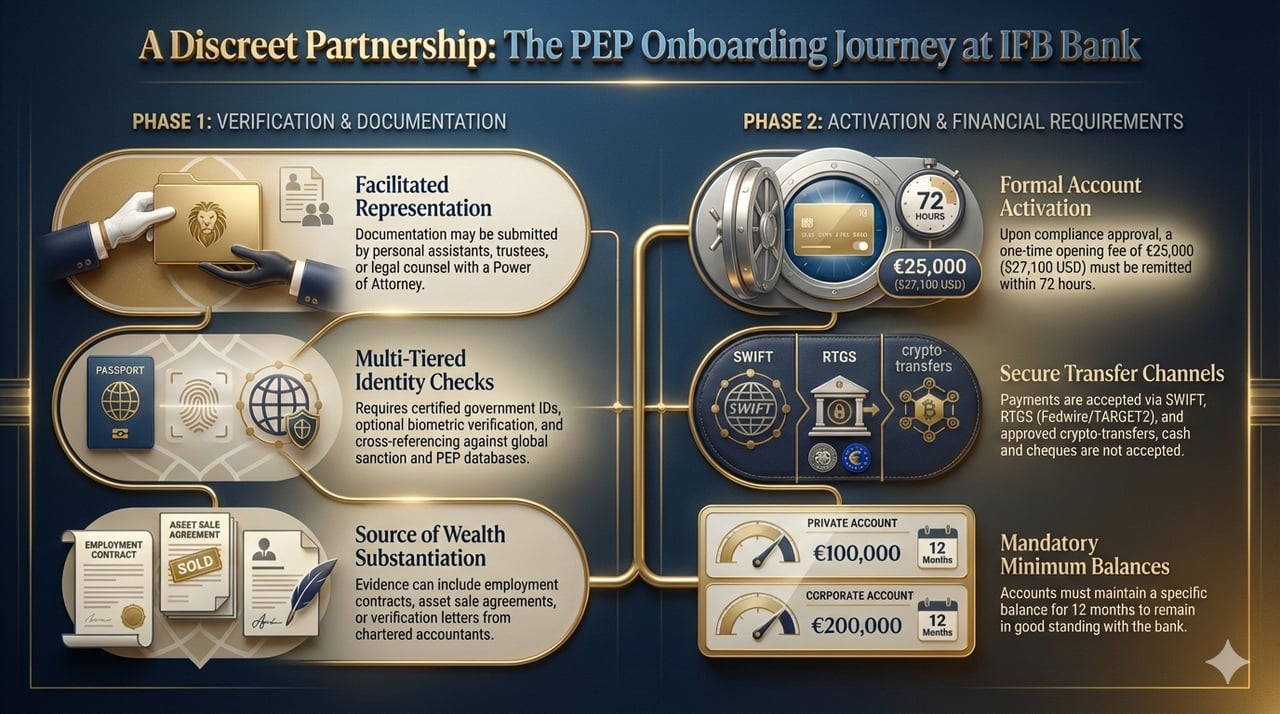
Beyond direct submission by the client, we recognise that PEPs often operate through trusted intermediaries: such as family members, personal assistants, trustees, corporate secretaries, or appointed wealth managers. IFB permits documentation to be submitted by these authorised representatives, provided that their authority is clearly evidenced. Examples of acceptable evidence include a notarised power of attorney, a formal trustee appointment letter, board resolutions for corporate representatives, or a legal mandate verifying the authorised individual’s right to act on the client’s behalf.
Beneficial Owners and Trustees:
If the client’s assets are held in trusts or other complex ownership structures, the trustee or a similarly enabled fiduciary may furnish the required documentation. In such scenarios, the trustee must provide:
Official Trust Documents: Proof of the trust’s existence (such as the trust deed), the trustee’s appointment, and information on the beneficiaries and settlors.
- Verification of Trustee Identity: Certified identity documents for the trustee or authorised signatory.
- Proof of Source of Wealth within the Trust: Audited financial statements, investment histories, or verifiable corporate documents that substantiate the trust’s funding sources.
- Professional Advisers (e.g., Lawyers or Accountants): Should a PEP prefer using legal counsel or a financial adviser to coordinate the submission, IFB will liaise with them directly, following receipt of written authorisation from the client. This reduces administrative burdens on the client and ensures that all documentation is collected and presented coherently.
2. Rigorously Verifying Identity
Primary Identification Requirements: Clients or authorised representatives must provide high-quality, government-issued photo identification, such as a passport or a national identity card. We request that these documents be certified as true copies by a notary public, a certified lawyer, or a trusted professional within the client’s jurisdiction. Digital scans must be clear, with no visual obstructions, and must present all security features visible on the original document.
Secondary Identification: In instances where a single ID is not sufficient, IFB may request a secondary form of identification (e.g., a driver’s licence or an official government ID), also certified. This step is often necessary if the primary ID is from a jurisdiction with limited verification infrastructure.
Biometric Verification (If Applicable): Where permissible and convenient, we may employ advanced digital identity verification solutions. These may include secure video calls in which the client (or authorised representative) displays their ID and answers verification questions, or the use of secure biometric checks (e.g., a facial recognition match against the provided ID). This option is offered only with client consent and is designed to simplify identity verification while preserving privacy.
Cross-Referencing Public Records and Databases: As part of our verification process, IFB cross-checks identity details against reputable international databases, sanction lists, and registers of politically exposed individuals. We also consult official public records (electoral rolls, government directories, public beneficial ownership registries) to confirm the authenticity of the provided identity details and roles.
3. Acceptable Documentation for Proof of Address
Personal Proof of Address: Typically, we require a recent utility bill, a bank statement, or a government-issued letter showing the client’s current residential address. In certain cases, official documentation from a reputable global institution (e.g., a tax authority, a national healthcare system) may also serve as proof.
Address Verification Through Representatives: If a PEP resides primarily outside their jurisdiction of citizenship or conducts business from multiple domiciles, authorised representatives may submit relevant address proofs. For instance, if the PEP’s personal secretary handles all correspondence through a formal office, documentation confirming the office’s validity and its link to the client is acceptable.
International Residence Confirmation: For PEPs with complex global footprints, IFB may engage local verification firms in the client’s country of residence to confirm the address. This step only occurs with the client’s knowledge and consent.
4. Verifying Source of Wealth and Funds
Direct Documentation from the Client or Representative: Documentation establishing the client’s source of wealth could include:
- Employment contracts and payslips (for those in formal governmental or corporate roles).
- Sale agreements for property, shares, or other substantial assets.
- Inheritance documentation or succession certificates.
- Audited financial statements from the client’s operating businesses.
External Verification and Expert Opinions: When the source of funds is complex (e.g., stemming from multiple jurisdictions, intricate corporate structures, or long-term investment vehicles), IFB may seek further verification. For example, a chartered accountant or a reputable auditing firm already working for the PEP can provide a letter confirming the legitimacy of the financial sources. Authorised representatives, such as legal counsel or corporate service providers, often facilitate these processes by gathering and presenting such attestations.
5. Handling Sensitive and Complex Situations
Language and Cultural Nuances: Should the PEP’s documentation be in a language not widely spoken internationally, IFB will request a certified translation. Trusted intermediaries, such as lawyers or official translators, may handle this on behalf of the client to prevent delays.
High-Level Verification for Non-Standard Cases: Certain PEP clients may hold roles in regions with less strong public record systems. In these instances, IFB will:
- Seek out independent legal opinions attesting to the client’s position and standing.
- Utilise international investigative procedures to confirm details regarding the client’s political exposure and wealth structure.
- Collaborate with embassies or consulates, when appropriate and only with the client’s consent.
6. Minimising Client Burden Through Clear Guidance
Dedicated Relationship Manager (RM): Your RM remains your first point of assistance, clarifying every documentation request. They can suggest the simplest pathways for verifying identity or wealth – be it through direct submissions, using a reputable notary, or drawing upon legal counsel’s resources.
Checklists and Templates: IFB provides checklists and documentation templates to authorised representatives. This ensures that required information is compiled in an orderly, precise manner, reducing the likelihood of repeated requests.
7. Finalising Onboarding and Payments
Confirmation of Completion: Once compliance has concluded its review of identity, address, source of wealth and source of funds, and senior management has approved the relationship, IFB confirms onboarding in writing and issues detailed activation instructions.
Account Activation Fee:
Clients are required to remit a non-refundable Account Activation Fee of €25,000.00 (twenty-five thousand Euro). You can convert the amount into another currency with the calculator below.
Account activation fee
| Fee | Amount (EUR) |
|---|---|
| Account Activation Fee (non-refundable) | €25,000 |
Payment must be made within 72 hours of acceptance via one of the following channels:
- SWIFT transfers (pacs.008 customer transfers, priority payments).
- RTGS systems (Fedwire, T2, CHAPS, SIC, etc.).
- RTP schemes (real-time settlement networks in permitted jurisdictions).
- Approved crypto-transfers to IFB’s designated wallet addresses.
- Alternative methods (cheques, money orders, cash deposits, unverified transfers) are not accepted under our KYC and AML protocols.
Minimum Balance Requirement:
After activation, clients must transfer and maintain the requisite Minimum Balance for twelve (12) months to ensure the account remains in good standing:
- €200,000 for corporate accounts.
- €100,000 for private accounts.
You can convert the amounts into another currency with the calculator below.
Minimum balances
| Account type | Minimum balance (EUR) |
|---|---|
| Private account | €100,000 |
| Corporate account | €200,000 |
This minimum balance may be remitted via the same secure channels as above:
- SWIFT,
- RTGS (Fedwire, T2, etc.),
- RTP,
- Approved crypto-transfers,
- Designated card channels (credit card top-ups via our secure portal).
8. Ongoing Monitoring and Periodic Review
Long-Term Relationship Management: After onboarding, PEP accounts are subject to enhanced ongoing monitoring and periodic reviews in accordance with regulatory requirements. During these routine check-ins, authorised representatives remain welcome to submit any updates required – such as changes in address, political roles, or trust structures – to ensure all records remain current and accurate.
Summary
At IFB, we understand that the stewardship of wealth for Politically Exposed Persons extends beyond the individual to encompass the long-term security of their family and legacy. Accordingly, funds entrusted to us are managed with a strong commitment to compliance, confidentiality and fiduciary responsibility.
Our structures can provide for the client’s family, heirs and designated beneficiaries, subject to applicable law and to the rules on PEPs, which continue to apply to family members and close associates.
IFB’s PEP onboarding process is designed to be thorough yet accommodating. By allowing authorised representatives – trustees, family members, personal assistants, legal counsel – to provide documentation on behalf of the client, and by offering multiple avenues for identity and wealth verification, we simplify what can be a complex journey. Throughout, we apply strict standards of security, compliance and discretion, ensuring that the PEP’s unique circumstances are managed with professionalism, efficiency, and sensitivity.
The complete schedule of fees, commissions and margins is published under Fees, Commissions & Margins.