
Alternative Transfer Methods
API & JSON Transfers

API & JSON Services Activation at IFB
API Services will be activated upon the client’s request once their account is in good standing:
- It maintains the minimum balance,
- exhibits a consistent financial track record, and
- aligns with legitimate business activities.
Additionally, the account must have
- no outstanding compliance issues, and
- all transactions must adhere to international financial regulations.
Final activation is subject to internal review and approval by our compliance and risk management team.
A message is not money
Why no SWIFT message, telex or server moves funds without settlement, in 90 seconds.
Verify a document with VL1 →Received a payment message, slip or confirmation? Have it checked before you rely on it.
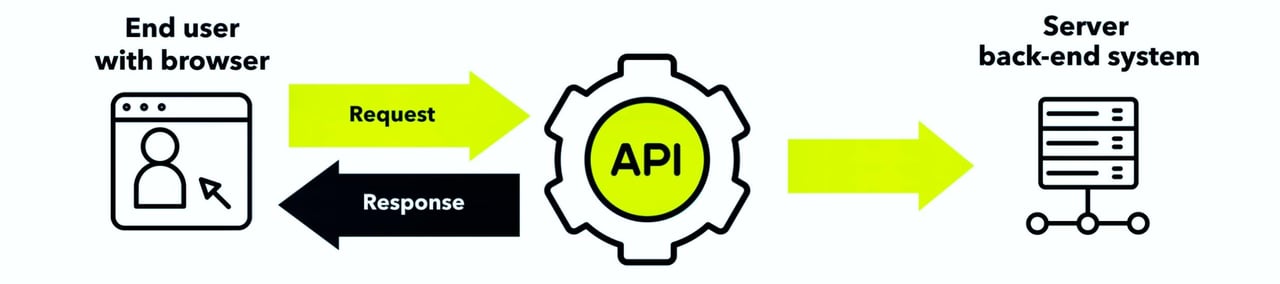
Our API services
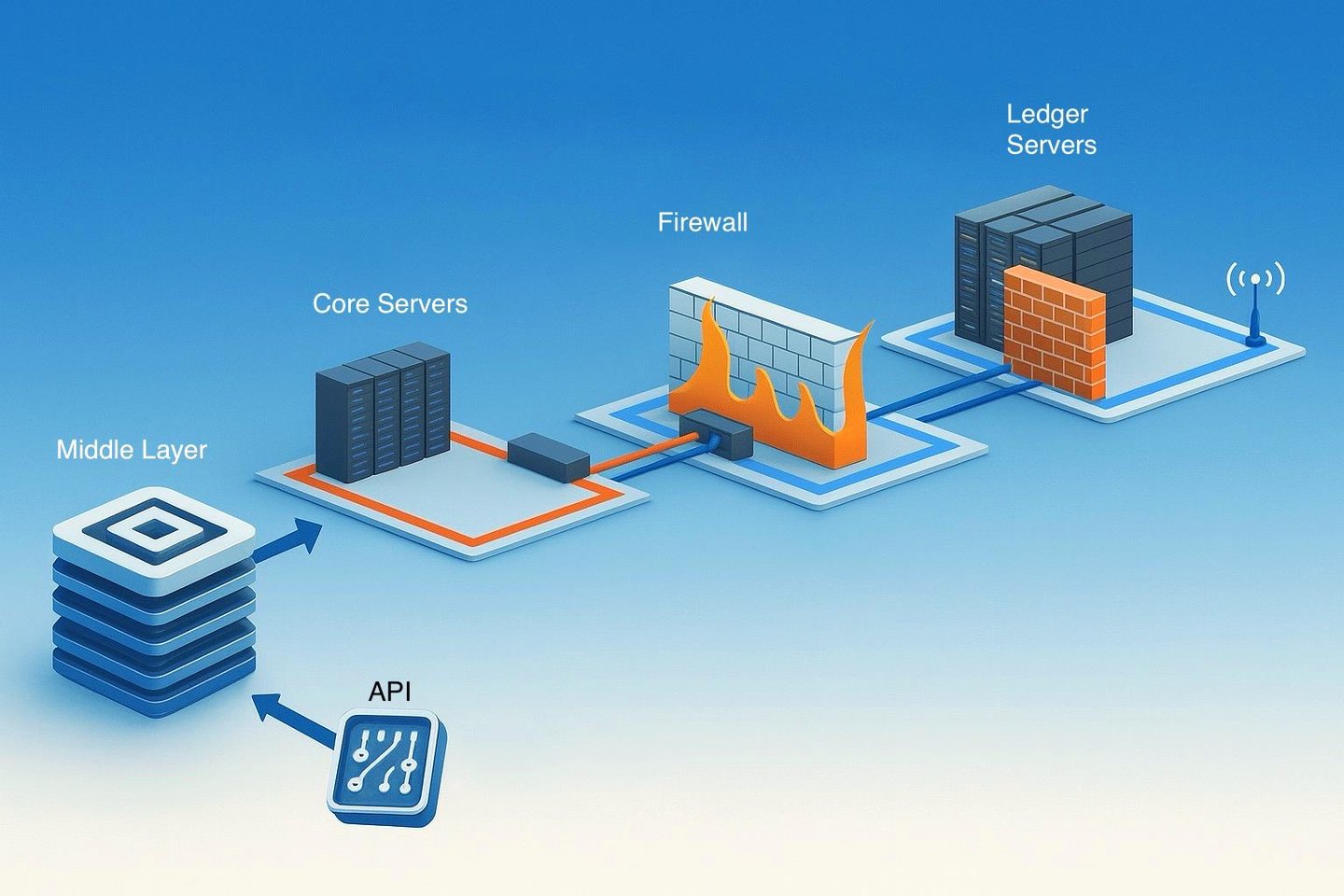
In API transfers, the connections are strictly limited to the bank’s external servers or, in certain cases, to core servers designated for special client interactions. However, these systems are never directly linked to the bank’s ledger servers, where the actual financial records are maintained. This separation ensures that the ledger servers remain entirely isolated, safeguarding the bank’s assets and maintaining the integrity of all financial operations within the secure framework of the banking system.
To see our API services connection guideline please scroll down to the end of this page (Key Exchange Procedure for Financial Institutions).
Our API (& JSON) Services
We provide API services to our select clientele of high-net-worth individuals and well-established corporate entities, with particular emphasis on discretion, confidentiality, and institutional integrity.
All API transactions are conducted exclusively between banks that are fully integrated into the international banking system, ensuring not only the secure exchange of authenticated API messages but also the effective and timely settlement of funds. Counterparties lacking such integration may be capable of message transmission, yet are inherently unable to complete financial settlement.
In API transfers, funds cannot be “downloaded” from a bank’s ledger servers, as these systems are always entirely isolated from external access. Unlike digital files stored in the cloud or on any normal server or computer, funds must always be transmitted through the secure and regulated framework of the global banking system, ensuring both their integrity and the compliance of every transaction.
Empirically, more than 77% of API transactions presented to us emanate from non-bank entities or from banks without the capability to send funds.
By contrast, we are positioned to transact without limitation as to amount, subject solely to rigorous verification of the originating institution and its demonstrable ability to effect settlement.

API (Application Programming Interface)
Contrary to a widespread notion, an API does not itself transfer funds. It operates as a sophisticated conduit for communication, an interface, between various bank software systems or between the customer with the back-end server of the bank, that is not connected with the core bank system of the bank. Its role is instrumental in issuing requests/commands to a bank’s digital infrastructure through a software interlink.
- Request/Command Issuance and Information Retrieval: At its core, an API in the banking sector does not directly execute financial transactions. Instead, it serves as an emissary, transmitting requests from external applications to the bank’s internet edge systems. For instance, when an instruction to initiate a transaction is sent through an API, the API merely conveys this request to the bank’s transaction processing systems. The actual movement of funds is then orchestrated by the bank’s internal mechanisms, underpinned by rigorous security and compliance protocols and in communication with correspondent banks, RTGS or RTP.
- Secure Communication Facilitator: The foremost function of a banking API is to ensure secure and efficient communication between external applications and the bank’s internal systems. This involves both the submission of transaction requests and the retrieval of account-related information. Through the use of advanced encryption and authentication measures, APIs guarantee that these communications are both secure and accessible only to authorized entities. This role can be likened to a highly secure and efficient postal service, ensuring that messages between two parties are delivered accurately and confidentially.
- Enhancement of Banking Services: While the direct transfer of funds is beyond the purview of APIs, they play a crucial role in enhancing the accessibility and functionality of banking services. By facilitating the exchange of commands and information, APIs enable third-party applications to offer a wide range of banking-related services. This includes providing real-time access to account balances, transaction histories, and initiating transactions that are then processed by the bank’s own systems.
- Regulatory Compliance and Data Integrity: In the execution of their duties, banking APIs adhere to stringent regulatory standards designed to protect consumer data and ensure the integrity of financial transactions. They act within the boundaries of legal and regulatory frameworks, such as PSD2 in Europe, which mandate the secure and standardized sharing of financial data. This ensures that APIs contribute to the ecosystem of digital banking not as direct facilitators of fund transfers, but as secure channels for initiating transactions and accessing financial information.
- Enhanced Scalability: APIs allow banks and fintech companies to easily scale their operations by integrating with external services and systems.
- Improved Customer Experience: By leveraging APIs, financial institutions can offer a more personalized and smooth banking experience, meeting the evolving expectations of digital-savvy customers.
- Operational Efficiency: APIs facilitate the automation of routine tasks, thereby reducing manual errors and increasing the efficiency of banking operations
- Innovation and Collaboration: The open nature of APIs promotes innovation by enabling collaboration between banks, fintech startups, and other financial service providers.
The essence of an API in the banking domain is not to transfer funds directly but to act as a sophisticated software intermediary that communicates requests and retrieves information. It is through this secure and structured communication that APIs enrich the digital banking environment, enabling a plethora of services while ensuring adherence to the highest standards of security and regulatory compliance.
External API’s
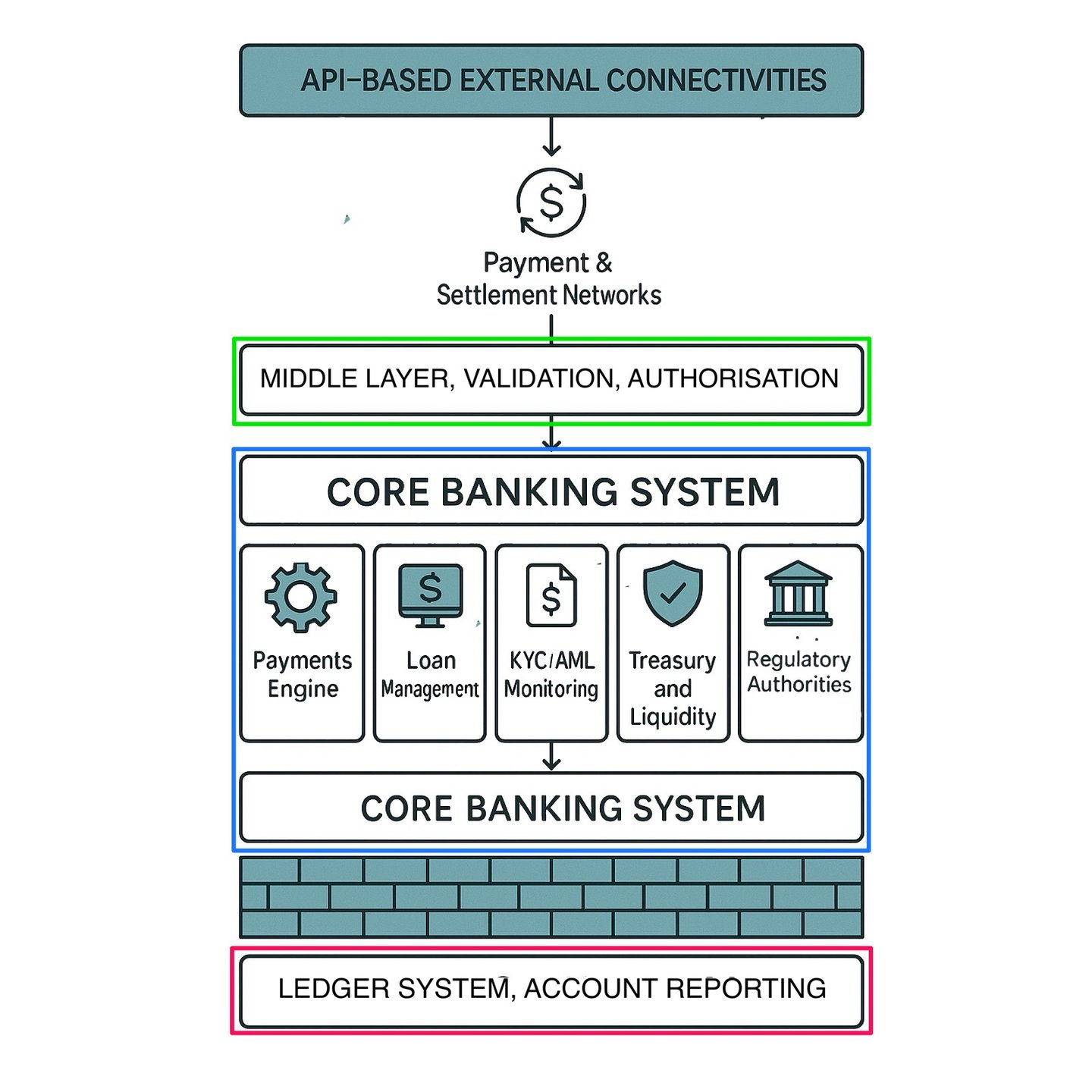
External APIs in banking environments are kept at an arm’s length even from the core system and even more from the ledger system of the bank due to stringent security requirements inherent in financial institutions. There are several compelling reasons for this indirect connection, all tied to the safeguarding of sensitive information and the operational integrity of the bank’s core functions:
1. Isolation of Sensitive Data
The core system contains the most sensitive and essential data of clients and processes in a bank, such as records and customer financial details and the ledger system has all the account balances and transaction records. Direct exposure of the core or ledger banking systems to external systems, through APIs, could significantly increase the risk of data breaches and manipulation of data and records. By limiting API interactions to a middle layer or peripheral system, banks can control and scrutinise data access and prevent inadvertent or unauthorised data breaches.
2. Minimising Attack Surfaces
Allowing external APIs to directly connect with the core or ledger system would create an additional entry point, increasing the attack surface that could be exploited by malicious actors. The more connection points that lead directly to the ledger, the greater the risk that attackers could breach the system. Indirect connections, typically through a middleware layer or API gateway, act as a protective buffer, screening and filtering access requests and handling them in a controlled, monitored manner.
3. Enhanced Access Control
By routing external API transmissions through an intermediate layer, banks can implement additional access control mechanisms, including rate limiting, authentication, and authorisation checks. This intermediary system validates the authenticity and legitimacy of each request before forwarding scrutinised data or instructions to the core system within the internal banking system. It enforces strict access policies and ensures only vetted requests are relayed from the core to the ledger system.
4. Data Integrity Assurance
Direct access by external APIs could pose risks to data integrity. If external systems were to interact directly with the ledger, even minor errors or unintended interactions could disrupt the consistency and accuracy of the data. A middle-layer system handles validation, translating API requests and confirming that they are accurate and appropriate before they reach the ledger. This controlled interaction is vital for maintaining the stability and trustworthiness of financial records.
5. Regulatory Compliance and Auditing
Banks operate under stringent regulatory frameworks that require rigorous security measures, especially regarding data access and handling. Ensuring that external API requests are processed by an indirect, controlled system simplifies compliance by providing a clear boundary between the ledger and external systems. It allows for detailed logging and auditing of every transaction, ensuring that any external interaction is fully traceable and accountable without exposing sensitive ledger data.
6. Reduction of Systemic Risks
If external APIs were to connect directly to the ledger system, any vulnerability or exploit within those APIs could directly impact the core financial records of the institution. Indirect access helps to contain and mitigate risks by allowing for the isolation of the ledger in the event of a security breach or system failure in the external API. By structuring connections indirectly, banks ensure that critical systems can remain secure, operational, and resilient even if external systems encounter issues.
In short
The indirect connection model, utilising middleware or an API gateway, ensures that the bank’s ledger remains insulated from potential threats posed by external connections, while still allowing safe, controlled data exchange with authorised third parties. This layered security architecture preserves data confidentiality, integrity, and availability, aligning with best practices in cybersecurity and regulatory standards.
Understanding Banking APIs more
Banking APIs act as intermediaries, allowing third-party developers and businesses to access bank functionalities and data in a secure, controlled manner. This access is decisive for creating applications that can interact directly with a bank’s systems, thus enabling a plethora of financial services without the need to reinvent the wheel.
The Diverse Spectrum of Banking API Types
Banking APIs are broadly categorized into four main types, each serving distinct purposes and catering to various financial needs:
- Core Banking APIs: These APIs focus on fundamental banking operations such as deposits, lending, and SME cross-border transactions. By providing access to these essential services, Core Banking APIs enable fintech applications to incorporate traditional banking functions smoothly.
- Plug & Play APIs: Tailored for financial operations like trading and accounting routines, these APIs also include authentication services through OAuth. They are designed to be easily integrated into existing systems, facilitating swift adoption and implementation.
- Cards, Wallets, and Transfers APIs: This category covers card issuing, wallets, multi-currency operations and fraud monitoring, often delivered with software development kits (SDKs). They are crucial for applications dealing with payments, currency exchange, and securing transactions.
- Acquiring APIs: Focused on payment acquisition, these APIs enable mobile payments, Near Field Communication (NFC) solutions, online card acquiring, and more. They play a significant role in expanding the avenues through which businesses can accept payments.
REST vs. SOAP: Architectural Styles in Banking APIs
In banking APIs, two principal communication paradigms prevail:
- REST (Representational State Transfer) is an architectural style: stateless requests and responses over HTTP, usually carrying JSON. It is lightweight and scales well, and it dominates modern open-banking interfaces.
- SOAP (Simple Object Access Protocol), by contrast, is a formal XML-based protocol with built-in standards for security (WS-Security) and error handling, still common in older core-banking integrations.
Both paradigms offer distinct advantages, and the choice between them depends on the specific requirements of the banking service being implemented.
Banking APIs are at the forefront of the financial sector’s digital transformation, offering a bridge between traditional banking services and innovative fintech solutions. By embracing these technological advancements, banks can not only enhance their operational efficiency and customer service but also stay competitive in an increasingly digital world. As the financial industry continues to evolve, the strategic utilization of banking APIs will undoubtedly play a crucial role in shaping its future.
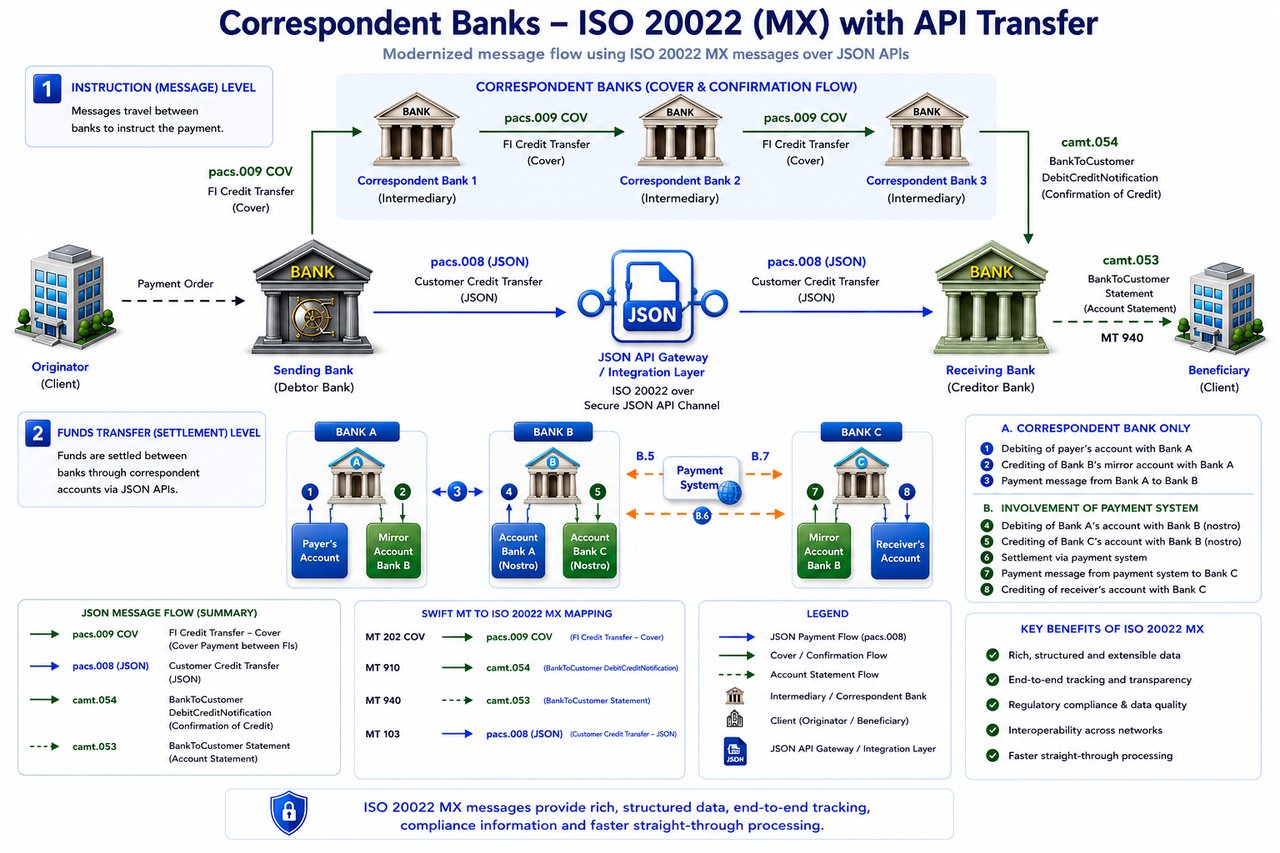
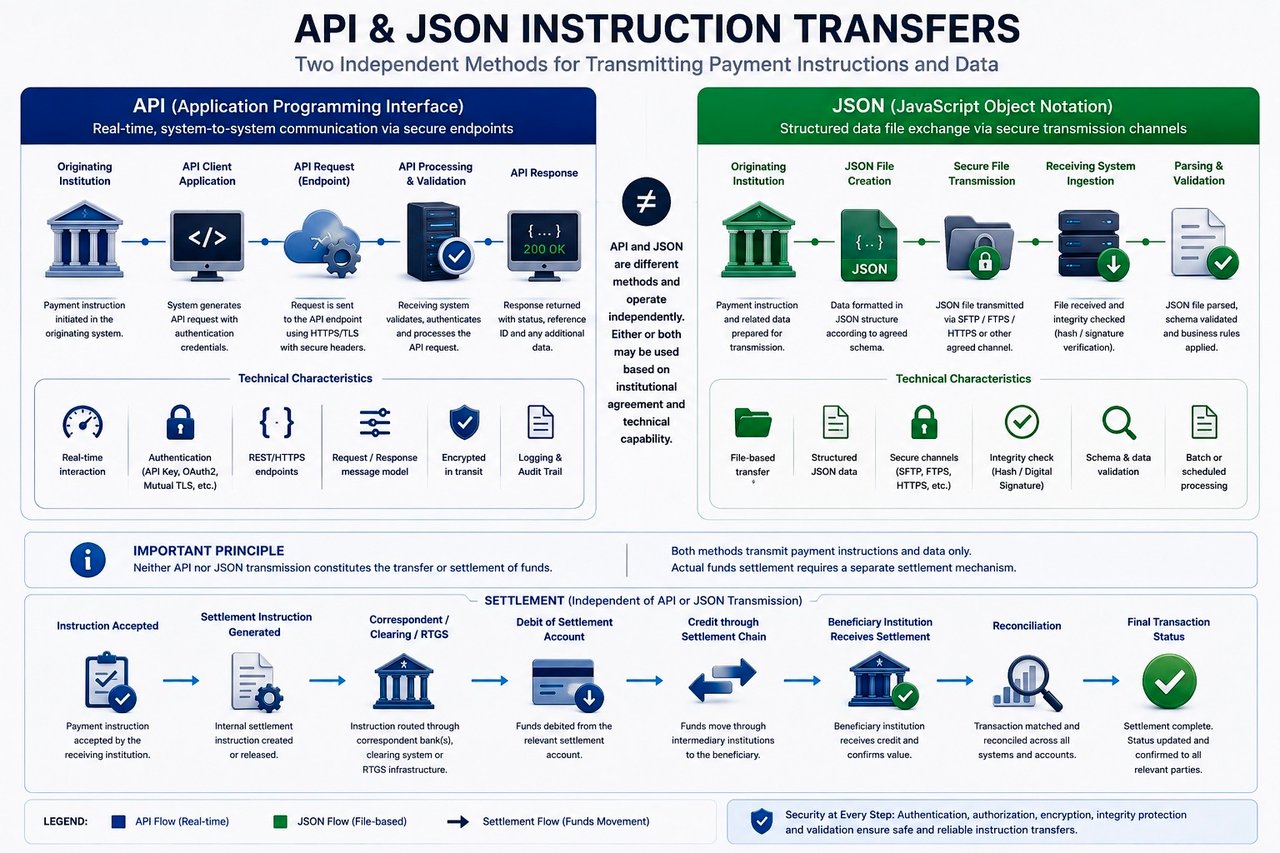
API-based communication enhances the efficiency of banking operations by enabling structured interaction between systems. However, APIs do not constitute independent payment mechanisms. Data transmitted via API, including JSON-formatted requests and responses, represents transaction instructions or system communication, not settlement.
The execution of any transfer initiated via API remains dependent on authorised financial institutions and recognised payment infrastructure. The presence of an API response or structured data output does not, in isolation, confirm that funds have been transferred.
JSON in API-Based Banking Environments
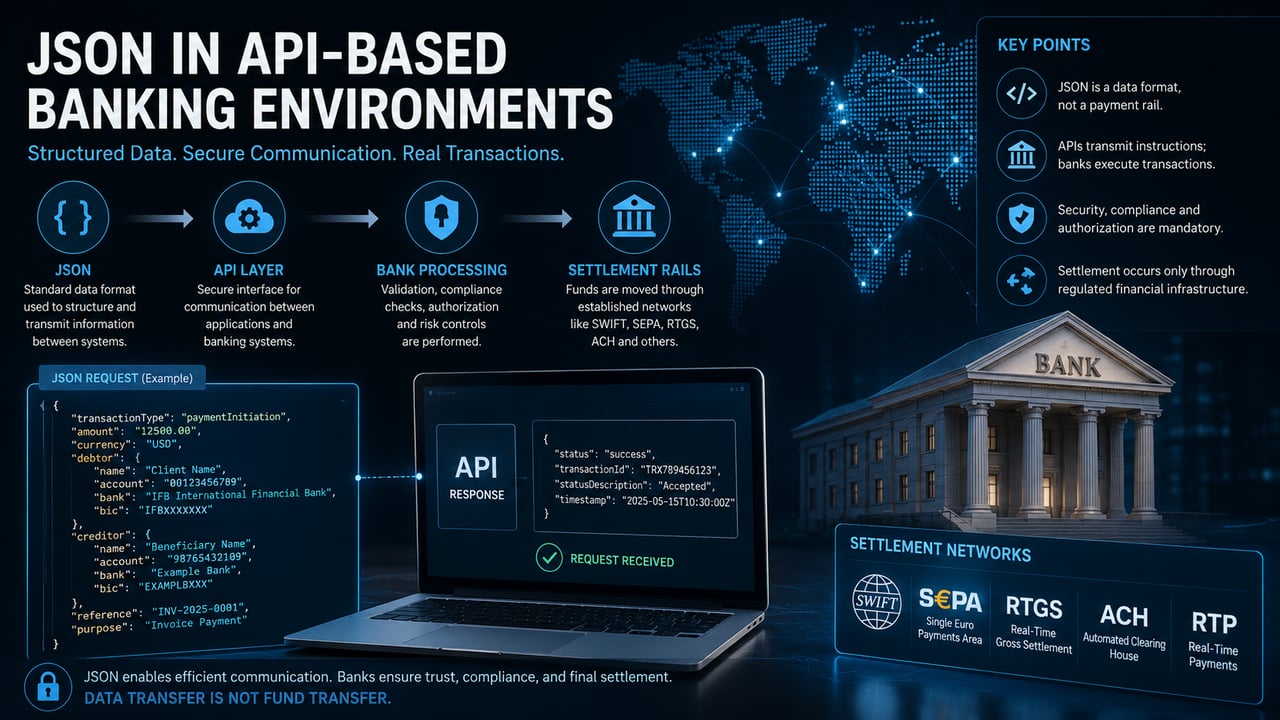
Within modern banking infrastructure, JSON functions as a standardised data format used in API communication layers. Its role is strictly technical: it structures and transmits information between systems. It does not execute transactions, hold value, or substitute institutional processes.
In API-based banking, JSON is typically used to encode payment instructions, account data, transaction metadata, and system responses in a format that is both machine-readable and interoperable across platforms. This allows external applications, client interfaces, and internal banking systems to communicate efficiently within a controlled environment.
When a payment is initiated through an API, the instruction may be transmitted in JSON format. However, the actual transfer of funds is executed separately by the bank through established payment rails such as SWIFT, SEPA, RTGS, or other recognised settlement systems. JSON merely conveys the instruction; it does not perform the transfer.
Functional Role in API Transactions
In practical terms, JSON serves as the interface layer between client-side applications and banking infrastructure. A typical API request may include structured fields such as sender identification, beneficiary details, account numbers, currency, amount, and transaction references. This data is validated and processed by the receiving system, which then determines whether the transaction can proceed.
Once validated, the instruction enters the bank’s internal processing environment, where compliance checks, risk controls, and authorisation procedures are applied. Only after these steps does the transaction proceed to the appropriate settlement channel.
JSON is therefore one component within a broader transaction lifecycle. It does not replace:
- institutional authorisation
- compliance verification
- account-level validation
- clearing and settlement processes
Separation Between Data and Settlement
A recurring misunderstanding arises when data transmission is conflated with fund movement. JSON, as a data format, can describe a transaction in detail, but it cannot create or settle that transaction. The presence of a JSON payload, regardless of its apparent completeness, does not constitute proof that funds have been transferred.
This distinction is critical in both operational and risk contexts. A valid transfer must be reflected in:
- the sending institution’s ledger
- the receiving institution’s ledger
- the intermediary settlement system, where applicable
Without these elements, no transfer has occurred, irrespective of any data representation.
Integration with Banking APIs
In regulated environments, JSON is typically embedded within secure API frameworks. These frameworks enforce authentication, encryption, and access control, ensuring that only authorised entities can initiate or retrieve financial data.
Typical use cases include:
- payment initiation through client interfaces
- retrieval of transaction histories
- balance enquiries
- beneficiary management
- real-time status updates
These functions enhance efficiency and interoperability but remain dependent on the underlying banking infrastructure.
Risk Considerations
Because JSON is human-readable and easily replicable, it is susceptible to misuse when presented outside controlled environments. A JSON document can be constructed, modified, or fabricated without difficulty. As such, it cannot serve as independent evidence of a completed transaction.
In professional banking practice, verification is always anchored in institutional records and recognised payment systems, not in standalone data representations.
For a broader treatment of transfer-related risks, refer to: Transfer Risk Fraud Awareness
Institutional Interpretation
Within IFB’s operational framework, JSON is recognised as a technical standard used in API communication. It is not recognised as a payment mechanism or settlement method.
All transactions, irrespective of how they are initiated, must ultimately be executed through regulated financial infrastructure. JSON may facilitate communication, but it does not alter the fundamental mechanics of banking.
Summary Position
JSON enhances the efficiency of digital banking interfaces by enabling structured data exchange. Its utility lies in communication, not in execution. A currency transfer remains a function of banking institutions, regulated systems, and settlement processes. JSON is a conduit for information within that structure, not a substitute for it.
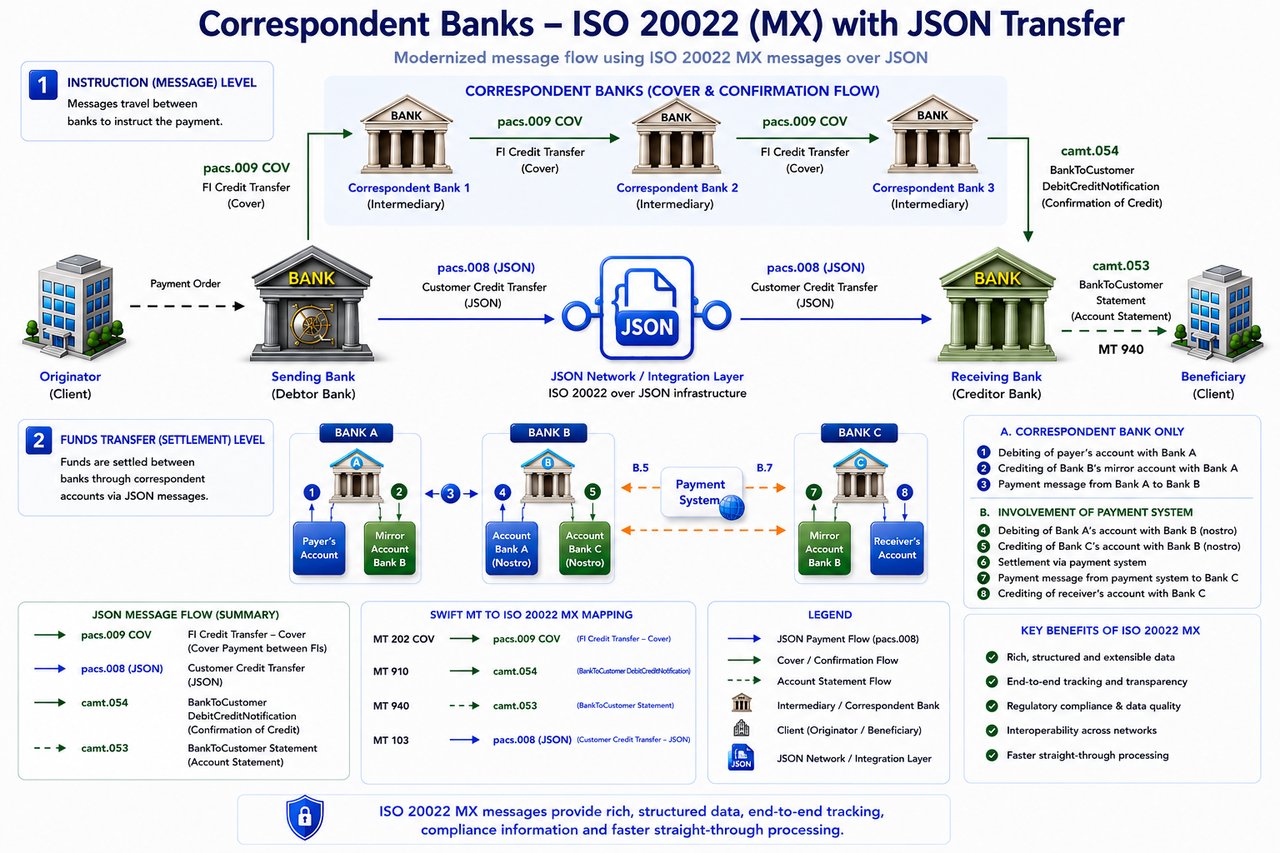
Terminology associated with alternative or legacy transfer methods should be interpreted within the context of banking infrastructure. Such terms may describe communication channels, internal processing methods, or historical practices, but they do not replace the requirement for regulated institutions, recognised payment systems, and formal settlement procedures.
Any transfer, regardless of terminology, must ultimately be processed, cleared, and reconciled within the established financial system.



Next step
Request an introduction
Tell us in a few lines who you are and what you have in mind. Your enquiry goes directly to the bank and is treated in confidence.
Prefer to talk? Book a 30-minute videoconference.
Key Exchange
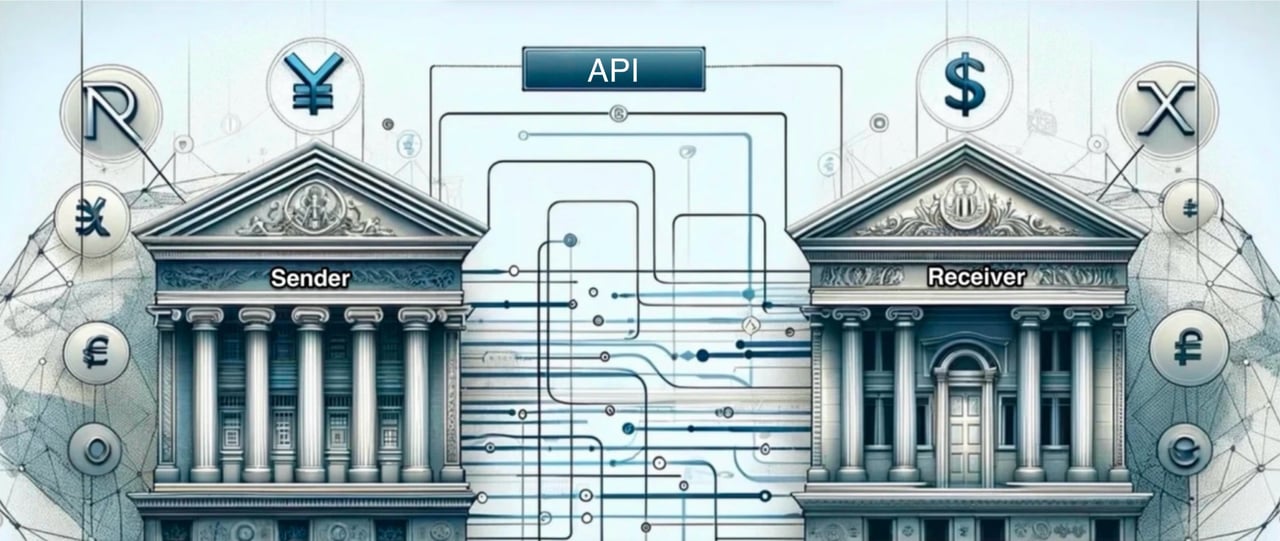
Key Exchange Procedure for Financial Institutions
- Should your esteemed financial institution intend to transmit through API to us, we kindly invite you to download and meticulously observe the guidelines outlined in the API Key Validation Procedure here.
- To generate the dynamic Output AES Code (Key) for your API instruction please click here.
- Api script will be provided by us: Example
If you want to know more about how to transfer funds or assets to your accounts with us, please get in contact with Marie Mayer.