
Fake Digital Asset Transfer Schemes Using “Tokenised Files”
IFB International Finance Bank – Fraud Prevention Advisory
International Finance Bank (“IFB”) has observed a rising number of fraudulent approaches involving alleged high-value digital asset transfers supposedly executed through “tokenised JSON files”, “crypto host receivers”, “bank endpoints”, “wallet activation protocols” or similar improvised terminology.
These schemes do not concern only USDT. The same fraud pattern may involve Bitcoin, Ethereum, stablecoins, tokenised assets, central bank digital currency claims, private blockchain coins, wrapped assets, alleged gold-backed tokens, or fictitious digital instruments described as “bank-grade” or “institutional”.
The terminology changes. The fraud architecture remains the same.
A file, certificate, code, screenshot, wallet display, API message or private “host” cannot itself prove ownership of digital assets or transfer them. A legitimate digital asset transfer requires control of the relevant wallet, a valid cryptographic signature, broadcast to the relevant blockchain or settlement network, and independent verification.
The Central Misrepresentation
Fraudsters frequently assert that digital assets can be transferred by sending, uploading or “hosting” a file. The file may be described as JSON, XML, encrypted, tokenised, coded, ledger-backed, smart-contract-enabled or bank-certified.
This is technically false.
A data file may contain information. It may contain addresses, metadata, transaction templates, screenshots, fabricated balances or arbitrary claims. It is not, by itself, a wallet, a custody account, a banking instrument or a settlement mechanism.
Digital assets do not move because a file says they move. They move only when a valid transaction is authorised by the party controlling the assets and accepted by the relevant network.
How Legitimate Digital Asset Transfers Work
In genuine digital asset settlement, the decisive evidence is not a document or a promise. It is verifiable control and verifiable execution.
The sender must control the relevant wallet or custody account. A transaction must be properly authorised. On a public blockchain, that usually means a cryptographically signed transaction broadcast to the network. Once accepted, the transaction can be independently reviewed through the relevant blockchain explorer or institutional custody record.
For institutional activity, this technical layer is only the beginning. Proper execution also requires identity verification, sanctions screening, source-of-funds analysis, source-of-wealth review, transaction monitoring, legal capacity checks and compliance approval. Large transactions cannot be made legitimate by speed, urgency or impressive terminology.
Common Warning Signs
These approaches often use invented language such as “bank crypto host”, “host receiver”, “endpoint wallet”, “tokenised file”, “wallet release code”, “gas tranche”, “ledger activation”, “private blockchain encashment” or “beneficiary wallet registration”.
Such terms are usually deployed to obscure the absence of real custody, real wallet control and real settlement mechanics.
Another frequent warning sign is the request for bank infrastructure information, IP addresses, server endpoints, wallet access or private technical data. These items are not required to receive a normal blockchain transfer. Requests of this nature may indicate social engineering, phishing, cyber reconnaissance or attempted unauthorised access.
Fraudsters also commonly refer to exceptional transaction values, often in the hundreds of millions or billions. They then create artificial urgency, promising that the operation can be completed within hours if the recipient provides technical details, pays fees or signs acceptance documents. This is classic pressure architecture.
A further indicator is the use of irrational commission economics. Genuine asset owners do not surrender extraordinary percentages to unknown intermediaries merely to move liquid digital assets. When a proposal promises outsized commissions for minimal work, the commercial logic is usually fraudulent.
Advance-Fee Risk
Many of these schemes eventually lead to a request for payment. The payment may be labelled as gas, activation cost, compliance fee, registration fee, validation charge, tax clearance, release fee, insurance bond, wallet funding, mirror transaction or liquidity proof.
These labels do not change the substance. The victim is being asked to pay money before any independently verifiable asset transfer has occurred.
No prudent institution should pay advance fees to unknown counterparties in exchange for alleged access to digital assets that have not been verified through recognised custody, banking or blockchain procedures.
Documents Are Not Settlement
Fraudulent parties often provide deeds of assignment, bank letters, screenshots, certificates, codes, transaction schedules, wallet printouts or alleged compliance forms.
Such materials may be forged, irrelevant or commercially meaningless.
A document can support a transaction, but it cannot replace settlement. Legal paperwork does not prove that a digital asset exists, that the sender controls it, that it is unencumbered, that it has lawful origin, or that it can be transferred.
For digital assets, the minimum threshold is independent verification of the asset, the wallet or custody account, the controlling party, the transaction history and the legal source of funds.
IFB Position
IFB treats unsolicited proposals involving “tokenised files”, “crypto hosts”, “bank endpoints”, “wallet activation”, “private encashment”, or similar structures as high-risk unless they are independently verified through recognised legal, banking, custody and blockchain channels.
IFB does not accept digital asset proposals based on unverifiable files, screenshots, private codes, server endpoints or informal intermediary assurances.
IFB will not provide private banking infrastructure data, server endpoint data, wallet credentials, private keys, seed phrases, advance payments or institutional confirmations for transactions that cannot be independently verified.
Protective Measures
Clients and counterparties should apply a simple standard: if the assets are real, they can be verified through legitimate custody records or on-chain evidence. If the sender controls them, the sender can prove control. If the transaction is lawful, the sender can provide full identity, source-of-funds and compliance documentation.
Any refusal to provide such evidence should be treated as a material red flag.
Suspicious approaches should be escalated to compliance, legal and cybersecurity teams before any engagement continues. No operational data, payment, signature or wallet access should be provided until the transaction has been formally verified.
In short
Digital asset fraud increasingly relies on technical theatre. Fraudsters use complex language, invented banking roles and fabricated file-based procedures to create the appearance of sophistication.
The fundamentals remain straightforward. A file is not a wallet. A screenshot is not proof of funds. A server endpoint is not a settlement rail. A document is not a blockchain transaction. A promise of extraordinary commission is not commercial legitimacy.
Legitimate digital asset transfers are verifiable, authorised, compliant and auditable. Any proposal that avoids these standards should be rejected.
A JSON file (“JavaScript Object Notation”) is simply a structured text file used to store and exchange data between systems, applications or servers. It can contain information such as wallet addresses, balances, transaction instructions or metadata, but it is not itself a wallet, banking instrument or transferable digital asset.
A JSON file cannot independently send, release or transfer cryptocurrency without a valid cryptographic transaction executed on the relevant blockchain network.
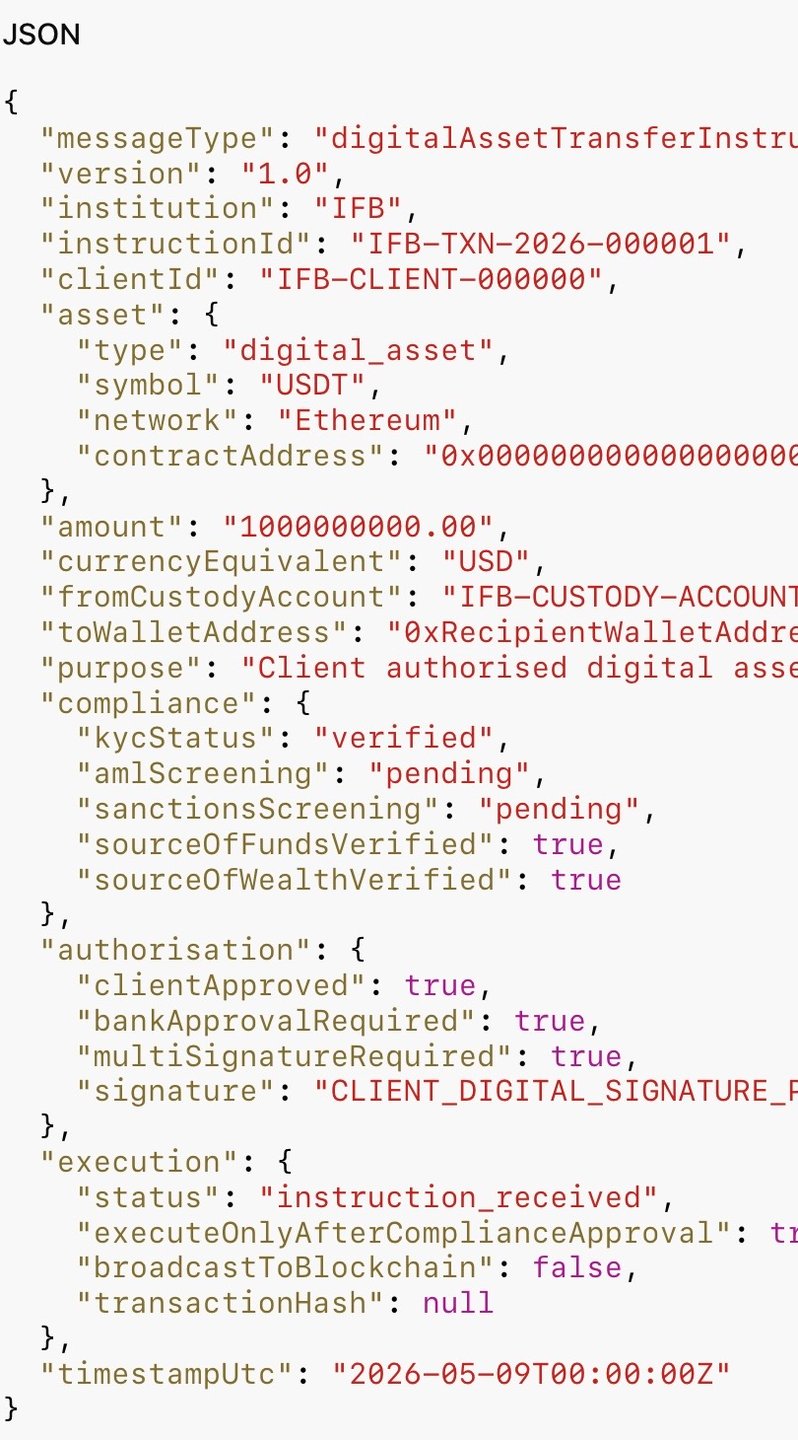
A JSON file can legitimately function as an instruction payload within a bank’s internal digital asset infrastructure, but only under strictly controlled conditions. In such a case, the JSON itself does not contain or transfer cryptocurrency. It merely carries structured transaction instructions which are interpreted by IFB’s authorised backend systems.
For example, if an IFB client already maintains verified digital asset custody with the bank, a JSON message may include data such as:
- client account identifier
- blockchain network
- recipient wallet address
- token type
- transaction amount
- compliance references
- cryptographic signatures
- API authentication data
Once received, IFB’s internal systems would validate:
- client authentication
- wallet ownership
- account balances
- AML/KYC compliance
- sanctions screening
- transaction policy limits
- internal authorisation rights
If all controls pass, IFB’s custody infrastructure or treasury wallet system may then generate a real blockchain transaction using the bank’s secured private keys or custody environment. The actual transfer occurs only when IFB’s authorised signing infrastructure cryptographically signs and broadcasts the transaction to the blockchain network.
The critical distinction is this:
the JSON file does not itself transfer crypto.
The bank transfers crypto after independently validating the instruction and executing a genuine blockchain transaction from assets already held under custody.
This is comparable to SWIFT messaging in traditional banking. A SWIFT MT103 message does not itself contain money. It is an authenticated instruction that causes banking systems to move funds through regulated settlement infrastructure. JSON in institutional digital asset systems can serve a similar orchestration function, but never as a standalone bearer instrument.



Next step
Request an introduction
Tell us in a few lines who you are and what you have in mind. Your enquiry goes directly to the bank and is treated in confidence.
Prefer to talk? Book a 30-minute videoconference.