
Currency Creation
Off- to On-Balance Conversion
The Differences Between Off-Ledger and Off-Balance in Banking
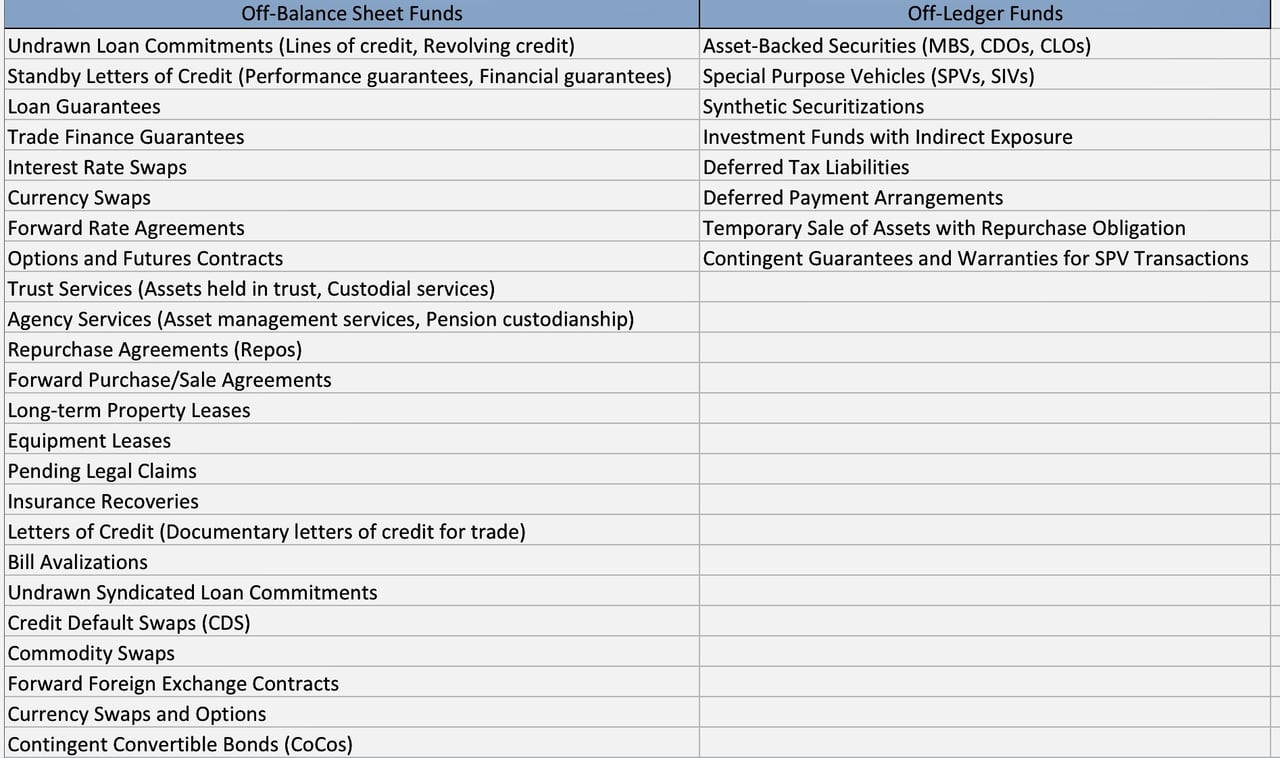
A. In the context of banking, “off-ledger” and “off-balance” funds operate distinctly:
The terms “off-balance sheet” and “off-ledger” are often used in financial contexts to describe different types of accounting treatments and disclosures. Here’s a detailed explanation of each term and the key differences between them:
Off-Balance Sheet
Definition:
Off-balance sheet items refer to assets or liabilities that do not appear on a company’s balance sheet. These items are typically contingent or notional in nature, meaning they represent potential future obligations or rights rather than current ones.
Characteristics:
- Contingent Nature: Off-balance sheet items often involve contingent liabilities or assets that may or may not materialize, depending on future events.
- Common Examples: Loan commitments, guarantees, derivative notional amounts, certain types of securitizations and, for lessees before IFRS 16 and ASC 842 (2019), operating leases.
- Purpose: These items are used to manage risk, leverage, and liquidity without impacting the apparent financial position of the entity on its balance sheet.
- Disclosure: While not included in the balance sheet, these items must be disclosed in the notes to the financial statements as per accounting standards, to ensure transparency.
Off-Ledger
Definition:
Off-ledger items are not commonly defined in traditional accounting but generally refer to funds or transactions that are not recorded in the primary ledgers of an entity. These might be used internally or externally but are not part of the formal accounting records.
Characteristics:
- Internal Records: Off-ledger items may be tracked internally for management purposes but are not included in the official financial statements.
- Informal Nature: These items can include informal commitments, internal adjustments, or management estimates that are not formalized in the accounting system.
- Purpose: They can be used for internal decision-making, budgeting, or planning without affecting the official financial records.
- Disclosure: These items are typically not disclosed in formal financial statements or notes. An item that should be recognised under the accounting rules but is kept off the ledger breaches accounting law.
Key Differences
- Accounting Treatment:
- Off-Balance Sheet: These items are recognized and disclosed according to standard accounting rules, often appearing in the notes to financial statements.
- Off-Ledger: These items are not recognized in the formal accounting records and are not subject to standard disclosure requirements.
2. Transparency and Disclosure:
- Off-Balance Sheet: There is a requirement for transparency and detailed disclosure in the notes to the financial statements.
- Off-Ledger: These items are typically internal and not disclosed to external stakeholders.
3. Regulatory Compliance:
- Off-Balance Sheet: Subject to regulatory oversight and must comply with accounting standards such as GAAP or IFRS.
- Off-Ledger: Not typically subject to the same regulatory requirements as they are not part of formal financial reporting.
4. Impact on Financial Ratios:
- Off-Balance Sheet: Can influence investors’ perception of risk and leverage without affecting the primary financial ratios directly.
- Off-Ledger: Do not impact financial ratios as they are not included in formal calculations.
Off-Ledger Funds in Banking:
In the banking sector, off-ledger funds or off-balance sheet funds, might involve transactions or accounts that are kept separate from the bank’s main accounting system. They are assets or liabilities that are not recorded on the balance sheet but can significantly impact a bank’s financial condition. These items often represent potential obligations or contingent assets that may become actualised under certain circumstances. A lawful example is client money that a bank holds in a fiduciary capacity (trust or fiduciary deposits): it is recorded in separate books and not on the bank’s own balance sheet. Unrecorded funds of the bank itself would breach accounting and supervisory rules.
Off-Balance Sheet Funds in Banking:
Banks often engage in off-balance sheet activities like issuing letters of credit, derivatives trading, or securitization of assets. An example is contingent liabilities like letters of credit, where the bank commits to paying a beneficiary if certain conditions are met. These are not recorded as liabilities on the balance sheet until the conditions are fulfilled, but they represent potential obligations.
In both cases, these practices can impact a bank’s apparent financial health and risk profile. Off-balance sheet activities, in particular, can significantly increase a bank’s risk exposure without affecting its reported financial metrics like debt levels.
B. In central banking, the concepts of “off-ledger” and “off-balance” activities can be quite different from commercial banking:
1. Off-Ledger in Central Banks: The term has no standard meaning in central banking: central bank transactions are recorded in their books. What may be off-balance-sheet are commitments, such as undrawn currency swap lines with other central banks. Once a swap line is drawn, it appears on the balance sheet – the Federal Reserve, for example, reports central bank liquidity swaps in its weekly H.4.1 statement.
2. Off-Balance in Central Banks: Central banks might hold assets or liabilities off their balance sheets in various ways. An example is the use of special purpose vehicles (SPVs) to manage certain types of assets or liabilities. These SPVs can be used to isolate financial risks or for unconventional monetary policies, like quantitative easing. The Bank of England’s Asset Purchase Facility, for example, is a separate subsidiary indemnified by HM Treasury and is not consolidated in the Bank’s own accounts, whereas the Federal Reserve consolidates the vehicles it controls, such as the Maiden Lane LLCs created in 2008.
Both off-ledger and off-balance sheet activities in central banking are subject to specific regulatory and oversight mechanisms due to their potential impact on national and global financial stability.
“Every major currency’s monetary base rests on promises. This is the ‘Central Bank operating handbook’ for resting it on something better.”
Differences between off-balance Sheets in Banks and Central Banks
In both commercial and central banks, the distinction between on-balance-sheet and off-balance-sheet items is crucial to understanding the risk profile and financial position of the institution. However, the nature of these items and their implications can differ significantly between the two types of banks.
Commercial Banks
For commercial banks, the on-balance-sheet items include traditional banking assets and liabilities such as loans, deposits, securities, and equity capital. These are straightforward items that directly affect the bank’s financial statements and are subject to regulatory capital requirements.
Off-balance-sheet items for commercial banks, on the other hand, are not directly reflected on the balance sheet. These might include items like guarantees, letters of credit, derivatives contracts, or securitized loans. These are contingent liabilities or assets that could potentially become real liabilities or assets depending on certain events or conditions. They are used for managing risk and serving clients; under the Basel framework, they are converted into credit-equivalent exposures through credit conversion factors and attract capital. However, these items can expose the bank to significant risks, as was evident during the 2008 financial crisis when off-balance-sheet securitized mortgages led to substantial losses for many banks.
Central Banks
Central banks operate differently from commercial banks. Their primary roles include managing the country’s money supply, setting interest rates, and ensuring the stability of the financial system.
On-balance-sheet items for central banks typically include foreign exchange reserves, gold reserves, domestic government securities, and loans to commercial banks. These assets are used to implement monetary policy and manage the country’s foreign exchange rate.
Off-balance-sheet items for central banks could include commitments to provide liquidity to commercial banks or to intervene in foreign exchange markets. These are not immediate liabilities, but they represent potential future cash outflows depending on the circumstances.
It’s crucial to note that the distinction between on-balance-sheet and off-balance-sheet for central banks is not about avoiding regulatory capital requirements (as it might be for commercial banks), since central banks don’t face such requirements. Instead, it’s about managing risk and implementing monetary policy.
It’s important to note
that converting off-balance funds into on-balance funds can have implications for a bank’s capital and liquidity requirements, as well as its overall risk profile. Therefore, banks should carefully consider the potential benefits and risks of each approach before deciding which one to use. Additionally, banks should ensure that they comply with regulatory requirements for on-balance sheet assets.
How Off-Balance-Sheet Items Reach a Central Bank’s Balance Sheet
A central bank’s off-balance-sheet items are commitments and contingencies, not stored funds. Typical examples are undrawn swap lines with other central banks, committed but undrawn lending facilities, guarantees, forward foreign-exchange positions and assets held in custody for others, such as gold or securities held for foreign central banks.
Such items move onto the balance sheet only through a real transaction or event:
- Drawing: when a counterparty draws on a swap line or facility, the central bank records a claim on the counterparty as an asset and the corresponding reserves or deposits as a liability. The Federal Reserve, for example, reports drawn central bank liquidity swaps in its weekly H.4.1 statement.
- Crystallisation of a guarantee: a guarantee is recognised as a liability or provision when payment becomes probable and can be measured reliably under the central bank’s accounting framework.
- Settlement of a forward transaction: the exchanged amounts are booked at settlement.
A board decision approves or reactivates a facility; the money itself is created only when the central bank acquires an asset, for example by purchasing securities or gold, or lends against collateral, and both sides of that transaction appear on its balance sheet. Each step is subject to the central bank’s statute, its accounting rules (in the Eurosystem, the ECB accounting guideline) and external audit.
Types of Off-Balance Sources in Central Banks
1. Approved off-balance-sheet commitments. These are facilities, swap lines and guarantees that the central bank’s board has reviewed and authorised. They are activated in three steps:
- Recognition on the balance sheet: when the commitment is drawn or called, the central bank records the resulting claim or liability – for example, a loan to a bank under a credit facility, or a provision for a guarantee that is expected to be called.
- Monetary policy operations: the assets acquired can then be used in open market operations or to back lending facilities that provide liquidity to banks.
- Economic impact: the operation is paid for by crediting reserves, so it expands central bank money and supports the central bank’s monetary objectives.
2. Commitments not yet approved. New facilities or guarantees require a proposal to the board describing their nature, purpose and expected impact, a risk assessment and due diligence, and a formal board decision. Once approved, they are treated like the approved commitments above.
3. Dormant facilities. Facilities that were once active but are unused, such as an expired swap line or a crisis-era lending facility, can be reviewed, re-approved by the board and reopened. They then follow the same accounting and operational process.
Strategic considerations. Every activation requires credit and market-risk assessment, transparent communication to markets and coordination with the banks that will use the facility.
Off-ledger Funds
In broad banking parlance, off-ledger funds are pools of capital or financial commitments that are not recorded on a financial institution’s official balance sheet (its “ledger”). While these may sometimes be reported in accompanying notes or disclosures, they are typically not integrated as direct assets or liabilities. Instead, they may be parked in special-purpose vehicles (SPVs), held in trust arrangements, or structured through other conduits, thereby reducing their visibility in standard financial statements.
When we speak of off-ledger funds within the context of central banking, the notion aligns conceptually but is more complex due to the sovereign and policy-oriented functions of a central bank. Central banks may use separate vehicles or commitments for crisis interventions or swap lines that are not always straightforward entries on their primary balance sheets. These remain subject to their statutes, audit and reporting rules, although public disclosure is sometimes delayed.
Off-Ledger Funds in Banking
1. Typical Characteristics
- Securitisation and SPVs: A commercial bank may bundle mortgages, loans, or other receivables and then move them into a securitisation vehicle, effectively removing them from its balance sheet.
- Structured Products: Derivative contracts or other complex financial instruments (e.g., credit default swaps) may carry contingent liabilities that are not presented as balance-sheet items, unless triggered under certain conditions.
- Regulatory and Risk Perspectives: From a regulatory standpoint, off-ledger instruments can offer capital relief or allow for risk management techniques that reduce on-balance-sheet exposure. However, these vehicles may also obscure real economic risks.
2. Transparency and Regulatory Considerations
- Disclosure Requirements: Even if certain funds are off-ledger, regulators often require disclosures in footnotes or appendices, particularly under International Financial Reporting Standards (IFRS) or US Generally Accepted Accounting Principles (GAAP).
- Moral Hazard: The potential exists for banks to understate their risk, which can mislead investors or regulators if off-ledger items are not adequately disclosed or understood.
Off-Ledger Funds in Central Banking
1. Function-Specific Structures
- Special Facilities: Central banks may employ “special facilities” (e.g., emergency lending programmes) in times of systemic stress. These may be run through separate vehicles; whether they are consolidated depends on the central bank’s accounting framework.
- Extraordinary Interventions: During financial crises, a central bank might extend guarantees or create ring-fenced entities to stabilise critical financial institutions. Guarantees remain off-balance-sheet until called, but are disclosed in the notes to the accounts.
2. Policy and Secrecy Dimensions
- National Security and Confidentiality: Some central bank activities are cloaked in confidentiality for national security or strategic reasons. Hence, details of specific operations may be disclosed with a delay to prevent precipitous market reactions; in the United States, for example, the Dodd-Frank Act requires the Federal Reserve to publish details of discount window loans with a lag of about two years.
- Public Accountability: Notwithstanding secrecy, there is a heightened call for transparency given a central bank’s public mandate. Legislative bodies and oversight committees may demand detailed disclosures of any off-ledger exposures to ensure responsible governance.
Similarities
- Exclusion from Primary Financial Statements: Both commercial banks and central banks have commitments and vehicles that do not appear on their core balance sheets.
- Regulatory Scrutiny: Whether in private banking or central banking, off-ledger operations attract regulatory and public interest due to the inherent opaqueness and possible systemic risks.
- Risk and Uncertainty: In both cases, off-ledger instruments can create scenarios in which underlying commitments or liabilities are not fully apparent, raising concerns about moral hazard, liquidity pressures, or credit risk.
Key Differences
1. Purpose and Motivation
- Commercial Banks: Typically motivated by risk mitigation, capital relief, or return optimisation. Banks may employ off-ledger vehicles primarily to comply with capital adequacy requirements or to engage in structured finance.
- Central Banks: May utilise off-ledger mechanisms for systemic stability, crisis management, or macroprudential objectives. Their rationale often lies in broader policy imperatives, such as sustaining liquidity or shielding critical operations from political or market turbulence.
2. Transparency Mandates
- Commercial Banks: Subject to detailed accounting standards and risk disclosure frameworks. Shareholders and regulators demand clarity on potential exposures for investment and prudential reasons.
- Central Banks: While there is a degree of public reporting, the timing and detail of disclosure for certain operations can be restricted to preserve the effectiveness of monetary policy or financial stability operations.
3. Jurisdictional Authority
- Commercial Banks: Operate under commercial and securities laws, as well as financial regulations with explicit oversight from supervisory agencies.
- Central Banks: Enjoy broader sovereignty in monetary matters, thus possessing unique privileges to create or absorb liquidity and to manage national currency affairs. This can justify delayed disclosure in exceptional circumstances, but not unrecorded transactions.
Potential Ramifications and Alternative Approaches
1. Enhanced Reporting and Audit:
- Alternative Solution: Mandate third-party or specialist public audits to deliver unbiased assessments, striking a balance between transparency and operational confidentiality.
2. Regulatory Harmonisation:
- Alternative Solution: Encourage coordinated frameworks among major financial centres (e.g., through the Basel Committee on Banking Supervision) to ensure consistency in classification and disclosure of off-ledger items.
3. Risk-Weighted Disclosure Mechanisms:
- Alternative Solution: Implement real-time or near real-time data tracking for contingent liabilities, accompanied by mandatory stress-testing that factors in off-ledger exposures.
Off-ledger funds, whether in private or central banking spheres, represent forms of financial stewardship conducted beyond the immediate gaze of traditional balance-sheet reporting. While the techniques (risk transfer, regulatory capital management, or contingent liquidity provision) are similar, the objectives differ substantially between commercial banks and central banks. Commercial banks tend to focus on optimising risk-return profiles and adhering to capital regulations, whereas central banks deploy off-ledger mechanisms in pursuit of macroeconomic stability, emergency relief, and policy-driven objectives.
To promote greater stability and confidence, it remains foremost to balance the legitimate need for operational flexibility with enhanced transparency and rigorous oversight. Over the long term, evolving regulatory environments and technological innovations (e.g., real-time data monitoring, advanced analytics) may offer new ways of addressing the inherent complexities and risks that off-ledger funds introduce into the global financial architecture.
Is There “Off-Balance Currency”?
No. Money exists only as a liability on someone’s balance sheet: banknotes and reserves are liabilities of the central bank, deposits are liabilities of commercial banks. There is no stock of “off-balance-sheet currency” or “off-ledger funds” waiting to be converted, and there is no “Central Counterparty (CCP) Currency Creation Process”. Central counterparties are clearing houses that stand between buyers and sellers in financial markets; they do not create currency.
When a central bank creates money, it extends its balance sheet: it acquires an asset – mainly government bonds, loans to banks or foreign-exchange reserves – and credits reserves on the liability side.
For companies and governments, recognising an off-balance-sheet commitment on the balance sheet, for example when a guarantee is called or a lease is capitalised under IFRS 16, improves transparency, but it creates no money and no funding.
IFB’s off- to on-balance service, described below, concerns the recognition of real assets and obligations.
IFB’s Off- to On-Balance Service
International Finance Bank supports governments, central banks, financial institutions and companies in bringing assets, claims and commitments that are currently held off-balance-sheet onto a statutory balance sheet, where the applicable accounting framework permits it. Typical cases are assets held through unconsolidated vehicles or in custody, contingent claims that have crystallised, and assets whose ownership and value have not yet been documented to the standard needed for recognition.
- Evidence package: legal title, settlement and custody records, independent valuation and the documents needed for initial recognition.
- Accounting analysis: recognition and measurement under IFRS, IPSAS, US GAAP or, for the public sector, ESA 2010.
- Structuring: acquisition, transfer, consolidation or reclassification of the asset or liability.
- Prudential and audit treatment: capital, liquidity and disclosure effects, coordinated with the auditors and, where relevant, the supervisor.
Recognition increases reported assets or equity only to the extent that the asset is real, controlled by the entity and reliably measurable. It improves transparency and can support financing against the asset, but it does not create money. Every mandate is subject to due diligence, compliance and sanctions review.
Currency Creation Procedure (CCP) at Central-Bank and Treasury Level, with Counter-Guarantees
Currency creation takes place through an extension of the central bank’s balance sheet: assets, primarily government bonds issued by the treasury, are added to the asset side, and reserves are recorded on the liability side. The central bank thus creates new reserves and acquires the corresponding assets. Where the operation carries credit risk, the treasury can stand behind it with a counter-guarantee or indemnity. The procedure runs in defined steps:
- Legal basis. The central bank law must permit the operation (asset purchases, a lending facility or a guarantee), and the treasury’s commitment must be authorised by budget law or parliament. Limits on monetary financing apply – in the EU, Article 123 TFEU prohibits central-bank credit to governments and direct purchases of their debt; many other central bank laws cap direct advances to the state.
- Treasury counter-guarantee. The ministry of finance issues a counter-guarantee or indemnity to the central bank covering losses on the facility. It is recorded and disclosed as a contingent liability of the state.
- Central-bank operation. The central bank buys assets or lends to banks or to a dedicated vehicle and credits the counterparties’ reserve accounts. These reserves are new central-bank money and appear on its balance sheet, with the acquired assets or loans on the asset side.
- Transmission. Banks use the additional liquidity in their own lending, which creates commercial-bank money in the form of new deposits.
- Loss and exit. If losses occur, the central bank calls the counter-guarantee and the treasury pays from the budget. As the assets mature or are sold and the loans are repaid, the reserves are extinguished again.
Precedents include the Bank of England’s Asset Purchase Facility (since 2009), indemnified by HM Treasury, and the Federal Reserve’s emergency lending facilities of 2020 under Section 13(3) of the Federal Reserve Act, backed by equity from the U.S. Treasury under the CARES Act.
IFB advises central banks and treasuries on the design of such operations: the legal basis, the counter-guarantee and its documentation, the accounting treatment (IPSAS, ESA 2010 and the central bank’s own framework), and the effects on inflation, the public debt and any IMF programme. The decisions remain with the central bank and the government.
The money creation process is the process by which new money is added to an economy. In most modern economies, it is carried out by central banks and commercial banks.
Central banks, such as the Federal Reserve or the European Central Bank, regulate the supply of money and ensure monetary stability. One way a central bank creates money is by purchasing assets, such as government bonds: when it buys a bond from a commercial bank, it pays by crediting that bank’s reserve account. These reserves are new central bank money.
Commercial banks create money when they lend: a loan credits the borrower’s account with a new deposit, which enters circulation when the borrower spends it. Repaying a loan destroys the corresponding money.
Reserve requirements do not create money; raising them, if anything, restricts lending. Many central banks have reduced or abolished them – the Federal Reserve set its requirement at zero in March 2020 – and steer money creation mainly through the policy interest rate.
Moving Items Between Off- and On-Balance Sheet
In legitimate finance, items move between off- and on-balance-sheet positions in a few well-defined ways, all governed by accounting standards (IFRS 9, IFRS 10, IFRS 16 or US GAAP) and prudential rules:
- Securitisation usually moves assets off the originator’s balance sheet: loans are sold to a special purpose vehicle, which issues securities to investors. Derecognition requires the transfer of substantially all risks and rewards, and if the originator controls the vehicle, it must consolidate it.
- Repurchase agreements move nothing off or on: in a repo, the securities sold stay on the seller’s balance sheet, and the cash received is recorded as a liability.
- Consolidation brings the assets and liabilities of a controlled vehicle onto the group balance sheet (IFRS 10).
- Drawing or crystallisation turns commitments and guarantees into on-balance-sheet loans or liabilities.
None of these steps creates money or funding out of off-balance-sheet items. A central bank cannot “issue off-balance funds” and later convert them: its liabilities, such as banknotes, reserves, deposits or debt certificates, are always on its balance sheet.
Already existing off-balance assets
Assets held outside a bank’s or central bank’s balance sheet, for example in a special purpose vehicle or in custody, can be mobilised in several ways:
- Securitisation: loans or receivables are pooled in a vehicle that issues securities to investors; the proceeds provide funding and liquidity.
- Repurchase agreements: securities are sold with an agreement to buy them back; the cash received provides liquidity while the securities remain the seller’s assets.
- Structured notes: a bank issues notes linked to the performance of the assets and uses the proceeds to fund or acquire them on its balance sheet.
Newly created facilities
A central bank can also issue its own debt securities – such as central bank bills or debt certificates – and use the proceeds or newly created reserves to acquire eligible assets, for example government bonds. Alternatively, it can establish a special purpose vehicle to hold eligible assets, as the Bank of England did with its Asset Purchase Facility. Once acquired, the assets are recognised on the balance sheet of the central bank or of the consolidated vehicle.


The Complex Mechanisms of Money Creation: Central Banks, Commercial Banks, and Economic Ideologies
Money, the bills and coins used in transactions every day, does not just spring into existence spontaneously. The process of currency creation and management involves a complex interplay between central banks, commercial lending institutions, regulatory frameworks, economic ideologies, and monetary policy tools. This intricate balancing act aims to expand access to capital for economic growth while keeping inflationary risks in check.
A. Key Central Bank Processes Driving Money Supply
Central banks have a number of potent but often misunderstood mechanisms to calibrate overall money supply in line with policy mandates. These help set the stage for commercial bank lending through reserves management, interest rates steering, and market interventions when needed. The constraints and impacts of these institutional choices also tie into long-running academic debates.
1. Flexible Bank Reserves Modulation
A key way that central banks shape the amount of funds commercial banks have available for lending is through open market operations (OMO): the buying and selling of securities holdings to respectively increase or decrease banking system reserves. But they also have additional tools to alter reserve balances dynamically.
i. Steering Short-Term Rates Through Open Market Operations
The most powerful and flexible mechanism used actively by leading central banks like the U.S. Federal Reserve is open market operations. As explained by the Federal Reserve Bank of New York, this refers to central banks engaging in transactions to purchase or sell securities holdings, typically government bonds or bills in practice, to expand or contract the quantity of reserves in the banking system.
This helps move a key benchmark interest rate, the target federal funds rate in the case of the Fed, to a level consistent with current monetary policy stances aiming to tighten or loosen credit conditions. When the Fed buys securities under expansionary policy, for instance, it credits reserves balances to commercial banks selling them. This expands their lending capacity, exerting downwards pressure on target short-term interbank lending rates. Additional lending also drives further money creation through the commercial banking system. Open market operations can thus flexibly calibrate overall money supply on an ongoing basis.
But it is an imperfect mechanism. As many researchers note, interest rates are a blunt signaling instrument and face decreasing stimulus effects once rates approach the zero lower bound. This has led central banks to rely increasingly on large-scale assets purchase programs to provide additional monetary policy accommodation in recent decades.
ii. Quantitative Easing for Added Stimulus
Quantitative easing or QE refers to central banks making large purchases of longer-dated, less liquid securities like government bonds, agency mortgage-backed securities or even corporate bonds to lower longer-term interest rates more broadly when short-term rates alone are deemed inadequate to support growth objectives. This is intended to incentivize lending, spending, and investments sensitive to longer-term rates like housing, thereby providing additional boosts to demand and economic activity during periods of stagnation.
But since longer-dated, riskier securities are less liquid, such programs expand central bank balance sheets much more substantially relative to the amount of stimulus generated compared to open market operations targeting short-term rates. This can heighten risks of market distortions and inflation, spurring significant debate among economists about the appropriate scope, economic impacts, and risks of this mechanism which has now seen widespread adoption by major central banks in fighting economic crises over the last 15 years.
iii. Altering Reserve Requirements to Loosen Lending
Besides open market operations and QE bond purchases to dynamically grow reserves balances, central banks can also simply loosen regulatory requirements for a more permanent effect since this frees up commercial banks’ preexisting assets. Lowering or eliminating reserve requirements reduces banks’ costs, although in modern systems lending is constrained mainly by capital, liquidity rules and demand.
Some central banks, such as the People’s Bank of China and the Reserve Bank of India, still change reserve ratios actively. The Federal Reserve reduced its reserve requirement ratios to zero in March 2020. Where reserves are unremunerated, requirements act as a tax on banks and tend to lower the deposit rates offered to customers.
iv. Direct Lending as Liquidity Backstop
The Federal Reserve and many other central banks globally also have discount window lending programs allowing eligible banks access to direct central bank loans, against pledged collateral like government securities, loans or mortgages, to meet temporary liquidity needs. Costs are typically set above prevailing market rates to ensure borrowers rely primarily on private funding markets to discourage overuse. But importantly, this facility helps ensure solvent firms retain access to required reserves even under financial market stress, when liquidity shortages may otherwise curb lending activity and stymie growth.
Research on discount window borrowing patterns suggests underutilization due to bank stigma from opting into such emergency help programs when private markets typically suffice to fund operations. This likely indicates that direct loans are serving more as a market stability backstop rather than as a normal tool to ease policy per se in practice currently. Nonetheless, such programs can directly alter commercial lending capacity by shoring up specific institutions’ balance sheets if ever warranted to contain liquidity shortfalls.
2. Adjusting Policy Rates to Steer Credit Conditions
Separate from directly controlling system reserves, monetary policymakers also use open communication on benchmark rate setting expectations to broadly influence credit conditions and the incentives of banks to expand lending relative to risks perceived across the economy. This provides a more indirect, signaling steering effect on money creation.
i. Benchmark Short-Term Rates as Key Signaling Tool
The most important reference rate globally is the U.S. federal funds target range, which the Federal Reserve raised rapidly in 2022–2023 to contain inflation. Major central banks provide clear forward guidance on target rate plans to shape expectations on the overall cost of credit over 6-18 month horizons, aiming to calibrate borrowing appetite and thereby aggregate demand growth to achieve mandated policy targets – whether inflation, output gaps or other aims set by statute.
As lending rates offered by commercial banks to consumers and businesses closely track the central bank’s policy rate, raising or cutting benchmarks appreciably impacts broader credit conditions and willingness to take out loans across sectors. This gives monetary policymakers an indirect but still quite effective lever to influence commercial bank lending behavior and thereby money creation dynamics, separate from reserves adjustments.
ii. Quantitative Tightening to Reduce System Liquidity
To reverse the substantial balance sheet expansions under quantitative easing programs once the economy strengthens, central banks have to deliberately reduce excess liquidity pumped in over multi-year crisis interventions through bond runoff schemes dubbed quantitative tightening (QT). This entails phasing out reinvestments as securities mature so excess reserves in the banking system decline gradually over time. QT also dampens lending capacity and credit availability more broadly as liquid assets shrink.
While QE and QT seem mechanically simple, their unprecedented scale could generate unpredictable market impacts and volatility spikes that destabilize commercial bank behavior more severely than intended. IMF research on QT risks flags from bond market selling pressure as portfolios rebalance and market making capacity shrinks. The counterargument suggests downplaying novel aspects since economic growth and inflation are key aggregates steered deliberately, not balance sheets per se. Nonetheless, deploying temporary QE then withdrawing liquidity remains an area with uncertain effects for commercial bank operations, despite increasing prevalence across central banks toolkit in recent decades.
3. Market Interventions to Manage Economic Shocks
In times of financial instability or currency pressures abroad, central banks may conduct more extensive buying and selling operations as needed to restore orderly markets and prevent ripple effects into the real economy. But such interventions skew relative asset prices and carry unintended consequences too, provoking criticisms.
i. Short-Term Foreign Exchange Actions
To relieve sudden pressures causing or exacerbating currency crashes, central banks can conduct direct foreign exchange intervention operations to counter disorderly, volatile declines. As explained by the Bank for International Settlements (BIS), this entails selling reserves of foreign currencies in sufficient size to slow or reverse falls, or at least signal policymaker concerns on excessive, destabilizing moves. Fx intervention aims to avoid panics and herd effects that overshoot economic fundamentals.
Research on such cases globally suggests short-term operations restraining misalignments can calm dysfunction and restore rational valuations, on occasion effectively. But some economists caution that interventions risk encouraging future speculation by absorbing risk of losses. This generates moral hazard. Temporary fx action also drains reserves without addressing root economic issues. If concerns are structural, countries may need to ultimately realign currency values, accept higher interest rates or enact deeper reforms.
ii. Asset Purchases to Preserve Market Functioning
In acute crises, the economic threat horizon extends beyond currency instability as all funding markets can seize up with risks of severe fallout into households and businesses. As seen in 2008 and again in March 2020 with Covid-19 shocks, even government bond markets can face evaporating demand, destabilizing core pricing relationships. This generates deep uncertainty on relative values and risks that freezes lending across assets.
Faced with threats of full financial meltdown, central banks like the Fed, ECB and Bank of England rapidly expanded existing QE programs to pledge open-ended purchases across bond markets essential for functioning economies. This aimed to serve as buyer-of-last-resort, restoring orderly trading mechanisms to preserve credit availability, in contrast with more selective fx intervention. The downside, however, was even larger expansion of balance sheets and associated risks. The combined balance sheets of major central banks grew by trillions of dollars within months. While necessary to avoid depression, critics see mounting dangers of market addiction and question exit strategies.
Overall the presence of contingent interventions breeds wider moral hazard. But given limits preventing withdrawal, central banks continue targeting stability for vulnerable markets to secure economic recovery before attempting to restore normality. The over-reliance risks from distortionary measures remains worrying however with poor understanding of second-order effects on commercial bank operations.
B. Commercial Bank Lending Mechanisms
Within the wider central bank framework governing reserves and interest rates, commercial banks have their own core lending models enabling deposit creation and money expansion. Banks hold only a fraction of their deposits as reserves, and they create new deposits when they lend. Risk considerations temper unchecked credit extension however.
1. The Power and Perils of Fractional Reserve Banking
A decisive yet commonly misunderstood fact about commercial banking systems is their practice of fractional reserve banking. This means banks hold only a fraction of their deposits as cash or central-bank reserves. Contrary to the popular picture, banks do not lend out deposits: the act of lending itself creates new deposits and thus money.
i. Money Multiplication from Fractional Reserves
Textbooks illustrate through simple examples how fractional reserve banking enables money multiplication and credit creation. Assume an initial cash deposit of $100 dollars in Bank A. With a reserve requirement of 10%, it would keep $10 as reserves on hand but loan out the rest $90. The borrower spends this $90 on goods or services at a recipient who then deposits the payment into Bank B. After keeping 10% or $9 as reserves, Bank B can now lend $81 to another customer. As this process repeats with loans creating new deposits, a small portion of reserves supports expansion of far greater balances across the commercial banking ecosystem.
With a 10% ratio, the originally deposited $100 enables up to $900 in new loans. But with a 5% requirement, this could theoretically reach $1,900. By only keeping a fraction of deposited money as reserves rather than the full amounts, lending supported in the wider financial system via deposits exceeds actual reserves by a factor of 10 or more. Absent regulation, the incentives favor endlessly expanding cycles of lending, at least until borrowers default. In practice, central banks stress that this textbook multiplier does not describe modern banking: lending is limited by capital, liquidity rules, the policy rate and borrower demand rather than by reserves (Bank of England, “Money creation in the modern economy”, 2014).
ii. Growing Recognition of Inherent Instability
Many observers have pointed to the instability of fractional reserve systems due to reliance on depositor confidence and market liquidity to avoid mass withdrawals, given the low actual cash ratios. This was borne out to dramatic effect in the Great Depression’s 1933 bank runs climax. Similar dynamics plagued 2007’s interbank market seizure up through emergency central bank relief measures.
Consequently, today’s commercial banking models recognize inherent mismatches from short-term liabilities like deposits against riskier long-term lending assets on their books. Regulations now ensure asset quality standards, access to central bank backstops as last resort, and resolution mechanisms to manage potential failures of even very large global banks. But the basic tension persists between striving to lend out excess reserves to profit from implicit maturity risks taken versus maintaining adequate safeguards and cash buffers to guarantee pledges redeemable on demand.
2. Liquidity Risks Contained Through New Safeguards
While maturity mismatch issues are better appreciated today, liquidity risks remain in transforming short-dated funds into earning assets and loans. Interbank markets bridge this gap but faced seizure in 2008. New regulations aim to temper associated threats to money creation availability even amid market disruptions.
i. Interbank Markets to Recycle Excess Reserves
A key mechanism allowing banks to manage reserve balances dynamically is the interbank lending market. This short-term funding marketplace lets institutions with surplus reserves lend them, mostly overnight, to those facing temporary shortfalls. Overnight lending rates represent benchmark indicators of liquidity conditions banks operate amid. As the Bank of International Settlements (BIS) observes, elevated rates signal tightened funding access from perceived counterparty risks while lower rates suggest stable flows recycling reserves where needed unimpeded.
But as severe asset repricing in 2007 led to uncertainty over hidden risks, trust in the interbank system evaporated. The IMF described this breakdown as a “systemic sudden stop” in critical short-term funding markets many banks relied upon to bridge deposit fluctuations. As queues requesting reserves could no longer clear through the paralyzed network, a series of failures and forced mergers followed. This underscored risks from structured products and necessity of liquidity buffers since market access could disappear abruptly.
ii. New Regulatory Support Structures
Given the economic carnage from frozen interbank channels, the Basel III accords established binding liquidity standards forcing banks to maintain adequate cash or high-quality assets to cover net cash outflows over a 30-day stress scenario. This Liquidity Coverage Ratio (LCR) directly buffers banks against tight markets that previously amplified systemic shortages into bank distress. Alongside heightened capital cushions, the liquidity coverage requirements structurally reduce chances of repeats of 2008 seizures in money markets critical to financial system functioning.
Nonetheless, regulators walk a tightrope. Excess regulation such as unduly high liquid asset mandates would impede profitable lending funded by short-dated deposits. Resilience against external shocks must be weighed against preserving adequate credit availability and some inherent maturity transformation supporting money creation flows. But given economic stakes, most regulators err conservatively on limiting bank risks.
3. Loan-Deposit Expansion Cycle in Action
The lending process can be illustrated with a simple example. Individual loans create new deposits, fueling further lending capacity while controlled through risk management frameworks.
i. Case Study of Money Creation from Mortgages
Consider a hypothetical homebuyer financing a USD 800,000 house through a mortgage from Bank A. The moment the loan is paid out, USD 800,000 in new deposit money is created. Bank A does not lend out other customers’ deposits; it creates a new deposit and expects to earn interest from the borrower’s monthly instalments.
When the seller banks the USD 800,000 at Bank B, Bank A transfers the same amount of central-bank reserves to Bank B. Bank B now holds a new deposit and new reserves; its further lending depends on its capital, its liquidity position and demand from creditworthy borrowers – not on a fixed reserve ratio, which in the United States has been zero since March 2020.
ii. Risk Evaluation Constraining Deposit Multiplication
Of course, prudential risk considerations temper approvals. Using underwriting criteria, Bank A must assess the borrower’s income and existing liabilities to judge the risk of default before agreeing to finance such a sizable home loan. Required credit scores, past payment history, debt-income ceilings and collateral valuations constrain the pace of loan creation from fractional reserves.
New capital regulations like Basel III also require larger base cushions tied to size of banks’ aggregate risk-weighted assets, directly limiting lending opportunities. While financial institutions aim to maximize loan assets, they must sufficiently provision against inevitable defaults and set interest rates high enough to profit given risks and costs faced in borrowing from client deposits. Finding optimal strategies between aggressive money creation fueling wider economic output and prudent safeguards maintaining public trust is an inherent tension in commercial banking.
4. Securitization Extending Credit Reach and Risks
Moving beyond direct lending against fractional reserves, banks have also pioneered indirect loan funding structures that extend money creation scale and availability but add opaque entanglement risks seen dramatically in 2008.
i. Securitization Expanding Liquidity and Credit
Chief among bank innovations expanding functional money claims beyond reserves held is securities issuance backed by expected repayment flows from consumer debts like mortgages, student loans, auto loans and credit card borrowing. Under securitization, packages of loans are funneled into structured investment vehicles (SIVs) or special purpose vehicles (SPVs) that sell tranched bonds backed by the underlying collateralized asset values to investors in global markets. This raises wholesale monies for further lending while freeing up bank capital for further lending.
Costs of Bringing Exposures onto a Bank’s Balance Sheet
When a bank recognises an exposure on its balance sheet – for example by drawing a credit commitment or consolidating a vehicle – the costs depend on the transaction, the regulatory environment and the assets involved, and cannot be stated in general. The main components are:
- Regulatory capital: Basel III requires at least 4.5% Common Equity Tier 1, 6% Tier 1 and 8% total capital relative to risk-weighted assets, plus a capital conservation buffer of 2.5% in Common Equity Tier 1, and a leverage ratio of at least 3%. For USD 1 billion of exposures at a 100% risk weight, that means at least USD 105 million of capital including the conservation buffer, before any countercyclical or systemic buffers. Off-balance-sheet commitments already attract capital through credit conversion factors.
- Liquidity: the Liquidity Coverage Ratio (LCR) requires high-quality liquid assets to cover net cash outflows over a 30-day stress period, and the Net Stable Funding Ratio (NSFR) requires stable funding for the asset and off-balance-sheet profile. Liquid assets usually yield less than loans.
- Transaction costs: legal fees, due diligence and administration.
- Indirect costs: effects on financial ratios, market perception and operational complexity.
Institutions should analyse these costs for each transaction; IFB does not publish general cost estimates.
Illustrative cost calculation per USD 1 billion
The following figures are an illustration based on stated assumptions, not a quotation. For USD 1 billion of exposures at a 100% risk weight brought onto a bank’s balance sheet:
- Capital: about USD 105 million of capital (10.5% including the conservation buffer); at an assumed cost of capital of 6–12% a year, about USD 6–13 million a year.
- Liquidity: holding liquid assets in place of higher-yielding assets, at an assumed yield difference of 1–3%, about USD 10–30 million a year.
- Transaction costs: legal, due diligence and administration, at an assumed 0.1–0.5%, about USD 1–5 million once.
On these assumptions, the recurring cost is in the order of USD 16–43 million a year, plus one-off costs of USD 1–5 million. The actual figures depend on the bank, the assets, the jurisdiction and market conditions.
Off-Ledger Accounts in International Banking
How the major financial centres treat off-ledger and off-balance-sheet constructs is set out in our Intelligence series: Off-Ledger Accounts in International Banking.
If you want to discuss with us your specific needs regarding currency creation, please contact our director Isof Baco.