
Payments & Transfers
Instant Payments
Real-time payment (RTP) systems
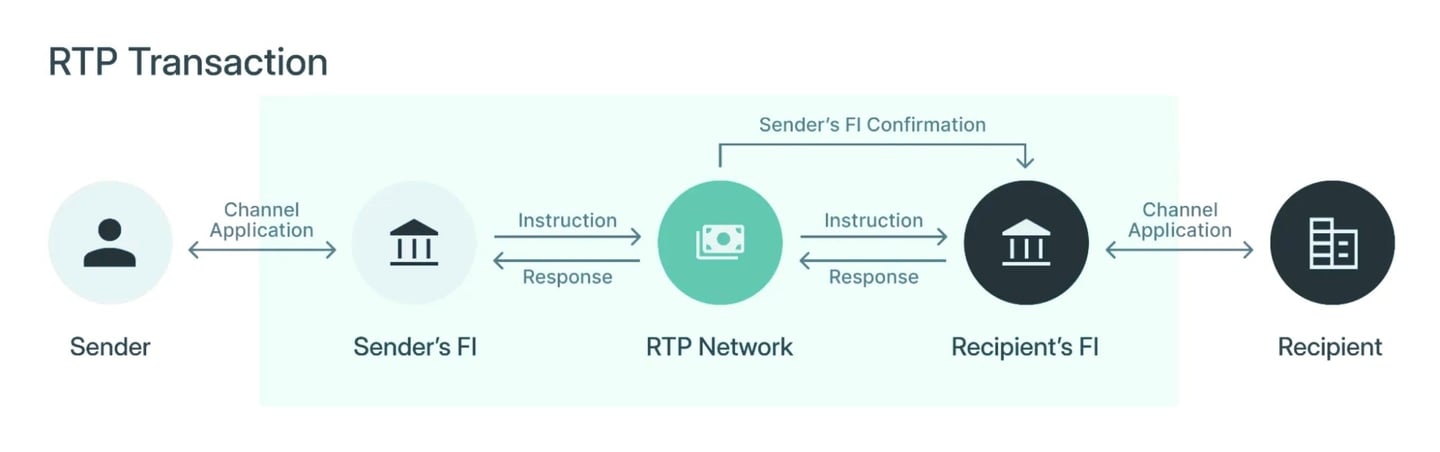
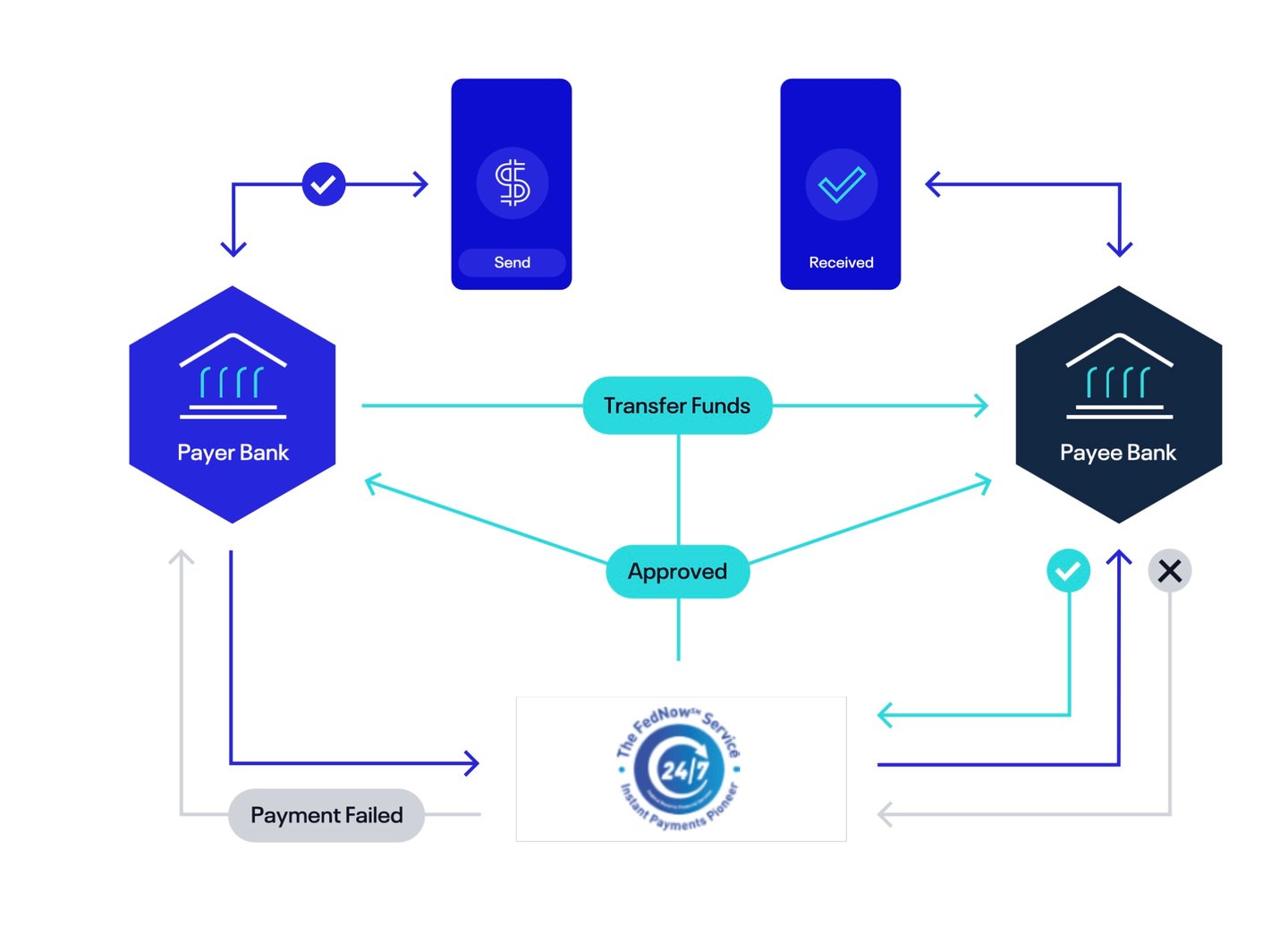
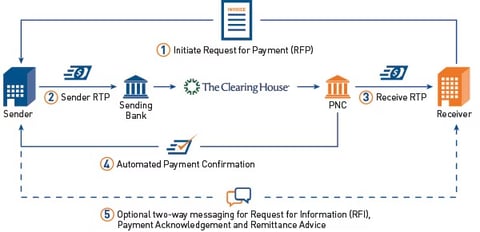
are advanced electronic payment systems that enable the immediate transfer and settlement of funds between banks and financial institutions. Here’s an overview of how they typically work:
Real-time payment systems around the world
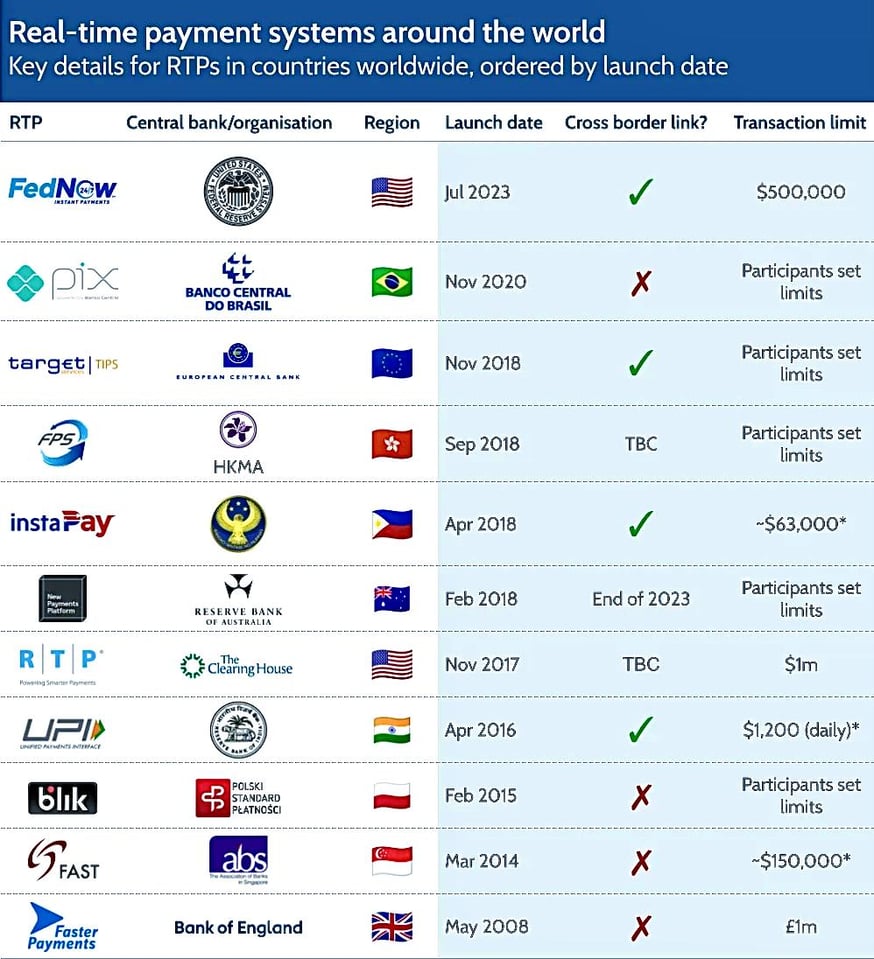
| System | Operator | Region | Launch | Transaction limit |
|---|---|---|---|---|
| FedNow | Federal Reserve | United States | July 2023 | USD 10 million (network maximum since November 2025) |
| Pix | Banco Central do Brasil | Brazil | November 2020 | Set by participants |
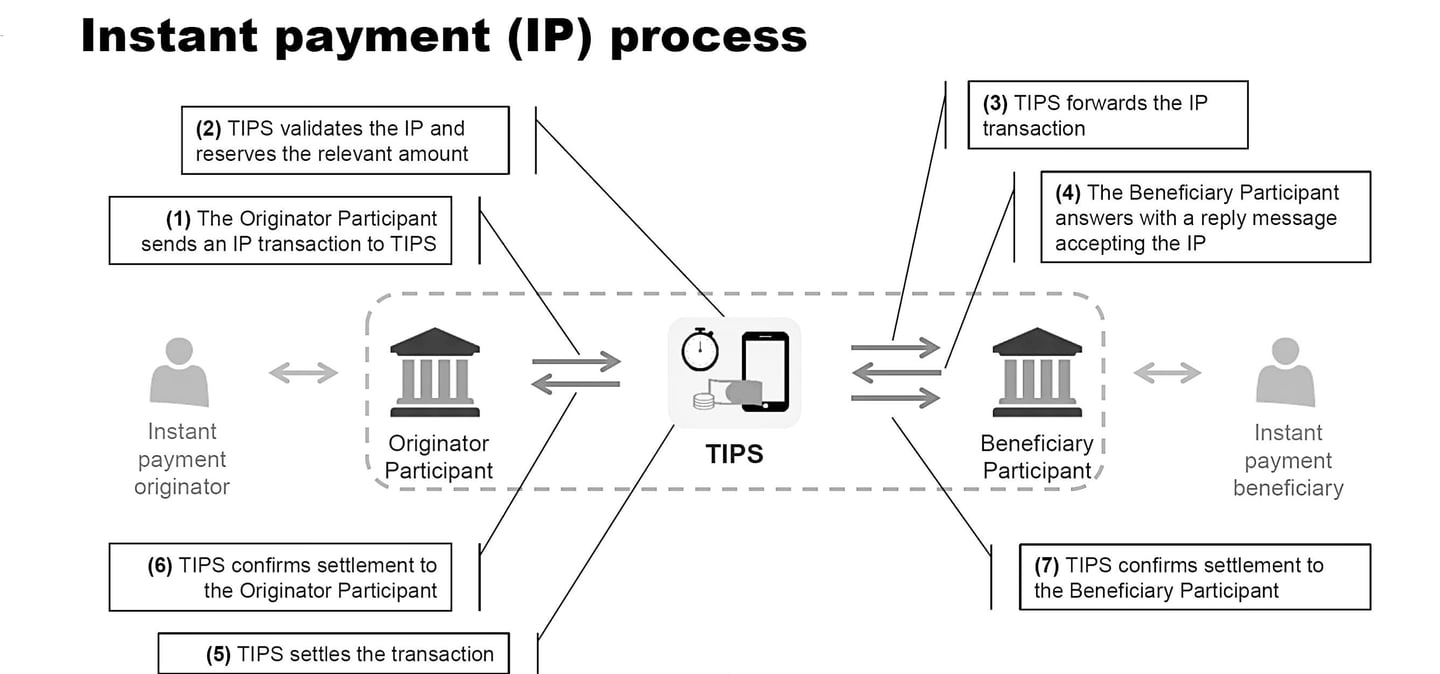
| TARGET Instant Payment Settlement (TIPS) | Eurosystem | Euro area (also SEK, DKK) | November 2018 | None at scheme level |
| FPS | Hong Kong Monetary Authority | Hong Kong | September 2018 | Set by participants |
| InstaPay | Bangko Sentral ng Pilipinas | Philippines | April 2018 | PHP 50,000 |
| New Payments Platform (NPP) | Australian Payments Plus; settlement by the Reserve Bank of Australia | Australia | February 2018 | Set by participants |
| RTP | The Clearing House | United States | November 2017 | USD 10 million (since February 2025) |
| UPI | NPCI | India | April 2016 | Generally INR 100,000 per day (higher for certain categories) |
| BLIK | Polski Standard Płatności | Poland | February 2015 | Set by participants |
| FAST | Association of Banks in Singapore | Singapore | March 2014 | SGD 200,000 |
| Faster Payments | Pay.UK (settlement at the Bank of England) | United Kingdom | May 2008 | GBP 1 million |
Limits are scheme maximums as of October 2026; banks may apply lower limits.
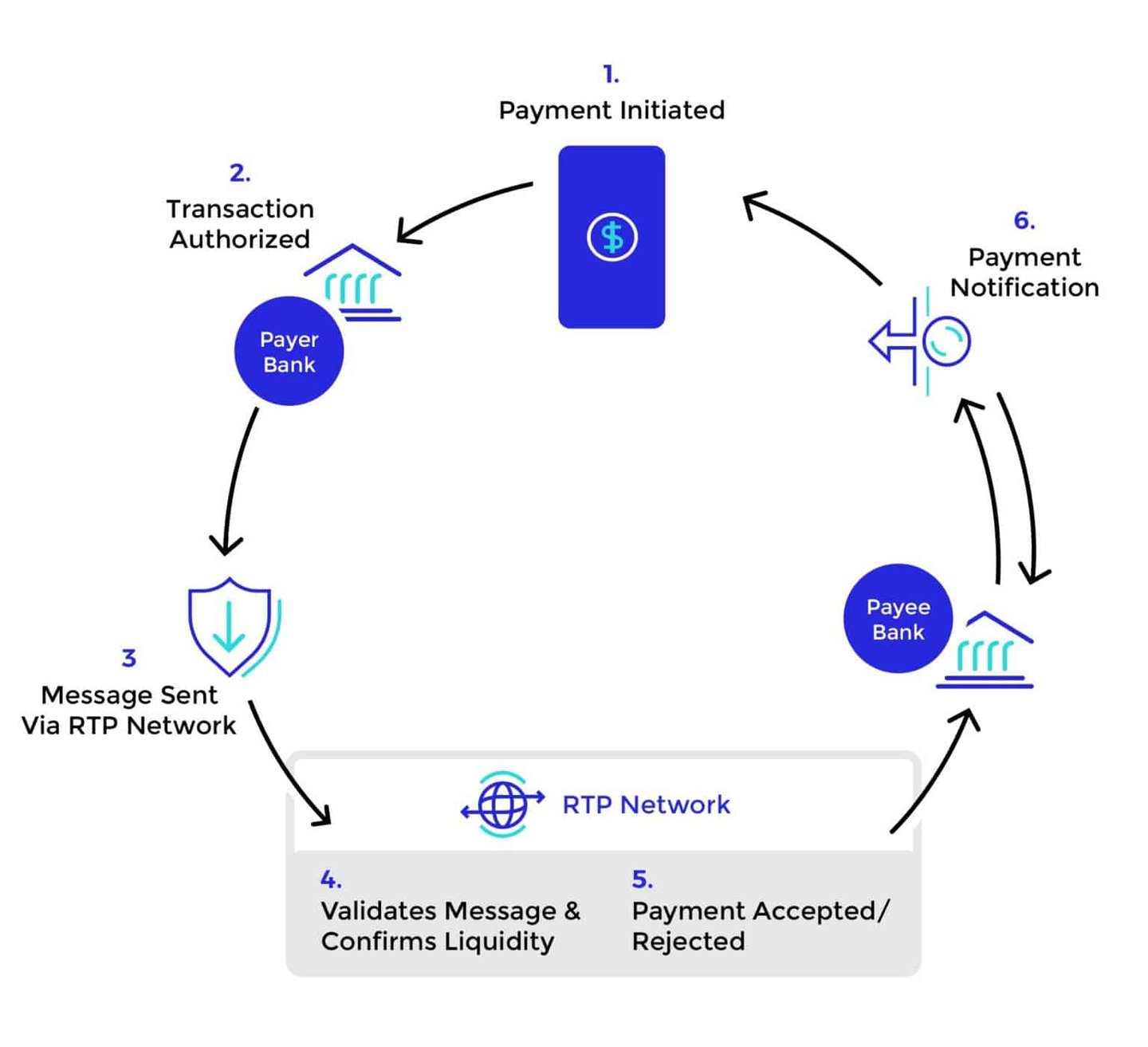
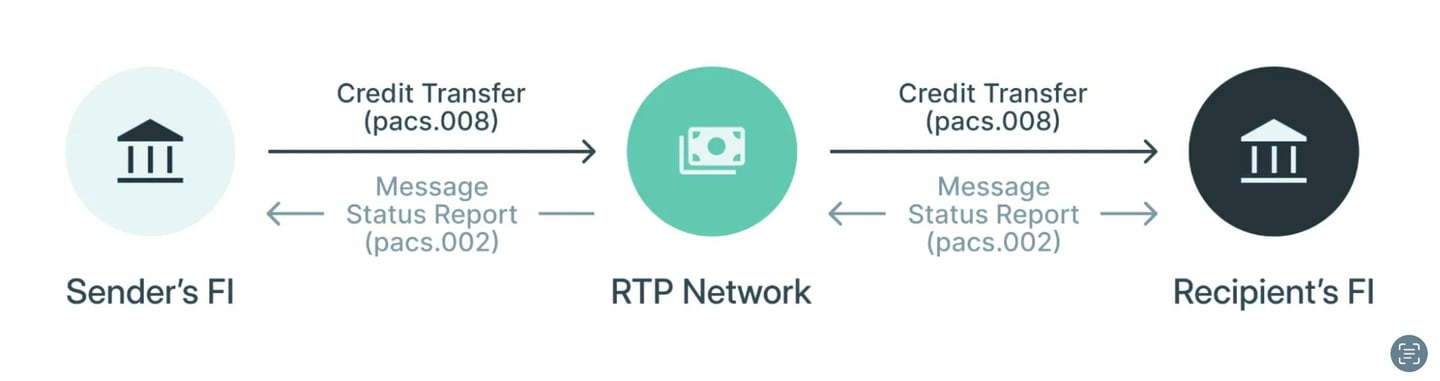
Integration with Banks: RTP systems are integrated with the banks through secure, standardized communication protocols. These integrations enable banks to send and receive payment instructions and confirmations to and from the RTP system. The integration often follows international standards like ISO 20022, which allows for full data exchange.
Sending Payment Instructions: When a customer initiates a payment, the sender’s bank formats this transaction request into a message that is compatible with the RTP system. This message includes all necessary details such as the amount, recipient account information, and any additional transaction details.
Receiving and Processing Payment Instructions: Upon receiving the payment instruction from the sender’s bank, the RTP system validates the transaction. This includes checks for sufficient funds, fraud detection, and ensuring compliance with regulatory requirements.
Communication with Receiver’s Bank: After validation, the RTP system forwards the transaction details to the receiver’s bank. This is done in real-time, allowing for immediate processing.
Immediate Funds Availability: One of the defining features of RTP systems is that the receiver’s bank credits the recipient’s account instantly upon receiving the confirmation from the RTP system. The funds are made available for use by the recipient without any delay.
Settlement of Funds Between Banks:
- Intraday Settlement: Some RTP systems settle each payment individually in central bank money (for example FedNow, TIPS and NPP); others track the net amounts owed by each participating bank, often against prefunded balances.
- Central Bank Accounts: At the end of a specified settlement period, the net positions are settled through accounts that the banks hold at the central bank. Each bank’s account is debited or credited with its net position.
- Liquidity Management: Banks manage their liquidity positions throughout the day to ensure they have sufficient funds to meet their settlement obligations.
Confirmation and Notification: After the transaction is processed, the RTP system sends a confirmation message to both banks. The banks then notify their respective customers (sender and receiver) of the transaction’s completion.
Record Keeping and Reconciliation: Both banks update their transaction records for accounting and reconciliation purposes. They ensure that all transactions processed through the RTP system are accurately reflected in their systems.
In summary, the RTP system acts as an intermediary that facilitates real-time communication and transaction processing between the banks. The settlement process, typically involving accounts at the central bank, ensures that the banks’ respective positions are balanced, maintaining the integrity and stability of the financial system.
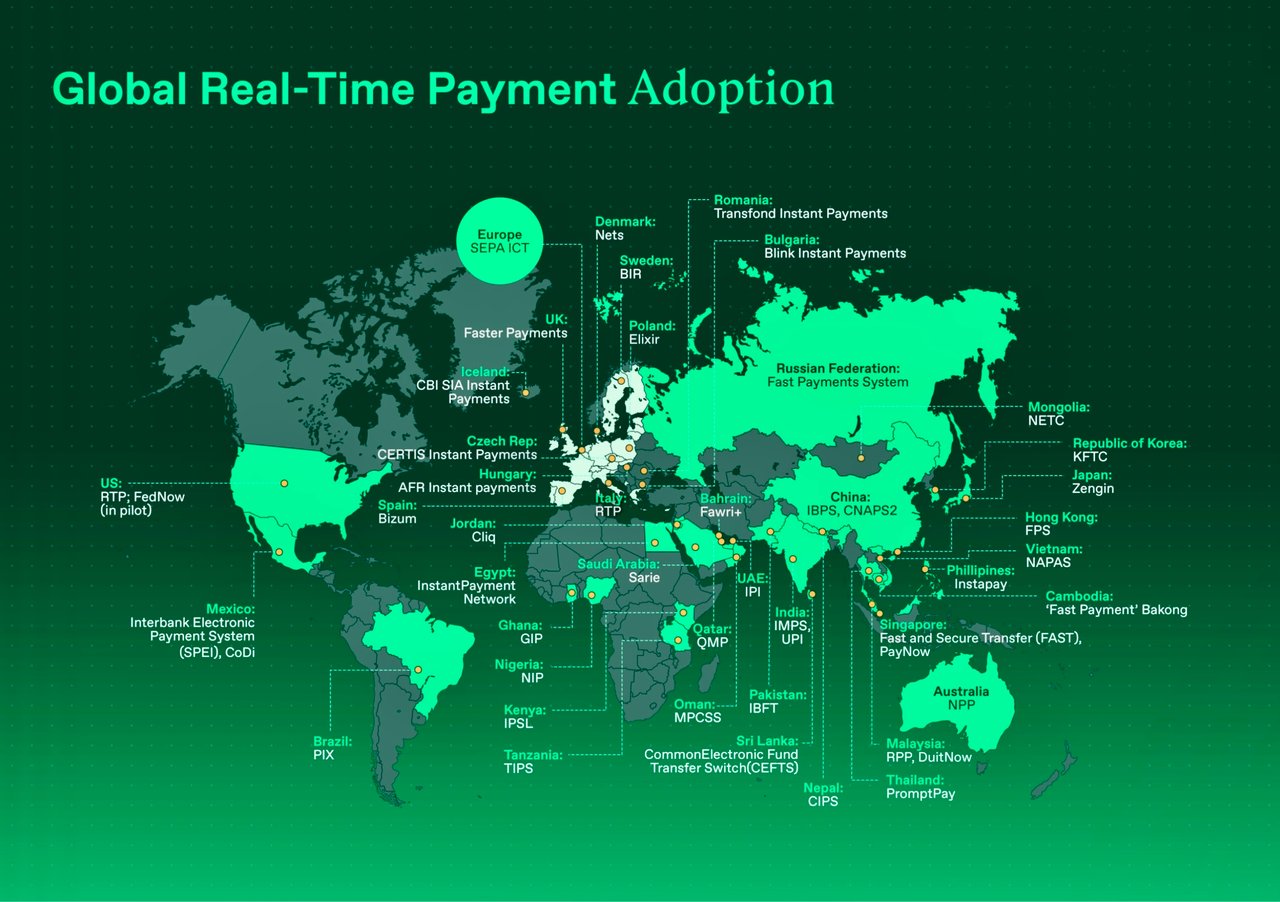
Real-time payment systems now operate in dozens of countries across every region.
Overview of some of the major and well-known instant payment systems globally, along with a brief description of each:
North America
- FedNow Service (USA): Developed by the Federal Reserve, live since July 2023.
- The Clearing House’s Real-Time Payments (RTP) (USA):Launched in 2017, offers real-time payments for financial institutions.
- Interac e-Transfer (Canada): Enables individuals and businesses to send and receive money instantly.
Europe:
- TARGET Instant Payment Settlement (TIPS): Operated by the Eurosystem since 2018, it settles instant payments in central bank money around the clock.
- UK Faster Payments Service: Launched in 2008, enables near-instant payments in the UK.
- SIC (Switzerland): The Swiss National Bank’s RTGS system, operating since 1987; instant payments in Swiss francs since August 2024.
- Express Elixir (Poland) – Operated by KIR since 2012, available 24/7.
- BiR (Sweden) – Bankgirot’s real-time system, launched in 2012.
- Swish (Sweden) – a mobile payment system allowing instant transfers
- Straksclearing (Denmark) – Instant clearing operated by Nets from 2014 until 2025, when krone instant payments moved to TIPS.
Asia:
- India’s Unified Payments Interface (UPI): A real-time payment system facilitating inter-bank transactions.
- IMPS (India) – Operated by NPCI since 2010, available 24/7.
- China’s Internet Banking Payment System (IBPS): Operated by the People’s Bank of China since 2010 for online interbank transfers.
- FAST (Singapore) – Introduced in 2014; linked with PayNow for proxy payments.
- KFTC (South Korea) – The Korea Financial Telecommunications & Clearings Institute operates the country’s real-time interbank transfer network.
- Zengin System (Japan) – Operating since 1973, available 24/7 since 2018.
- PromptPay in Thailand; Established: 2017, Payments can be addressed to a national ID or mobile phone number.
Africa:
- South Africa’s Real-Time Clearing (RTC): Facilitates real-time interbank payment processing.
- Nigeria’s NIBSS Instant Payments (NIP): Provides instant payment services across Nigerian banks.
- GhIPSS Instant Pay (Ghana): Instant interbank transfers operated by the Ghana Interbank Payment and Settlement Systems.
Australia:
- New Payments Platform (NPP): Launched in 2018, allows for immediate funds transfer between banks.
Latin America:
- Brazil’s PIX: Launched by the Central Bank of Brazil, offers instant 24/7 payments.
- SITRAF (Brazil) – Fund-transfer system operated by Núclea (formerly CIP) since 2002.
- SPEI (Mexico) – Banco de México’s interbank transfer system, introduced in 2004 and available 24/7.
- TEF (Chile) – Online interbank transfers, available 24/7.
- Transfiya (Colombia): Mobile-number transfers operated by ACH Colombia; Banco de la República is building the national instant system Bre-B.
Middle East:
- CliQ (Jordan): Instant payments operated by JoPACC, addressable by alias or mobile number.
- Fawri+ (Bahrain): Instant interbank transfers operated by BENEFIT since 2015.
Hubcentric RTP Architecture
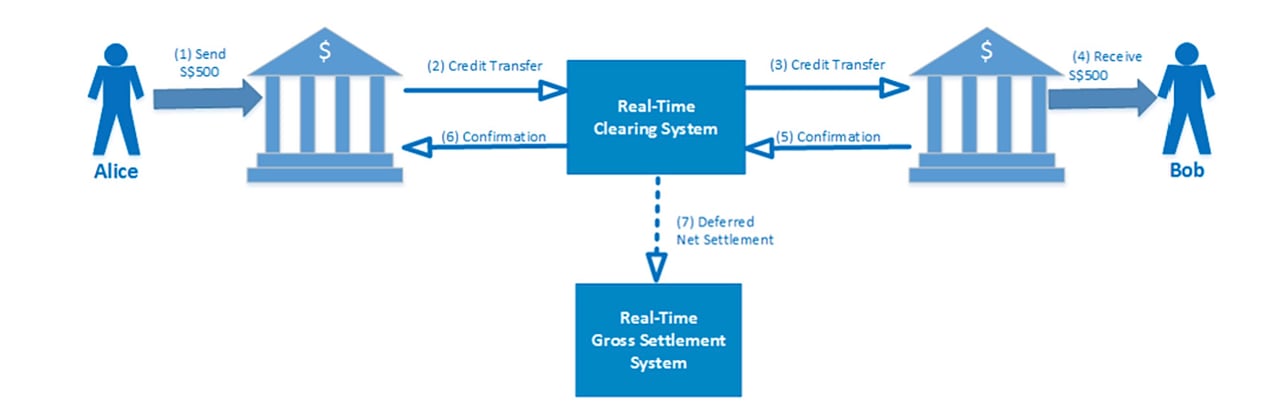
The hub-centric model is the most common. This model centralizes the clearing process at the clearing house, operating in a near real-time framework. Typically, it involves a four-stage sequence: firstly, the originating bank submits a payment request to the clearing house; secondly, the clearing house forwards this request to the receiving bank; thirdly, the receiving bank sends a payment confirmation back to the clearing house; and finally, the clearing house conveys this confirmation to the originating bank. The decisive role of the clearing house encompasses the validation of transactions, computation of settlement positions, and the facilitation of payment instructions between banks. Upon successful processing of the payment instruction, the payee banks record the transaction and update the payee’s account. Similarly, the payer banks post the transaction and update the payer’s account following the receipt of payment confirmation. Settlements within this model are customarily executed on a deferred net settlement basis, conducted multiple times within a day to reduce counterparty risks.
Significantly, this model is exemplified by the implementation in Singapore’s FAST payment network and the UK’s Faster Payment System.
RTGS-Centric RTP Architecture

As delineated in the preceding section, the Real-Time Payment System (RTP) contrasts with the wholesale payment mechanism known as the Real-Time Gross Settlement (RTGS) system. Unlike RTP, which typically settles transactions on a deferred net settlement basis at least daily via a hub-centric model, the RTGS framework, in certain nations, is adapted to accommodate both low-value and high-value transactions. This adaptation may arise due to modest retail payment volumes or as a result of the system’s evolutionary trajectory.
A notable instance of this model is Switzerland’s SIC system, which utilizes RTGS for managing both retail and high-value payments. Similarly, Japan’s Zengin system processes both high-value and low-value transactions within the same clearing infrastructure. In this system, transactions are segregated based on their value: transactions equal to or exceeding 100 million JPY are routed through an RTGS, while those below this threshold are processed via a deferred net settlement (DNS) system. Another example is Mexico’s SPEI, which executes multilateral netting at intervals of a few seconds for processing both high-value and retail payments.
Distributed RTP Architecture
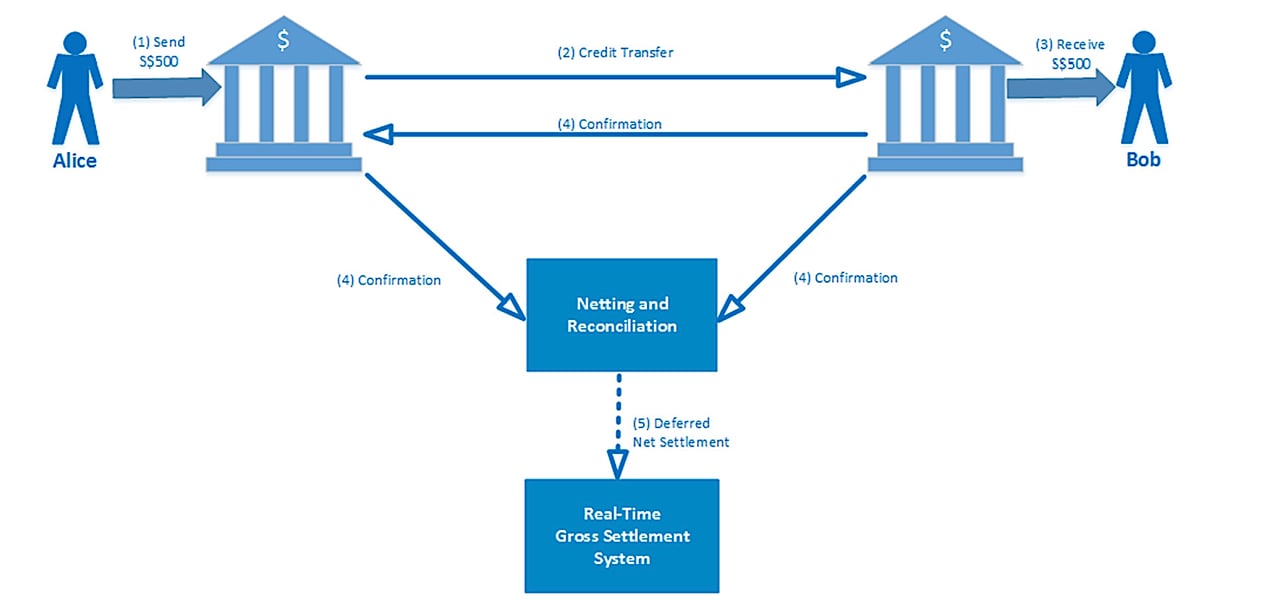
The final archetype in payment systems is the distributed model, characterized by the bilateral clearing of payments directly between the payer’s and payee’s banks.
Australia’s New Payment Platform (NPP) exemplifies this model. Instead of deferred net settlement, each NPP payment is settled individually and immediately in central bank money through the Reserve Bank of Australia’s Fast Settlement Service (FSS), which operates 24/7 alongside its RTGS system.
Instant
SWIFT Instant
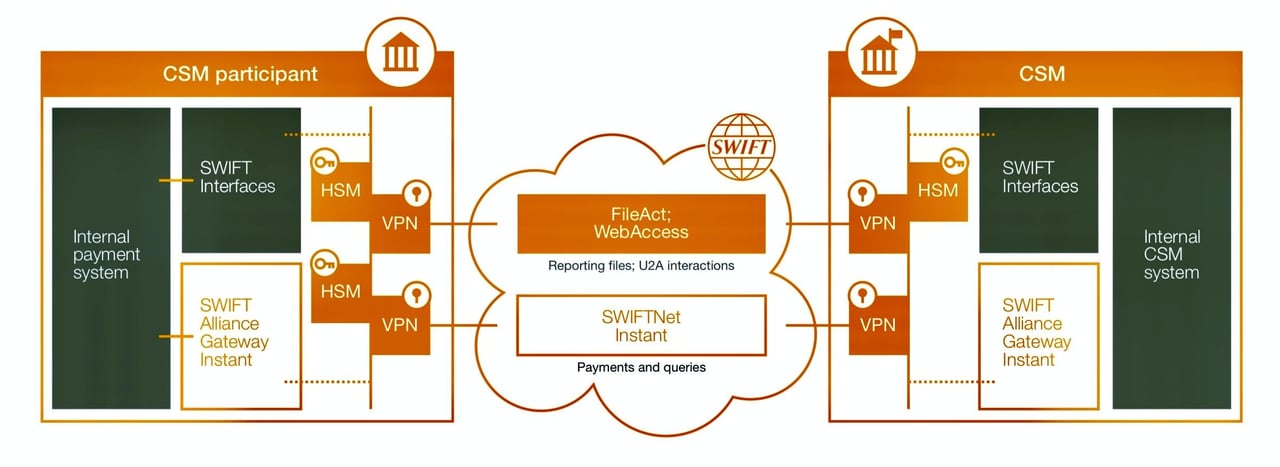
SwiftNet Instant. It is a real-time, low latency messaging platform that is available 24/7 and supports the secure exchange of instant payment flows between Clearing and Settlement Mechanisms (CSMs) and their participants.
Customers can connect to SwiftNet Instant through their existing Swift connectivity and security infrastructure, including VPN boxes, leased lines and hardware security modules. Integration with the bank’s IT environment is achieved through the Alliance Gateway Instant (AGI).
All parties along the instant payment chain can use AGI and SwiftNet Instant messaging. Applications include payment initiation from an overlay service, indirect member communications with a sponsoring member, or a corporate receiving a payment confirmation.
SwiftNet Instant carries the messages; clearing and settlement remain with the domestic instant payment system, using ISO 20022.

SEPA Instant Credit Transfer
In the EU, instant credit transfers in euro follow the European Payments Council’s SEPA Instant Credit Transfer scheme (SCT Inst), launched in November 2017. The service is available 24 hours a day, 365 days a year, and the recipient’s payment service provider (PSP) must confirm within ten seconds whether the funds have been made available to the recipient. The scheme no longer sets a maximum amount. Under the Instant Payments Regulation (EU) 2024/886, PSPs in the euro area must be able to receive instant payments since January 2025 and send them since October 2025, at no higher price than standard credit transfers and with Verification of Payee.
If you want to know more about how to transfer funds through the corresponding banking system, please get in contact with our Head of Correspondent Banking M. Amri Elarisse
Differences between RTP & ACH
The key differences between a Real-Time Payment (RTP) system and an Automated Clearing House (ACH) system lie in their processing speed, transaction settlement, and use cases. Here are the main distinctions:
1. Processing Speed:
RTP System:
- Speed:Transactions are processed and settled almost instantaneously, typically within seconds.
- Availability: Operates 24/7/365, allowing for continuous processing of transactions.
ACH System:
- Speed: Transactions are processed in batches and can take from several hours to a few days to settle.
- Availability: Operates during banking hours, with specific processing windows on business days.
2. Transaction Settlement:
RTP System:
- Settlement: Settles transactions in real-time, meaning the funds are immediately available to the recipient upon completion of the transaction.
- Finality: Transactions are irrevocable once completed.
ACH System:
- Settlement: Uses batch processing, typically settling transactions in multiple batches throughout the day (same-day ACH) or next-day.
- Finality: Transactions can be reversed or canceled during the processing period.
3. Use Cases:
RTP System:
- Usage: Ideal for urgent payments, such as person-to-person (P2P) payments, bill payments, and business-to-business (B2B) transactions requiring immediate confirmation.
- Examples: RTP and FedNow in the U.S., Faster Payments in the UK, SCT Inst in the euro area, and Pix in Brazil.
ACH System:
- Usage: Suitable for non-urgent transactions, such as payroll, recurring bill payments, direct deposits, and vendor payments.
- Examples: Direct deposit payroll, utility bill payments, mortgage payments, and recurring subscription services.
4. Cost:
RTP System: Fees vary by system; some charge more than batch payments, while others, such as Pix for individuals and SCT Inst under EU rules, cost no more than standard transfers.
ACH System: Generally lower fees due to batch processing and delayed settlement.
5. Security and Compliance:
RTP System:
- Security: Utilizes advanced encryption and security measures to protect real-time transactions.
- Compliance: Must adhere to stringent regulatory standards due to the instantaneous nature of transactions.
ACH System:
- Security: Also employs strong security protocols but is more focused on protecting batch-processed transactions.
- Compliance: Adheres to regulations set by entities like Nacha (formerly the National Automated Clearing House Association) in the US, ensuring secure processing and settlement.




Next step
Request an introduction
Tell us in a few lines who you are and what you have in mind. Your enquiry goes directly to the bank and is treated in confidence.
Prefer to talk? Book a 30-minute videoconference.